QUESTION IMAGE
Question
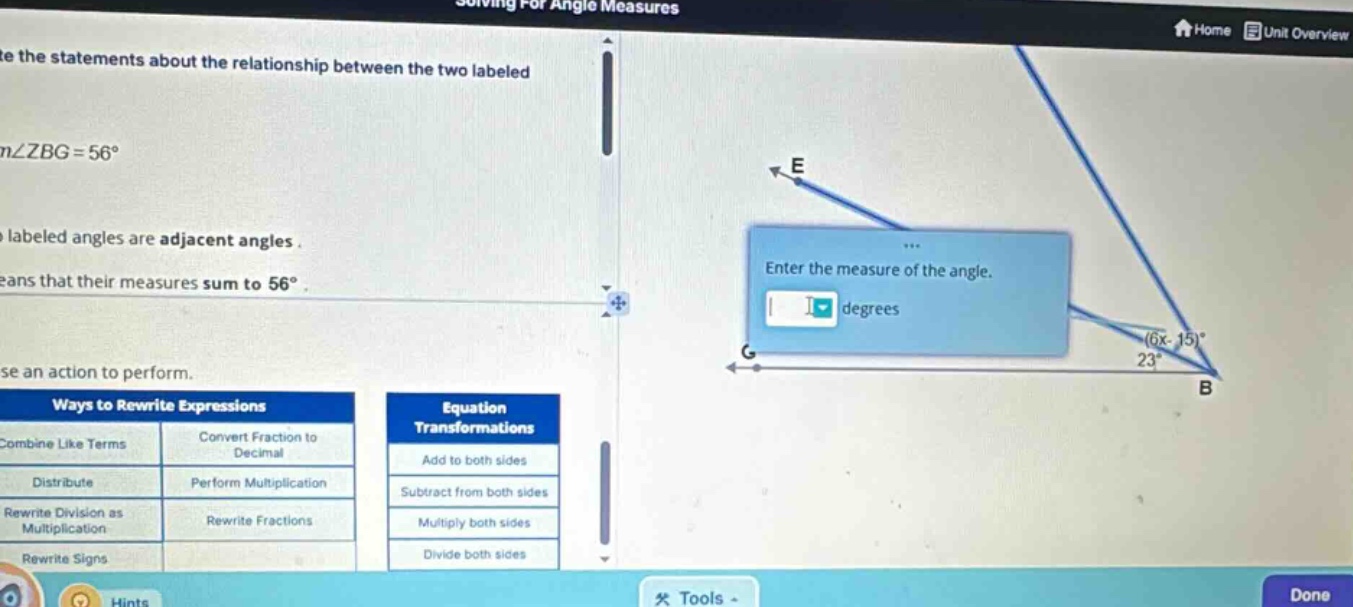
solving for angle measures te the statements about the relationship between the two labeled m∠zbg = 56° labeled angles are adjacent angles. eans that their measures sum to 56° , se an action to perform. ways to rewrite expressions combine like terms convert fraction to decimal distribute perform multiplication rewrite division as multiplication rewrite fractions rewrite signs equation transformations add to both sides subtract from both sides multiply both sides divide both sides enter the measure of the angle. degrees g b 23° (6x - 15)°
Step1: Identify the angle relationship
From the diagram, we can see that the sum of the angles \(23^\circ\), \((6x - 15)^\circ\) and the angle we need to find (let's say \(\angle EBG\)) should relate to a straight line or a known angle. Wait, actually, looking at the left side, we know \(m\angle ZBG = 56^\circ\). Wait, maybe the two angles \(23^\circ\) and \((6x - 15)^\circ\) add up to \(56^\circ\)? Wait, no, let's re - examine. Wait, the angle at \(B\): the total angle \(m\angle ZBG=56^\circ\), and it is composed of \(23^\circ\) and \((6x - 15)^\circ\)? Wait, no, maybe the angle between \(E\) and \(B\) and the other two angles. Wait, let's correct. Let's assume that \(23^{\circ}+(6x - 15)^{\circ}=56^{\circ}\) (since they are parts of \(\angle ZBG\) which is \(56^{\circ}\)).
Step2: Solve the equation for \(x\)
First, simplify the left - hand side of the equation \(23+(6x - 15)=56\).
\(23 + 6x-15=56\)
\(6x + 8 = 56\)
Subtract 8 from both sides: \(6x=56 - 8=48\)
Divide both sides by 6: \(x=\frac{48}{6}=8\)
Step3: Find the measure of \((6x - 15)^\circ\)
Substitute \(x = 8\) into \((6x - 15)^\circ\).
\(6\times8-15=48 - 15 = 33^\circ\)
Step4: Find the measure of the angle at \(E\)
Wait, maybe the angle we need to find is the sum of \(23^\circ\) and \((6x - 15)^\circ\)? Wait, no, earlier we thought \(m\angle ZBG = 56^\circ\). Wait, if \(m\angle ZBG=56^\circ\), and the two angles \(23^\circ\) and \((6x - 15)^\circ\) are part of it, but maybe the angle between \(E\) and \(G\) is \(56^\circ\)? Wait, no, let's re - look. Wait, the problem says "Enter the measure of the angle" (the angle at \(E\) and \(B\) and \(G\)? Wait, maybe the angle \(\angle EBG\) is equal to \(m\angle ZBG\) minus the other two? No, wait, maybe I made a mistake. Wait, let's start over.
Wait, the given angle \(m\angle ZBG = 56^\circ\). The angle at \(B\) has three parts? No, looking at the diagram, the angle between \(G\) (the horizontal line) and \(B\) has two angles: \(23^\circ\) and \((6x - 15)^\circ\), and the angle between \(E\) and \(B\) and \(G\) is what we need? Wait, no, maybe the angle \(\angle EBG\) is equal to \(m\angle ZBG\). Wait, no, the left side says \(m\angle ZBG = 56^\circ\). Let's assume that the sum of \(23^\circ\) and \((6x - 15)^\circ\) is equal to \(56^\circ\). So:
\(23+(6x - 15)=56\)
\(6x+8 = 56\)
\(6x=48\)
\(x = 8\)
Then \((6x - 15)=6\times8 - 15=33\)
Then the angle we need to find (the angle between \(E\) and \(B\) and \(G\)): Wait, maybe the angle is \(56^\circ\)? No, that doesn't make sense. Wait, maybe the angle between \(E\) and \(B\) is equal to \(m\angle ZBG\) minus \(23^\circ\) and \((6x - 15)^\circ\)? No, that can't be. Wait, maybe I misread the diagram. Wait, the problem says "the two labeled angles are adjacent angles. means that their measures sum to \(56^\circ\)". Wait, maybe the two angles are \(23^\circ\) and the angle we need to find, and their sum is \(56^\circ\)? Then the angle would be \(56 - 23=33^\circ\)? No, that's the same as \((6x - 15)^\circ\) when \(x = 8\). Wait, maybe the angle we need to enter is \(56^\circ\)? No, that's not right. Wait, let's check again.
Wait, the left side of the screen says \(m\angle ZBG = 56^\circ\). The diagram on the right has angles at \(B\): \(23^\circ\), \((6x - 15)^\circ\), and the angle between \(E\) and \(B\). So the sum of \(23^\circ\), \((6x - 15)^\circ\) and the angle between \(E\) and \(B\) is not, but maybe the angle between \(E\) and \(G\) is \(56^\circ\), and it is composed of the angle between \(E\) and \(B\) and the angle between \(B\) and \(G\) (which is \(…

Snap & solve any problem in the app
Get step-by-step solutions on Sovi AI
Photo-based solutions with guided steps
Explore more problems and detailed explanations
\(56\)