QUESTION IMAGE
Question
solving equations containing two radicals
solving equations containing two radicals
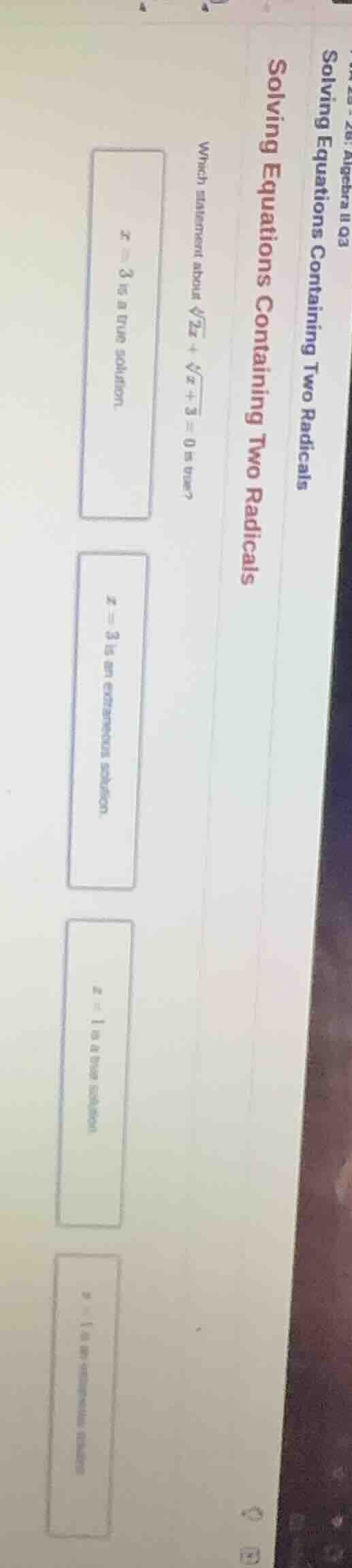
which statement about $sqrt4{2x} + sqrt4{x + 3} = 0$ is true?
$x = 3$ is a true solution.
$x = 3$ is an extraneous solution.
$x = 1$ is a true solution.
$x = 1$ is an extraneous solution.
Step1: Isolate one radical
$\sqrt[3]{2x} = -\sqrt[3]{x+3}$
Step2: Cube both sides
$(\sqrt[3]{2x})^3 = (-\sqrt[3]{x+3})^3$
$2x = -(x+3)$
Step3: Solve linear equation
$2x = -x -3$
$2x + x = -3$
$3x = -3$
$x = -1$
Step4: Verify $x=3$ in original equation
Substitute $x=3$: $\sqrt[3]{2*3} + \sqrt[3]{3+3} = \sqrt[3]{6} + \sqrt[3]{6} = 2\sqrt[3]{6}
eq 0$
Step5: Verify $x=-1$ in original equation
Substitute $x=-1$: $\sqrt[3]{2*(-1)} + \sqrt[3]{-1+3} = \sqrt[3]{-2} + \sqrt[3]{2} = 0$
Thus $x=3$ does not satisfy the original equation, so it is an extraneous solution, and $x=-1$ is a valid true solution (not listed as an extraneous option).

Snap & solve any problem in the app
Get step-by-step solutions on Sovi AI
Photo-based solutions with guided steps
Explore more problems and detailed explanations
$x = 3$ is an extraneous solution.