QUESTION IMAGE
Question
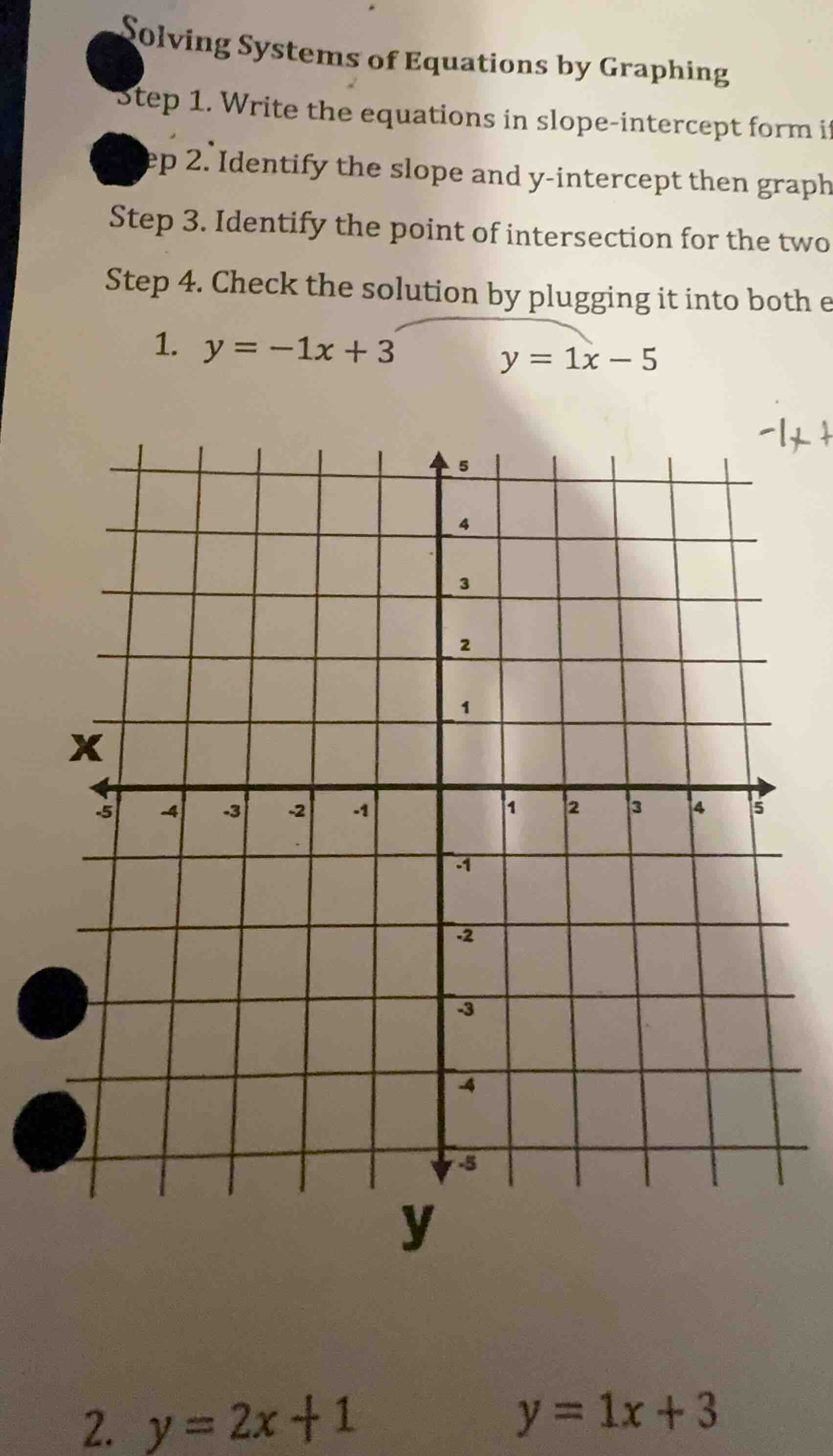
solving systems of equations by graphing
step 1. write the equations in slope - intercept form if
step 2. identify the slope and y - intercept then graph
step 3. identify the point of intersection for the two
step 4. check the solution by plugging it into both e
- $y = -1x + 3$ $y = 1x - 5$
- $y = 2x + 1$ $y = 1x + 3$
Problem 1: Solve \( y = -x + 3 \) and \( y = x - 5 \) by Graphing (and Checking)
Step 1: Write in Slope - Intercept Form (Already Done)
The equations are already in slope - intercept form (\( y=mx + b \), where \( m \) is the slope and \( b \) is the y - intercept). For \( y=-x + 3 \), \( m_1=-1 \) and \( b_1 = 3 \). For \( y=x - 5 \), \( m_2 = 1 \) and \( b_2=-5 \).
Step 2: Graph the Equations
- For \( y=-x + 3 \):
- The y - intercept is \( (0,3) \). Using the slope \( m=-1=\frac{-1}{1} \), from \( (0,3) \), we move down 1 unit and right 1 unit to get the point \( (1,2) \), or up 1 unit and left 1 unit to get \( (-1,4) \).
- For \( y=x - 5 \):
- The y - intercept is \( (0,-5) \). Using the slope \( m = 1=\frac{1}{1} \), from \( (0,-5) \), we move up 1 unit and right 1 unit to get the point \( (1,-4) \), or down 1 unit and left 1 unit to get \( (-1,-6) \).
Step 3: Find the Intersection Point
To find the intersection algebraically (we can also do it from the graph), set the two equations equal to each other:
\( -x + 3=x - 5 \)
Add \( x \) to both sides: \( 3 = 2x-5 \)
Add 5 to both sides: \( 2x=8 \)
Divide by 2: \( x = 4 \)
Substitute \( x = 4 \) into \( y=x - 5 \): \( y=4 - 5=-1 \)
So the intersection point is \( (4,-1) \).
Step 4: Check the Solution
- For \( y=-x + 3 \): Substitute \( x = 4 \), \( y=-4 + 3=-1 \). The left - hand side (LHS) is \( y=-1 \), and the right - hand side (RHS) is \( -4 + 3=-1 \). So \( -1=-1 \) (true).
- For \( y=x - 5 \): Substitute \( x = 4 \), \( y=4 - 5=-1 \). The LHS is \( y=-1 \), and the RHS is \( 4 - 5=-1 \). So \( -1=-1 \) (true).
Problem 2: Solve \( y = 2x+1 \) and \( y = x + 3 \) by Graphing (and Checking)
Step 1: Write in Slope - Intercept Form (Already Done)
The equations are in slope - intercept form. For \( y = 2x+1 \), \( m_1 = 2 \) and \( b_1=1 \). For \( y=x + 3 \), \( m_2 = 1 \) and \( b_2=3 \).
Step 2: Graph the Equations
- For \( y = 2x+1 \):
- The y - intercept is \( (0,1) \). Using the slope \( m = 2=\frac{2}{1} \), from \( (0,1) \), we move up 2 units and right 1 unit to get \( (1,3) \), or down 2 units and left 1 unit to get \( (-1,-1) \).
- For \( y=x + 3 \):
- The y - intercept is \( (0,3) \). Using the slope \( m = 1=\frac{1}{1} \), from \( (0,3) \), we move up 1 unit and right 1 unit to get \( (1,4) \), or down 1 unit and left 1 unit to get \( (-1,2) \).
Step 3: Find the Intersection Point
Set the two equations equal to each other:
\( 2x+1=x + 3 \)
Subtract \( x \) from both sides: \( x+1 = 3 \)
Subtract 1 from both sides: \( x=2 \)
Substitute \( x = 2 \) into \( y=x + 3 \): \( y=2 + 3=5 \)
So the intersection point is \( (2,5) \).
Step 4: Check the Solution
- For \( y = 2x+1 \): Substitute \( x = 2 \), \( y=2\times2+1=5 \). LHS \( y = 5 \), RHS \( 2\times2 + 1=5 \). So \( 5 = 5 \) (true).
- For \( y=x + 3 \): Substitute \( x = 2 \), \( y=2 + 3=5 \). LHS \( y = 5 \), RHS \( 2+3 = 5 \). So \( 5 = 5 \) (true).

Snap & solve any problem in the app
Get step-by-step solutions on Sovi AI
Photo-based solutions with guided steps
Explore more problems and detailed explanations
s
- The solution to \( y=-x + 3 \) and \( y=x - 5 \) is \( x = 4,y=-1 \) or the ordered pair \( (4,-1) \).
- The solution to \( y = 2x+1 \) and \( y=x + 3 \) is \( x = 2,y=5 \) or the ordered pair \( (2,5) \).