QUESTION IMAGE
Question
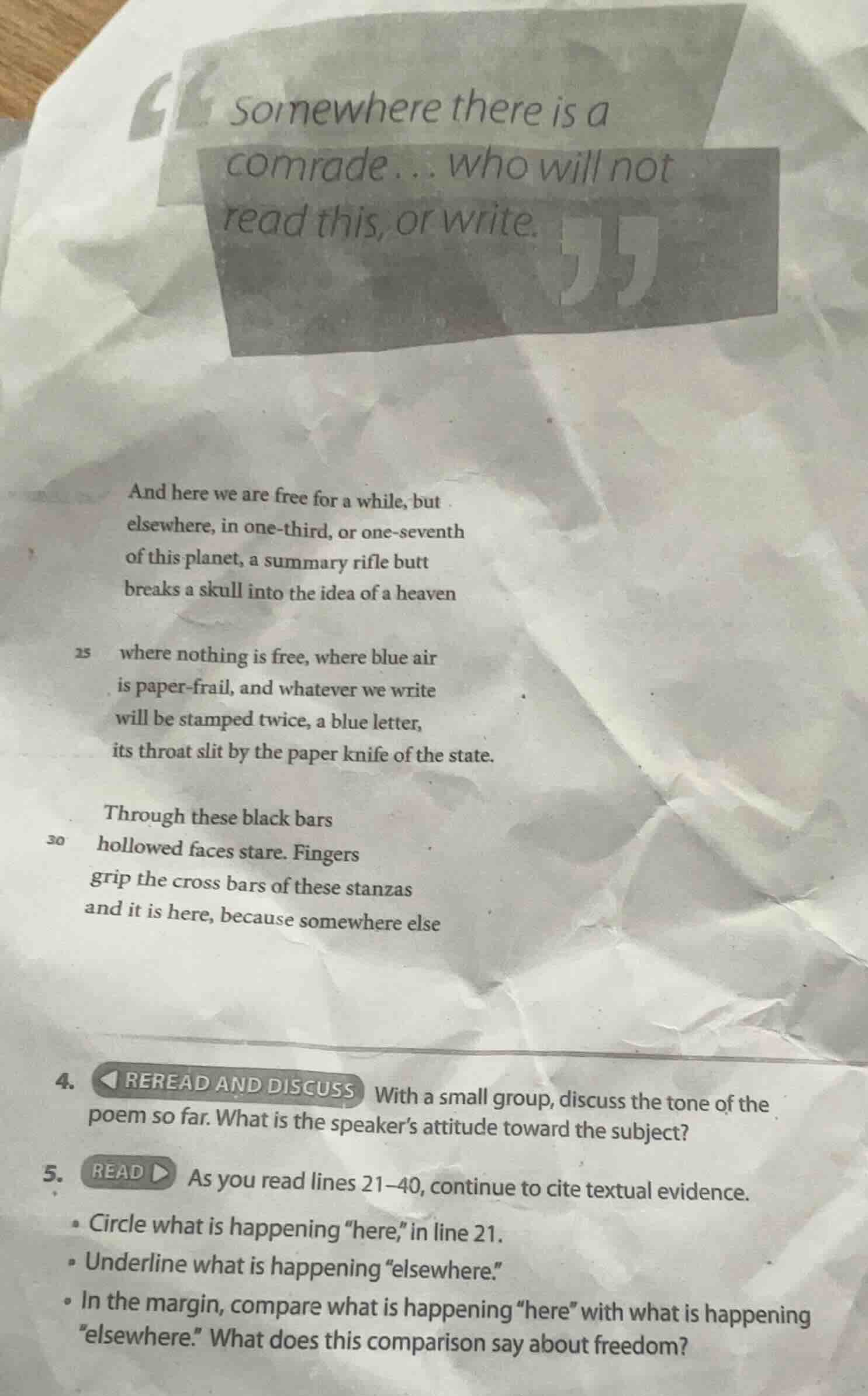
somewhere there is a comrade... who will not read this, or write.
and here we are free for a while, but elsewhere, in one - third, or one - seventh of this planet, a summary rifle butt breaks a skull into the idea of a heaven
15 where nothing is free, where blue air is paper - frail, and whatever we write will be stamped twice, a blue letter, its throat slit by the paper knife of the state.
through these black bars
30 hollowed faces stare. fingers grip the cross bars of these stanzas and it is here, because somewhere else
- reread and discuss with a small group, discuss the tone of the poem so far. what is the speaker’s attitude toward the subject?
- read as you read lines 21–40, continue to cite textual evidence.
- circle what is happening “here,” in line 21.
- underline what is happening “elsewhere.”
- in the margin, compare what is happening “here” with what is happening “elsewhere.” what does this comparison say about freedom?
For Question 4:
The poem's tone is somber, urgent, and mournful, with a sharp undercurrent of political anger. The speaker contrasts their temporary freedom with the violent oppression faced by others globally, showing a compassionate, guilt-ridden, and defiant attitude—they recognize privilege while bearing witness to the suffering of comrades denied basic rights like reading/writing, and state violence against dissidents.
For Question 5:
- "Here" (line 21): The speaker and others are "free for a while" (able to read, write, and gather without immediate state violence).
- "Elsewhere": A "summary rifle butt breaks a skull into the idea of a heaven where nothing is free, where blue air is paper-frail, and whatever we write will be stamped twice, a blue letter, its throat slit by the paper knife of the state"; "hollowed faces stare through these black bars" (people are imprisoned, subjected to state violence, have no freedom of expression, and live under brutal, restrictive control).
- Comparison on freedom: Freedom is not universal—it is a fragile, temporary privilege for some, while others live under violent, totalitarian control that suppresses even basic acts of expression. The contrast emphasizes that freedom is relative, and the "free" speaker is acutely aware that their liberty exists alongside the imprisonment and suffering of others, framing freedom as something that is denied to most and policed by state power.

Snap & solve any problem in the app
Get step-by-step solutions on Sovi AI
Photo-based solutions with guided steps
Explore more problems and detailed explanations
Question 4:
The poem has a somber, urgent, and indignant tone. The speaker's attitude is compassionate, guilt-stricken, and defiant—they bear witness to the violent oppression of comrades denied basic rights, while acknowledging their own temporary, privileged freedom.
Question 5:
- "Here": The speaker and peers have temporary freedom to read, write, and gather without immediate state harm.
- "Elsewhere": People face state violence (skulls broken by rifle butts), imprisonment (hollowed faces behind bars), and total suppression of free expression (writing is censored by the state, air feels "paper-frail" and restricted).
- Comparison on freedom: Freedom is an uneven, fragile privilege, not a universal right. The split shows that for some, freedom is a temporary reprieve, while for most, it is entirely erased by brutal state control, highlighting that true freedom cannot exist when others are systematically oppressed.