QUESTION IMAGE
Question
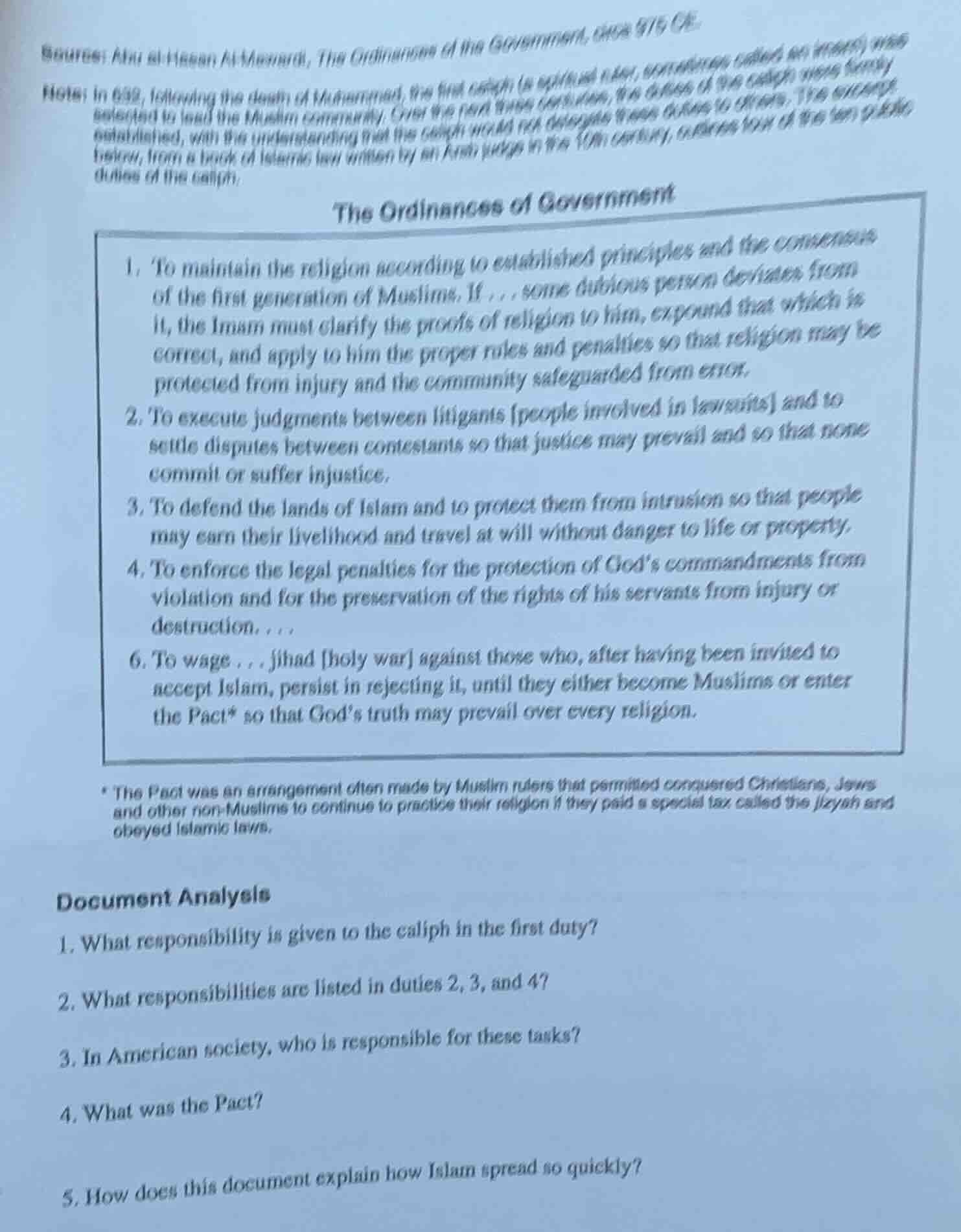
source: abu al-hasan ali mawardi, the ordinances of the government, c.968 - 975 ce.
note: in 632, following the death of muhammad, the first caliph (or spiritual ruler, sometimes called an imam) was selected to lead the muslim community. over the next three centuries, the office of the caliph was firmly established, with the understanding that the caliph would tea despoils taken during its conquests. the excerpt below, from a book of islamic law written by an arab judge in the 10th century, describes four of the ten public duties of the caliph.
the ordinances of government
- to maintain the religion according to established principles and the consensus of the first generation of muslims. if... some dubious person deviates from it, the imam must clarify the proofs of religion to him, expound that which is correct, and apply to him the proper rules and penalties so that religion may be protected from injury and the community safeguarded from error.
- to execute judgments between litigants people involved in lawsuits and to settle disputes between contestants so that justice may prevail and so that none commit or suffer injustice.
- to defend the lands of islam and to protect them from intrusion so that people may earn their livelihood and travel at will without danger to life or property.
- to enforce the legal penalties for the protection of god’s commandments from violation and for the preservation of the rights of his servants from injury or destruction....
- to wage... jihad holy war against those who, after having been invited to accept islam, persist in rejecting it, until they either become muslims or enter the pact* so that god’s truth may prevail over every religion.
- the pact was an arrangement often made by muslim rulers that permitted conquered christians, jews and other non - muslims to continue to practise their religion if they paid a special tax called the jizyah and obeyed islamic laws.
document analysis
- what responsibility is given to the caliph in the first duty?
- what responsibilities are listed in duties 2, 3, and 4?
- in american society, who is responsible for these tasks?
- what was the pact?
- how does this document explain how islam spread so quickly?
- Identified the first duty's requirement for the caliph.
- Summarized the distinct tasks in duties 2, 3, 4.
- Matched each caliph duty to U.S. societal roles.
- Pulled the definition of the Pact from the footnote.
- Connected the listed duty of jihad to Islamic expansion.

Snap & solve any problem in the app
Get step-by-step solutions on Sovi AI
Photo-based solutions with guided steps
Explore more problems and detailed explanations
- The caliph (imam) must maintain Islam per established principles/early Muslim consensus, correct religious deviants, apply proper rules/penalties to protect the religion and community from error.
- Duty 2: Execute legal judgments and settle disputes to uphold justice.
Duty 3: Defend Islamic lands from intrusion to ensure safe livelihood and travel for people.
Duty 4: Enforce legal penalties to protect God's commandments and the rights of people.
- - For maintaining religious orthodoxy (duty 1): No single official; religious leaders of individual Muslim communities, and the U.S. government protects religious freedom generally.
- For executing judgments/settling disputes (duty 2): Judges, courts, and the judicial system.
- For defending territory (duty 3): The U.S. military, border patrol, and law enforcement.
- For enforcing legal penalties (duty 4): Law enforcement, prosecutors, and the judicial system.
- For religious expansion efforts (duty 6): No official U.S. role; religious groups engage in voluntary outreach.
- The Pact was an arrangement by Muslim rulers that allowed conquered non-Muslims (Christians, Jews, etc.) to practice their religion if they paid a special tax (jizyah) and obeyed Islamic laws.
- The document states that the caliph was tasked with waging jihad against those who rejected Islam after being invited to accept it, until they converted or entered the Pact. This use of military pressure combined with the option of protected status (via the Pact) provided a framework that facilitated the spread of Islamic political and religious authority quickly.