QUESTION IMAGE
Question
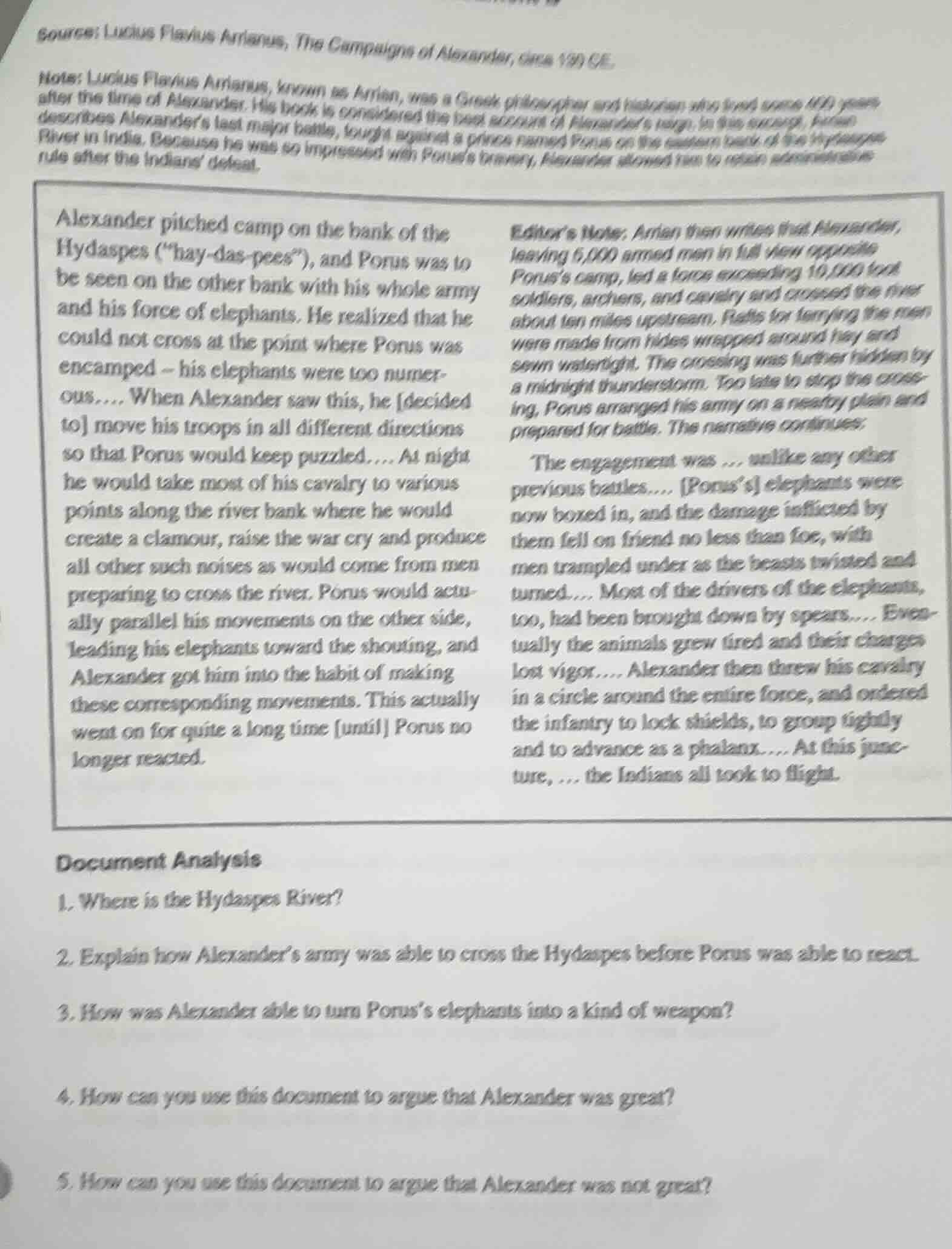
source: lucius flavius arrianus, the campaigns of alexander, circa 190 ce. note: lucius flavius arrianus, known as arrian, was a greek philosopher and historian who lived some 400 years after the time of alexander. his book is considered the best account of alexander’s reign. in this excerpt, arrian describes alexander’s last major battle, fought against a prince named porus on the eastern bank of the hydaspes river in india. because he was so impressed with porus’s bravery, alexander allowed him to retain administrative rule after the indians’ defeat. alexander pitched camp on the bank of the hydaspes (“hay - das - pees”), and porus was to be seen on the other bank with his whole army and his force of elephants. he realized that he could not cross at the point where porus was encamped – his elephants were too numerous.... when alexander saw this, he decided to move his troops in all different directions so that porus would keep puzzled.... at night he would take most of his cavalry to various points along the river bank where he would create a clamour, raise the war cry and produce all other such noises as would come from men preparing to cross the river. porus would actually parallel his movements on the other side, leading his elephants toward the shouting, and alexander got him into the habit of making these corresponding movements. this actually went on for quite a long time until porus no longer reacted. editor’s note: arrian then writes that alexander, leaving 6,000 armed men in full view opposite porus’s camp, led a force exceeding 10,000 foot soldiers, archers, and cavalry and crossed the river about ten miles upstream. rafts for ferrying the men were made from hides wrapped around hay and sewn watertight. the crossing was further hidden by a midnight thunderstorm. too late to stop the crossing, porus arranged his army on a nearby plain and prepared for battle. the narrative continues: the engagement was... unlike any other previous battles.... porus’s elephants were now boxed in, and the damage inflicted by them fell on friend no less than foe, with men trampled under as the beasts twisted and turned.... most of the drivers of the elephants, too, had been brought down by spears.... eventually the animals grew tired and their charges lost vigor.... alexander then threw his cavalry in a circle around the entire force, and ordered the infantry to lock shields, to group tightly and to advance as a phalanx.... at this juncture,... the indians all took to flight. document analysis 1. where is the hydaspes river? 2. explain how alexander’s army was able to cross the hydaspes before porus was able to react. 3. how was alexander able to turn porus’s elephants into a kind of weapon? 4. how can you use this document to argue that alexander was great? 5. how can you use this document to argue that alexander was not great?
1. Where is the Hydaspes River?
From the note, it's stated that the battle was on the eastern bank of the Hydaspes River in India. So the Hydaspes River is in India (on the eastern bank where the battle with Porus occurred).
First, Alexander left 6,000 armed men in full view opposite Porus’s camp to distract. Then he led over 10,000 troops (foot soldiers, archers, cavalry) to cross about ten miles upstream. Rafts were made from hides (wrapped around hay, sewn watertight) and the crossing was hidden by a midnight thunderstorm. Also, he had previously distracted Porus with false crossing attempts (moving troops, creating noise) to make Porus stop reacting to such feints, so when the real crossing happened, Porus was unprepared.
During the battle, Porus’s elephants were boxed in. Their damage fell on friends and foes (men trampled as elephants twisted/turned). Most elephant drivers were killed by spears. The elephants grew tired, losing charge vigor. Then Alexander surrounded them with cavalry and ordered infantry to advance as a phalanx, causing chaos that made the Indians flee—effectively using the elephants’ own chaos (and Porus’s reliance on them) against his army.

Snap & solve any problem in the app
Get step-by-step solutions on Sovi AI
Photo-based solutions with guided steps
Explore more problems and detailed explanations
The Hydaspes River is in India (on the eastern bank where Alexander fought Porus).