QUESTION IMAGE
Question
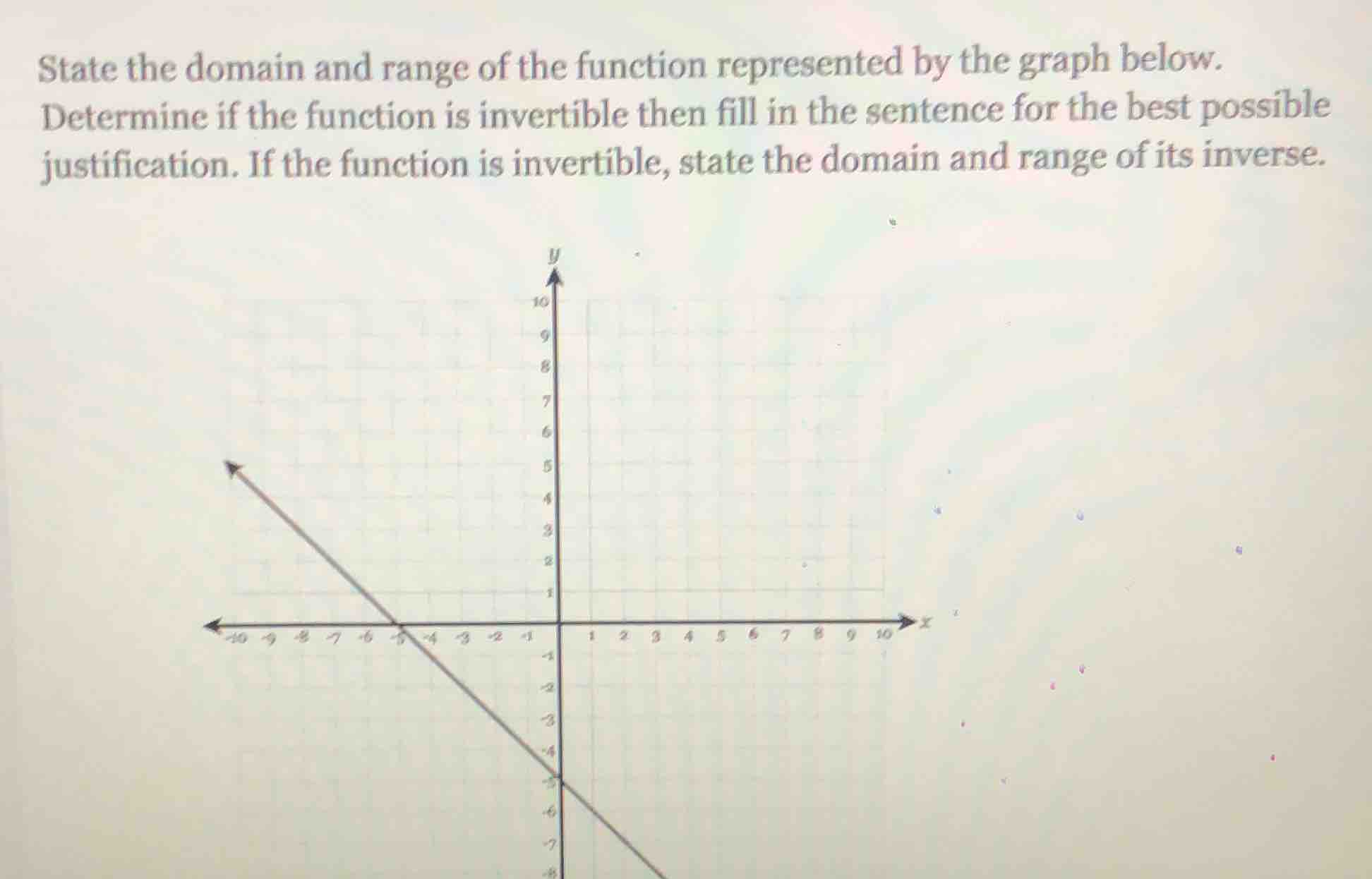
state the domain and range of the function represented by the graph below. determine if the function is invertible then fill in the sentence for the best possible justification. if the function is invertible, state the domain and range of its inverse.
Step1: Analyze the graph's domain
The graph is a straight line (linear function) extending infinitely in both directions along the x - axis. So, the domain (set of all x - values) is all real numbers. In interval notation, the domain is $(-\infty, \infty)$.
Step2: Analyze the graph's range
Since the line is linear with a non - zero slope, it will take on all real y - values as x varies over all real numbers. So, the range (set of all y - values) is also all real numbers, or in interval notation $(-\infty, \infty)$.
Step3: Determine if the function is invertible
A function is invertible if and only if it is one - to - one (passes the horizontal line test). For a linear function $y = mx + b$ where $m
eq0$, the graph is a straight line with a non - vertical and non - horizontal (since the slope here is non - zero, as the line is not horizontal) slope. A non - horizontal, non - vertical line will intersect any horizontal line at most once. So, this linear function is one - to - one and thus invertible.
Step4: Find the domain and range of the inverse function
For an invertible function, the domain of the inverse function is the range of the original function, and the range of the inverse function is the domain of the original function. Since the domain and range of the original function are both $(-\infty, \infty)$, the domain of the inverse function is $(-\infty, \infty)$ and the range of the inverse function is $(-\infty, \infty)$.

Snap & solve any problem in the app
Get step-by-step solutions on Sovi AI
Photo-based solutions with guided steps
Explore more problems and detailed explanations
- Domain of the function: $(-\infty, \infty)$
- Range of the function: $(-\infty, \infty)$
- The function is invertible (because it is a linear function with a non - zero slope, so it passes the horizontal line test).
- Domain of the inverse function: $(-\infty, \infty)$
- Range of the inverse function: $(-\infty, \infty)$