QUESTION IMAGE
Question
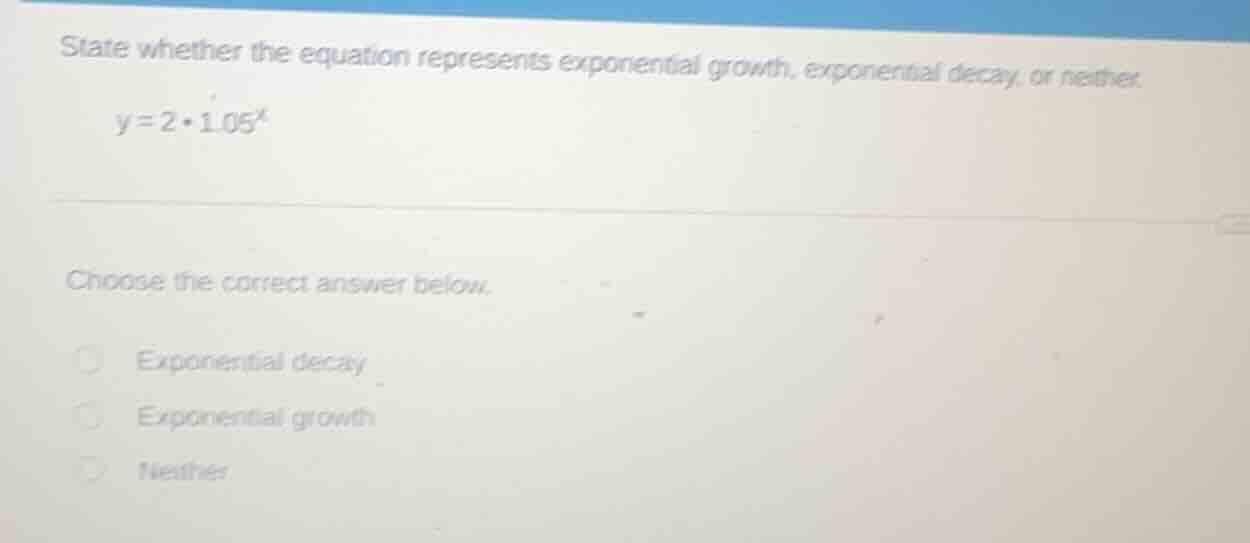
state whether the equation represents exponential growth, exponential decay, or neither.
$y = 2 \cdot 1.05^x$
choose the correct answer below.
\\(\circ\\) exponential decay
\\(\circ\\) exponential growth
\\(\circ\\) neither
Step1: Recall exponential function form
The general form of an exponential function is \( y = a \cdot b^x \), where \( a>0 \) and \( b>0 \). If \( b > 1 \), it's exponential growth; if \( 0 < b < 1 \), it's exponential decay.
Step2: Identify \( b \) in the given equation
In the equation \( y = 2 \cdot 1.05^x \), we have \( a = 2 \) and \( b = 1.05 \).
Step3: Compare \( b \) with 1
Since \( 1.05>1 \), by the definition of exponential growth (when \( b > 1 \) in \( y = a \cdot b^x \)), this function represents exponential growth.

Snap & solve any problem in the app
Get step-by-step solutions on Sovi AI
Photo-based solutions with guided steps
Explore more problems and detailed explanations
B. Exponential growth