QUESTION IMAGE
Question
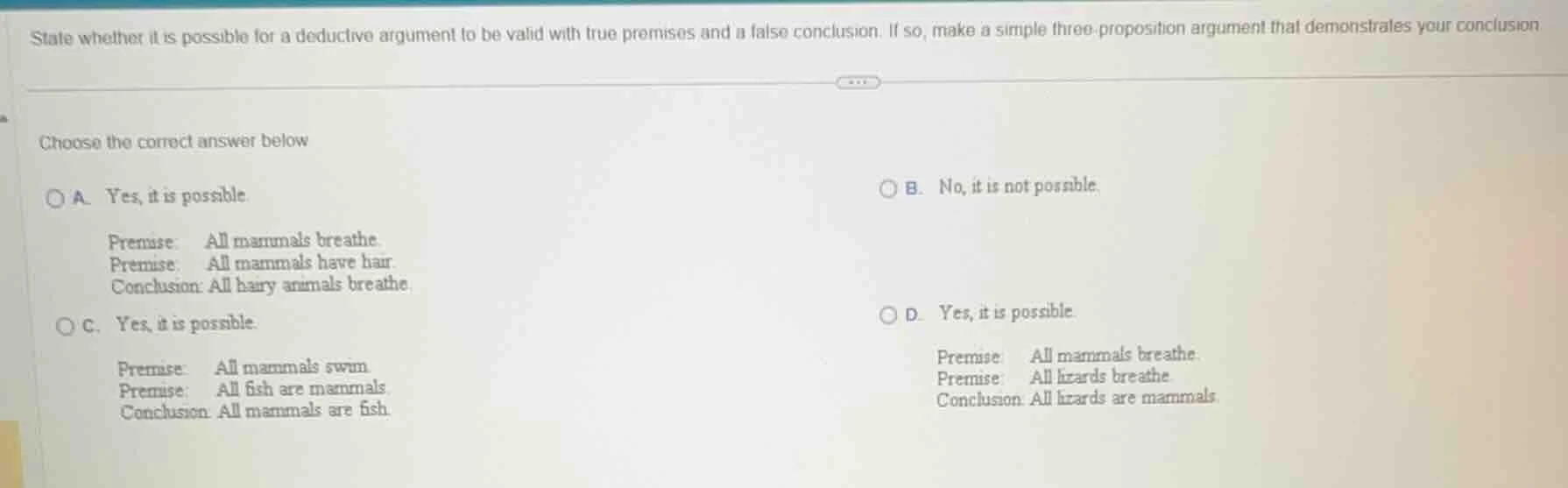
state whether it is possible for a deductive argument to be valid with true premises and a false conclusion. if so, make a simple three - proposition argument that demonstrates your conclusion
choose the correct answer below
a. yes, it is possible
premise: all mammals breathe.
premise: all mammals have hair.
conclusion: all hairy animals breathe.
b. no, it is not possible.
c. yes, it is possible.
premise: all mammals swim.
premise: all fish are mammals.
conclusion: all mammals are fish.
d. yes, it is possible.
premise: all mammals breathe.
premise: all lizards breathe
conclusion: all lizards are mammals.
To determine the answer, we analyze the definition of a valid deductive argument: a valid deductive argument is one where if the premises are true, the conclusion must be true (i.e., it is impossible for the premises to be true and the conclusion false).
- For option A: The premises "All mammals breathe" and "All mammals have hair" are true, but the conclusion "All hairy animals breathe" – there could be hairy non - mammal animals (e.g., some insects with hair - like structures) that don't breathe in the same way or at all (though in reality most animals breathe, but logically the conclusion doesn't follow necessarily from the premises, but the key here is about true premises and false conclusion possibility. However, the main point is the definition: in a valid deductive argument, true premises must lead to true conclusion. So a valid deductive argument cannot have true premises and a false conclusion.
- For option B: By the definition of a valid deductive argument, if an argument is valid, the truth of the premises guarantees the truth of the conclusion. So it is not possible for a valid deductive argument to have true premises and a false conclusion. The example in A is actually an invalid argument (since the conclusion doesn't follow necessarily from the premises), and the examples in C and D have false premises (e.g., in C "All mammals swim" and "All fish are mammals" are false; in D "All lizards are mammals" is false and the premises don't support the conclusion in a valid way).

Snap & solve any problem in the app
Get step-by-step solutions on Sovi AI
Photo-based solutions with guided steps
Explore more problems and detailed explanations
B. No, it is not possible.