QUESTION IMAGE
Question
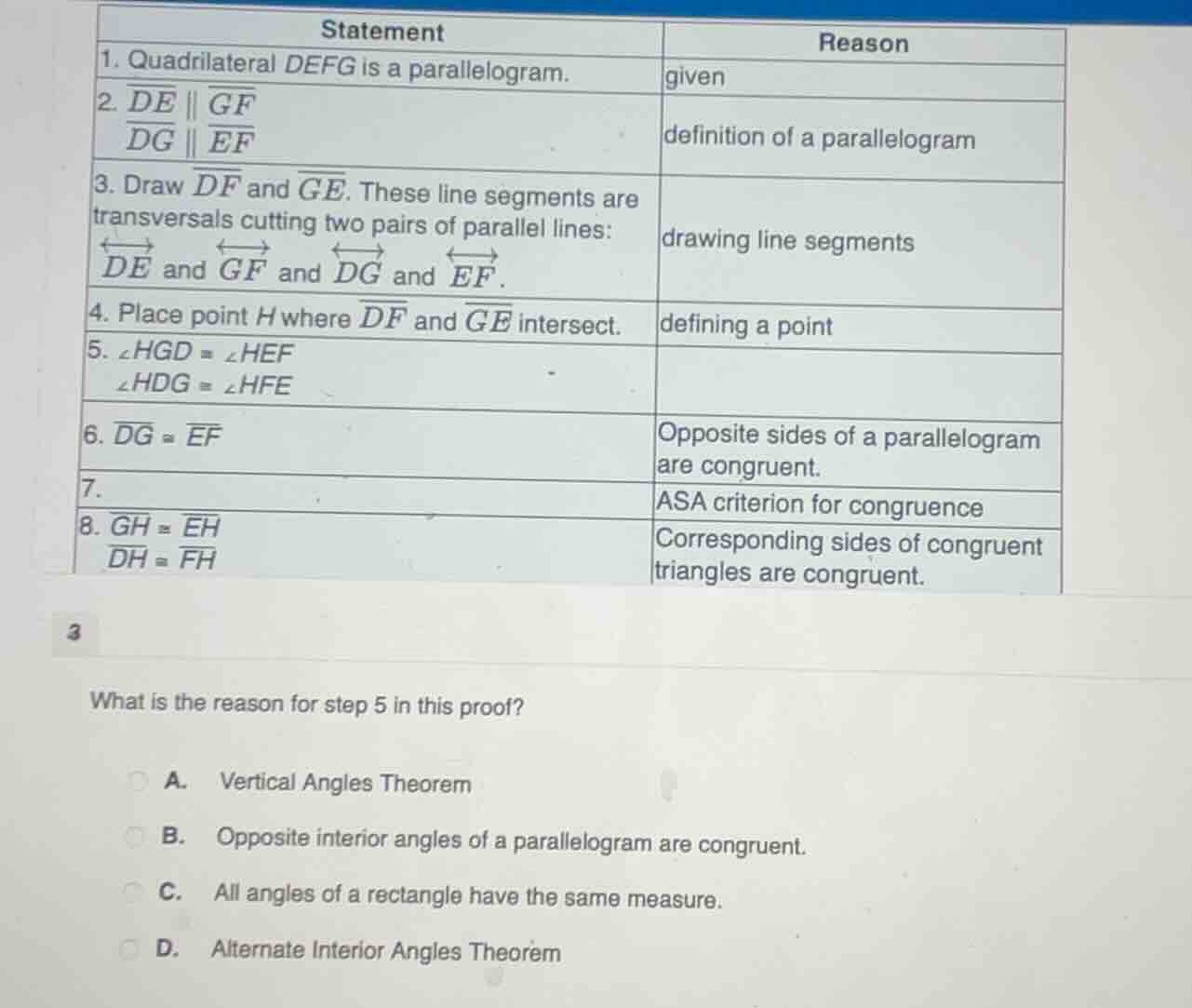
statement reason 1. quadrilateral defg is a parallelogram. given 2. \\(\overline{de} \parallel \overline{gf}\\) \\(\overline{dg} \parallel \overline{ef}\\) definition of a parallelogram 3. draw \\(\overline{df}\\) and \\(\overline{ge}\\). these line segments are transversals cutting two pairs of parallel lines: \\(\overleftrightarrow{de}\\) and \\(\overleftrightarrow{gf}\\) and \\(\overleftrightarrow{dg}\\) and \\(\overleftrightarrow{ef}\\). drawing line segments 4. place point h where \\(\overline{df}\\) and \\(\overline{ge}\\) intersect. defining a point 5. \\(\angle hgd \cong \angle hef\\) \\(\angle hdg \cong \angle hfe\\) 6. \\(\overline{dg} \cong \overline{ef}\\) opposite sides of a parallelogram are congruent. 7. asa criterion for congruence 8. \\(\overline{gh} \cong \overline{eh}\\) \\(\overline{dh} \cong \overline{fh}\\) corresponding sides of congruent triangles are congruent. 3 what is the reason for step 5 in this proof? a. vertical angles theorem b. opposite interior angles of a parallelogram are congruent. c. all angles of a rectangle have the same measure. d. alternate interior angles theorem
Step 5 states pairs of angles are congruent. These angles are formed when transversals intersect two pairs of parallel sides of the parallelogram. The Alternate Interior Angles Theorem states that when a transversal cuts two parallel lines, the alternate interior angles are congruent, which matches this scenario.

Snap & solve any problem in the app
Get step-by-step solutions on Sovi AI
Photo-based solutions with guided steps
Explore more problems and detailed explanations
D. Alternate Interior Angles Theorem