QUESTION IMAGE
Question
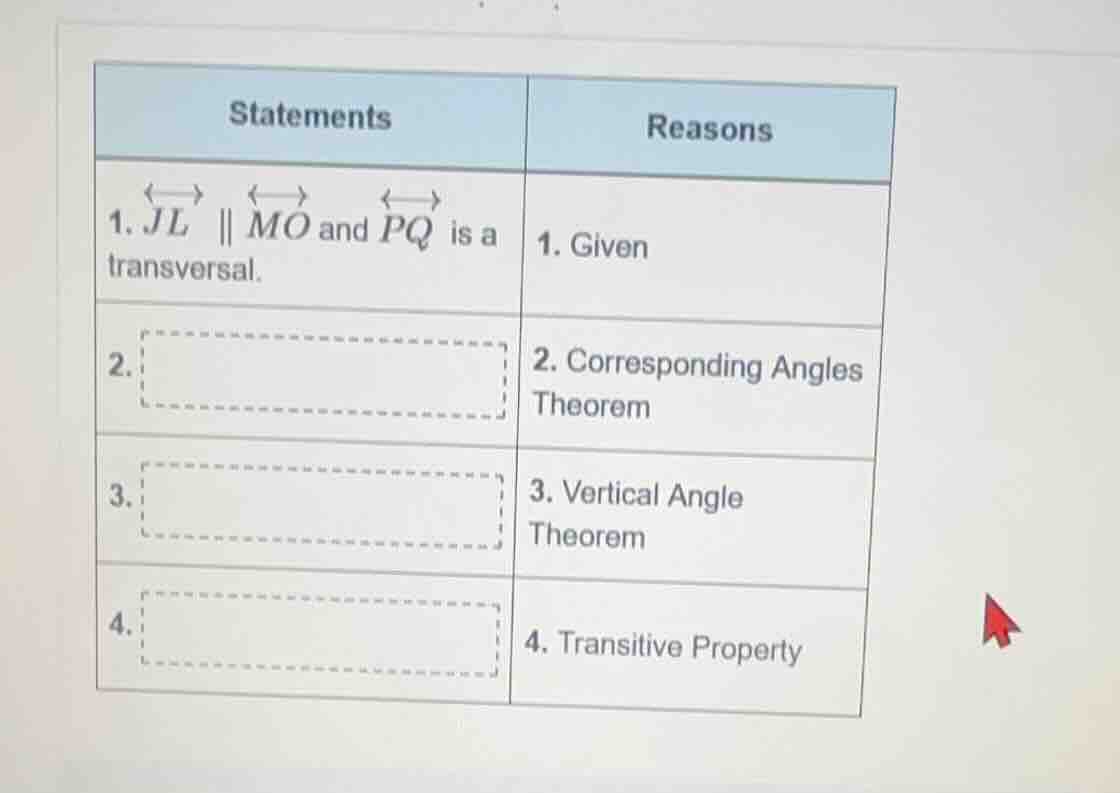
statements reasons 1. \overleftrightarrow{jl} \parallel \overleftrightarrow{mo} and \overleftrightarrow{pq} is a transversal. 1. given 2. blank 2. corresponding angles theorem 3. blank 3. vertical angle theorem 4. blank 4. transitive property
To solve this proof, we analyze each step based on the given information and geometric theorems:
Step 1: Understand the Given
We know \( \overleftrightarrow{JL} \parallel \overleftrightarrow{MO} \) and \( \overleftrightarrow{PQ} \) is a transversal (given).
Step 2: Corresponding Angles Theorem
When two parallel lines are cut by a transversal, corresponding angles are congruent. Let’s denote a pair of corresponding angles, e.g., \( \angle JXP \cong \angle MYP \) (where \( X \) and \( Y \) are intersection points of \( \overleftrightarrow{PQ} \) with \( \overleftrightarrow{JL} \) and \( \overleftrightarrow{MO} \), respectively). So the statement for step 2 is: Corresponding angles formed by \( \overleftrightarrow{PQ} \) with \( \overleftrightarrow{JL} \) and \( \overleftrightarrow{MO} \) are congruent (e.g., \( \angle JXP \cong \angle MYP \)).
Step 3: Vertical Angle Theorem
Vertical angles are congruent. Suppose \( \angle JXP \) and \( \angle KXL \) are vertical angles (where \( K \) is another point on \( \overleftrightarrow{JL} \)). Then \( \angle JXP \cong \angle KXL \). So the statement for step 3 is: Vertical angles (e.g., \( \angle JXP \) and \( \angle KXL \)) are congruent (e.g., \( \angle JXP \cong \angle KXL \)).
Step 4: Transitive Property
If \( \angle MYP \cong \angle JXP \) (from step 2) and \( \angle JXP \cong \angle KXL \) (from step 3), then by the transitive property, \( \angle MYP \cong \angle KXL \). So the statement for step 4 is: The angle congruent to \( \angle MYP \) (from step 2) is also congruent to the vertical angle (from step 3) (e.g., \( \angle MYP \cong \angle KXL \)).
Final Statements (Filled In):
- \( \boldsymbol{\angle JXP \cong \angle MYP} \) (Corresponding Angles Theorem)
- \( \boldsymbol{\angle JXP \cong \angle KXL} \) (Vertical Angle Theorem)
- \( \boldsymbol{\angle MYP \cong \angle KXL} \) (Transitive Property)
(Note: The specific angle labels depend on the diagram, but the logic follows the theorems. Replace angle labels with those from the actual diagram for precision.)

Snap & solve any problem in the app
Get step-by-step solutions on Sovi AI
Photo-based solutions with guided steps
Explore more problems and detailed explanations
To solve this proof, we analyze each step based on the given information and geometric theorems:
Step 1: Understand the Given
We know \( \overleftrightarrow{JL} \parallel \overleftrightarrow{MO} \) and \( \overleftrightarrow{PQ} \) is a transversal (given).
Step 2: Corresponding Angles Theorem
When two parallel lines are cut by a transversal, corresponding angles are congruent. Let’s denote a pair of corresponding angles, e.g., \( \angle JXP \cong \angle MYP \) (where \( X \) and \( Y \) are intersection points of \( \overleftrightarrow{PQ} \) with \( \overleftrightarrow{JL} \) and \( \overleftrightarrow{MO} \), respectively). So the statement for step 2 is: Corresponding angles formed by \( \overleftrightarrow{PQ} \) with \( \overleftrightarrow{JL} \) and \( \overleftrightarrow{MO} \) are congruent (e.g., \( \angle JXP \cong \angle MYP \)).
Step 3: Vertical Angle Theorem
Vertical angles are congruent. Suppose \( \angle JXP \) and \( \angle KXL \) are vertical angles (where \( K \) is another point on \( \overleftrightarrow{JL} \)). Then \( \angle JXP \cong \angle KXL \). So the statement for step 3 is: Vertical angles (e.g., \( \angle JXP \) and \( \angle KXL \)) are congruent (e.g., \( \angle JXP \cong \angle KXL \)).
Step 4: Transitive Property
If \( \angle MYP \cong \angle JXP \) (from step 2) and \( \angle JXP \cong \angle KXL \) (from step 3), then by the transitive property, \( \angle MYP \cong \angle KXL \). So the statement for step 4 is: The angle congruent to \( \angle MYP \) (from step 2) is also congruent to the vertical angle (from step 3) (e.g., \( \angle MYP \cong \angle KXL \)).
Final Statements (Filled In):
- \( \boldsymbol{\angle JXP \cong \angle MYP} \) (Corresponding Angles Theorem)
- \( \boldsymbol{\angle JXP \cong \angle KXL} \) (Vertical Angle Theorem)
- \( \boldsymbol{\angle MYP \cong \angle KXL} \) (Transitive Property)
(Note: The specific angle labels depend on the diagram, but the logic follows the theorems. Replace angle labels with those from the actual diagram for precision.)