QUESTION IMAGE
Question
a. a stationary front because a warm air mass is pushing out a cold air mass.
b. a cold front because a warm air mass is moving above a cold air mass.
c. a warm front because a warm air mass is pushing out a cold air mass.
d. an occluded front because a warm air mass is moving above a cold air mass.
Brief Explanations
To determine the correct front, we analyze each option:
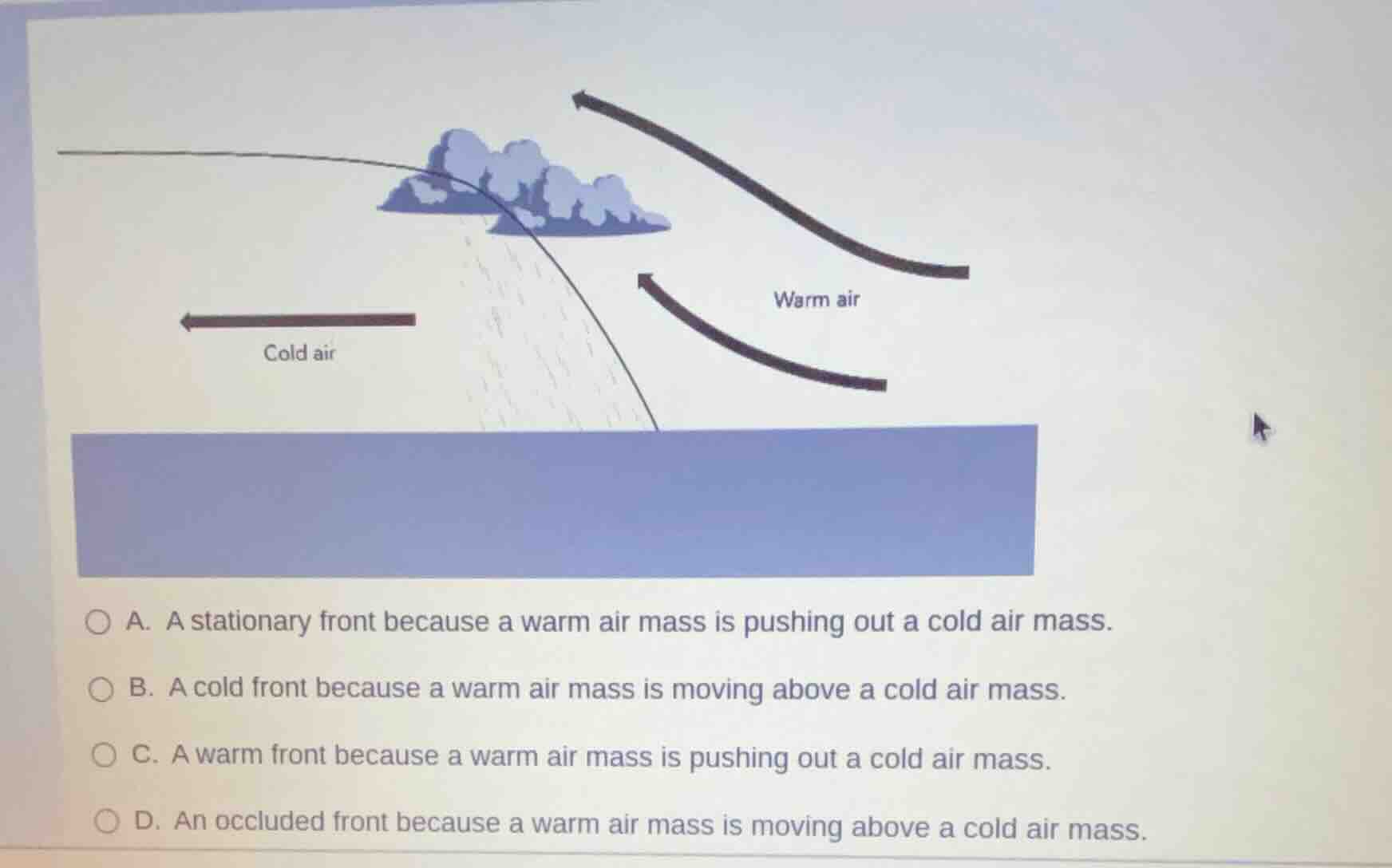
- Option A: A stationary front has little to no movement of air masses, but the diagram shows movement, so A is incorrect.
- Option B: A cold front occurs when a cold air mass pushes into a warm air mass, forcing the warm air to rise rapidly. However, the diagram shows warm air pushing out cold air, so B is incorrect.
- Option C: A warm front is when a warm air mass (less dense) moves over a cold air mass (more dense), pushing the cold air out. The diagram shows warm air moving and cold air being displaced, which matches a warm front.
- Option D: An occluded front involves three air masses, and the diagram only shows two (warm and cold), so D is incorrect.

Snap & solve any problem in the app
Get step-by-step solutions on Sovi AI
Photo-based solutions with guided steps
Explore more problems and detailed explanations
C. A warm front because a warm air mass is pushing out a cold air mass.