QUESTION IMAGE
Question
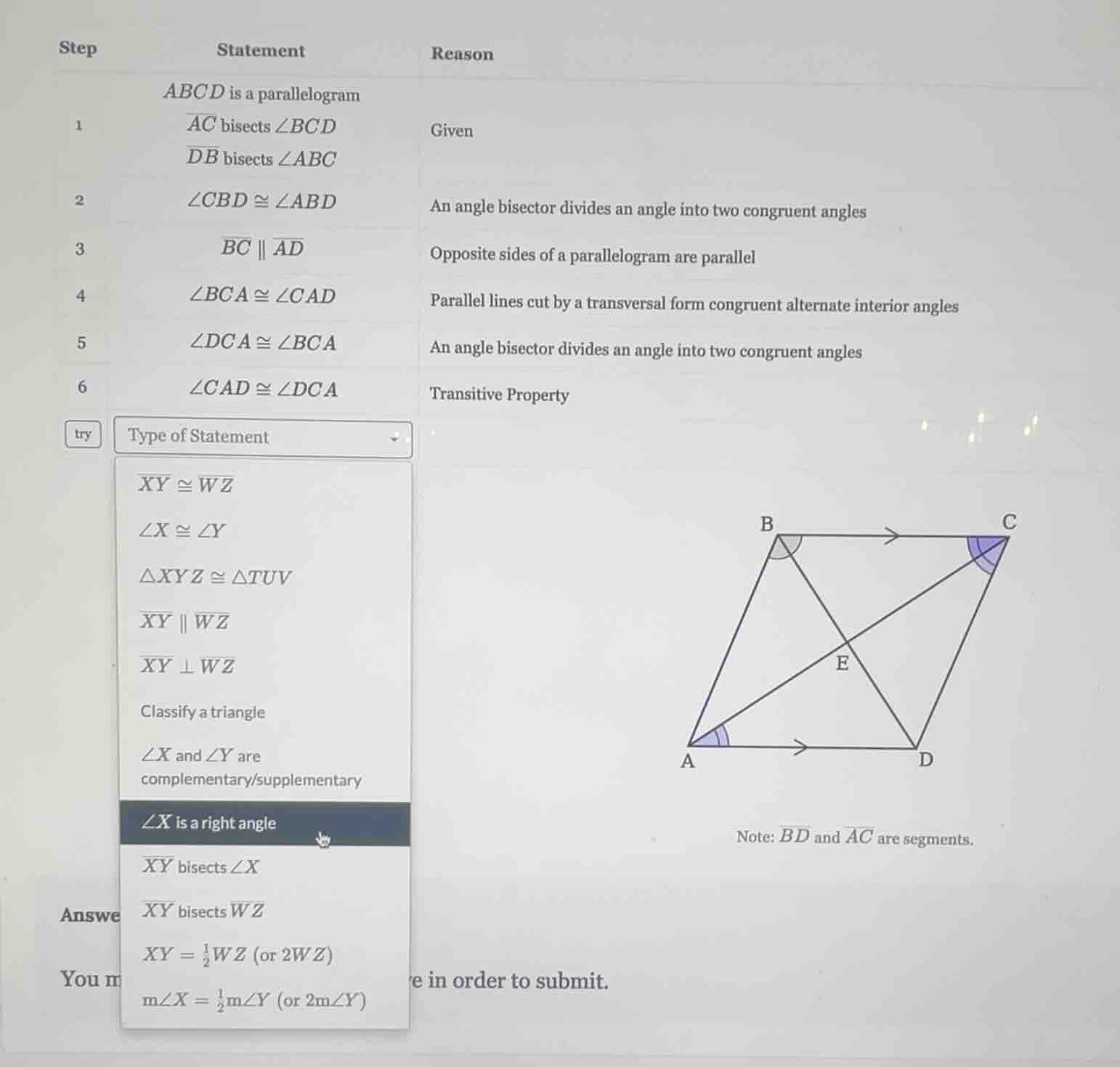
step 1: statement - abcd is a parallelogram, $overline{ac}$ bisects $angle bcd$, $overline{db}$ bisects $angle abc$; reason - given. step 2: statement - $angle cbd cong angle abd$; reason - an angle bisector divides an angle into two congruent angles. step 3: statement - $overline{bc} parallel overline{ad}$; reason - opposite sides of a parallelogram are parallel. step 4: statement - $angle bca cong angle cad$; reason - parallel lines cut by a transversal form congruent alternate interior angles. step 5: statement - $angle dca cong angle bca$; reason - an angle bisector divides an angle into two congruent angles. step 6: statement - $angle cad cong angle dca$; reason - transitive property. then there is a type of statement dropdown with options: $overline{xy} cong overline{wz}$, $angle x cong angle y$, $\triangle xyz cong \triangle tuv$, $overline{xy} parallel overline{wz}$, $overline{xy} perp overline{wz}$, classify a triangle, $angle x$ and $angle y$ are complementary/supplementary, $angle x$ is a right angle, $overline{xy}$ bisects $angle x$, $overline{xy}$ bisects $overline{wz}$, $xy = \frac{1}{2}wz$ (or $2wz$), $mangle x = \frac{1}{2}mangle y$ (or $2mangle y$). there is also a diagram of parallelogram $abcd$ with segments $bd$ and $ac$, and angles marked at $b$, $c$, $a$. note: $overline{bd}$ and $overline{ac}$ are segments.
Step1: Identify next logical statement
From $\angle CAD \cong \angle DCA$, by the converse of the isosceles triangle theorem, the sides opposite these angles are congruent. The side opposite $\angle CAD$ is $\overline{CD}$, and the side opposite $\angle DCA$ is $\overline{AD}$. So $\overline{AD} \cong \overline{CD}$. This matches the $\overline{XY} \cong \overline{WZ}$ statement type.
Step2: Confirm statement type
The derived statement is a congruent sides statement, which corresponds to the $\overline{XY} \cong \overline{WZ}$ option in the dropdown.

Snap & solve any problem in the app
Get step-by-step solutions on Sovi AI
Photo-based solutions with guided steps
Explore more problems and detailed explanations
$\overline{AD} \cong \overline{CD}$ (matching the $\overline{XY} \cong \overline{WZ}$ statement type)