QUESTION IMAGE
Question
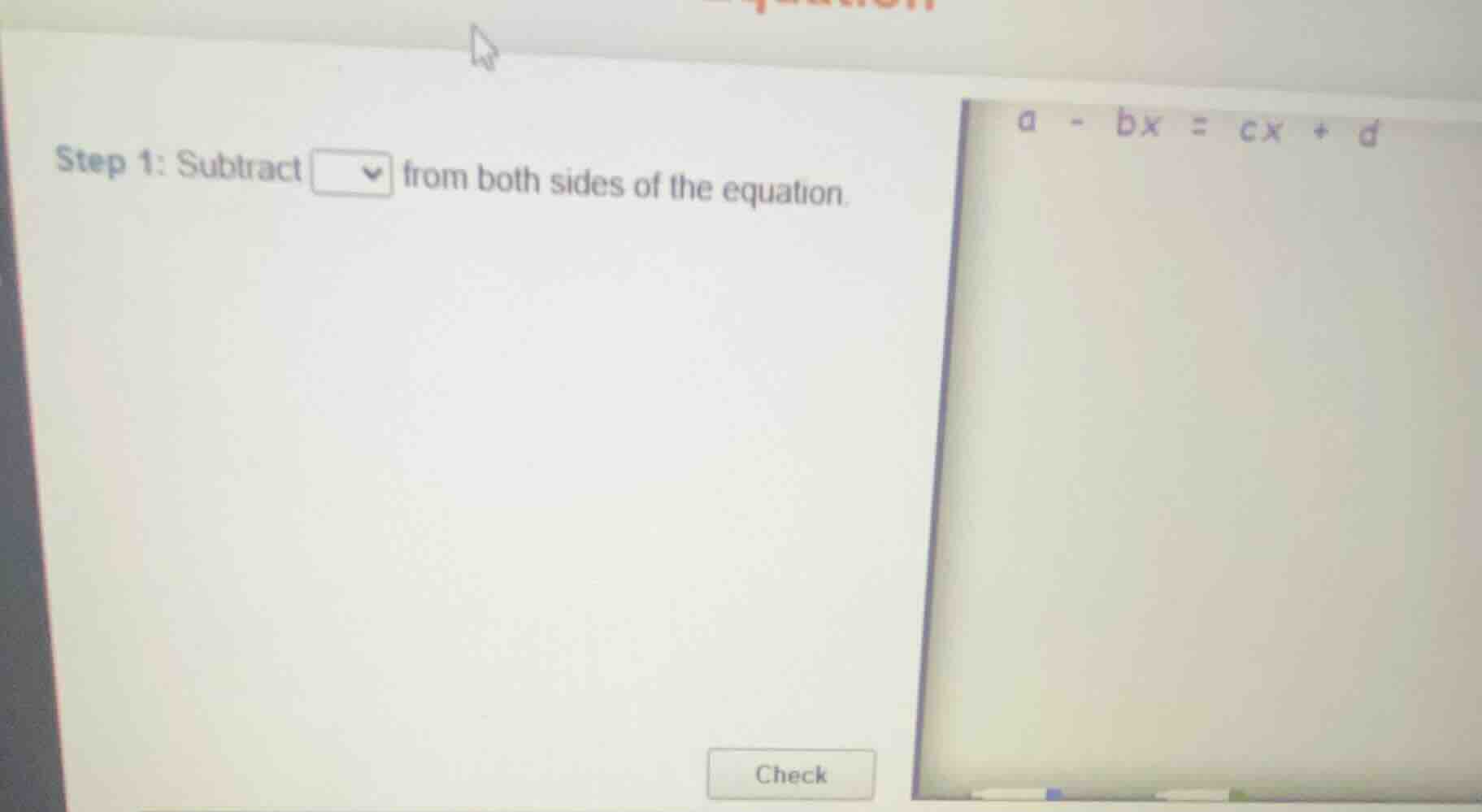
step 1: subtract $\boldsymbol{square}$ from both sides of the equation.
$a - bx = cx + d$
check
Step1: Isolate constant on left side
Subtract $d$ from both sides:
$$a - bx - d = cx + d - d$$
$$a - d - bx = cx$$
Alternative Step1 (isolate $x$ terms on right):
Subtract $a$ from both sides:
$$a - bx - a = cx + d - a$$
$$-bx = cx + d - a$$
Step2: (Clarification of goal)
The standard first step to solve for $x$ is to group constants on one side and $x$-terms on the other. The most logical first step is removing the constant $d$ from the right, or $a$ from the left.

Snap & solve any problem in the app
Get step-by-step solutions on Sovi AI
Photo-based solutions with guided steps
Explore more problems and detailed explanations
The value to subtract is $\boldsymbol{d}$ (or $\boldsymbol{a}$; the most standard choice is $\boldsymbol{d}$ to isolate $x$-terms on the right after simplification).
If following the standard process to solve for $x$:
After subtracting $d$, we proceed to collect $x$-terms:
$$a - d = cx + bx$$
$$a - d = x(b + c)$$
$$x = \frac{a - d}{b + c}$$