QUESTION IMAGE
Question
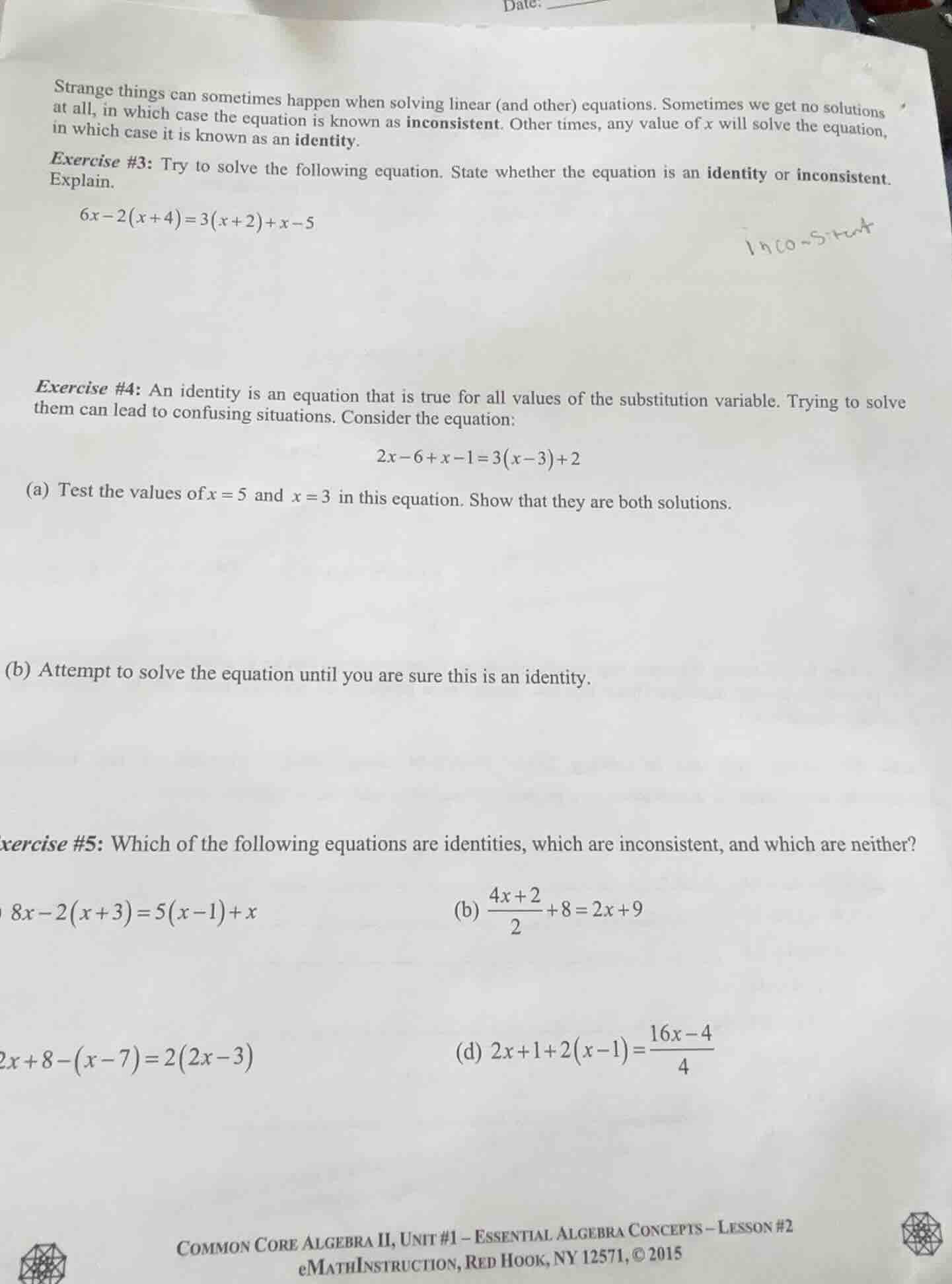
strange things can sometimes happen when solving linear (and other) equations. sometimes we get no solutions at all, in which case the equation is known as inconsistent. other times, any value of x will solve the equation, in which case it is known as an identity.
exercise #3: try to solve the following equation. state whether the equation is an identity or inconsistent. explain.
\\(6x - 2(x + 4) = 3(x + 2) + x - 5\\)
exercise #4: an identity is an equation that is true for all values of the substitution variable. trying to solve them can lead to confusing situations. consider the equation:
\\(2x - 6 + x - 1 = 3(x - 3) + 2\\)
(a) test the values of \\(x = 5\\) and \\(x = 3\\) in this equation. show that they are both solutions.
(b) attempt to solve the equation until you are sure this is an identity.
exercise #5: which of the following equations are identities, which are inconsistent, and which are neither?
\\(8x - 2(x + 3) = 5(x - 1) + x\\)
(b) \\(\frac{4x + 2}{2} + 8 = 2x + 9\\)
\\(2x + 8 - (x - 7) = 2(2x - 3)\\)
(d) \\(2x + 1 + 2(x - 1) = \frac{16x - 4}{4}\\)
common core algebra ii, unit #1 - essential algebra concepts - lesson #2
emathinstruction, red hook, ny 12571, \\(\copyright\\) 2015
Exercise #3
Step1: Expand both sides
$6x - 2x - 8 = 3x + 6 + x - 5$
Step2: Combine like terms
$4x - 8 = 4x + 1$
Step3: Subtract $4x$ from both sides
$-8 = 1$
Step1: Test $x=5$ (left side)
$2(5)-6+5-1 = 10-6+5-1 = 8$
Step2: Test $x=5$ (right side)
$3(5-3)+2 = 3(2)+2 = 8$
Step3: Test $x=3$ (left side)
$2(3)-6+3-1 = 6-6+3-1 = 2$
Step4: Test $x=3$ (right side)
$3(3-3)+2 = 3(0)+2 = 2$
Step1: Combine like terms (left)
$3x - 7 = 3(x-3)+2$
Step2: Expand right side
$3x - 7 = 3x - 9 + 2$
Step3: Simplify right side
$3x - 7 = 3x - 7$

Snap & solve any problem in the app
Get step-by-step solutions on Sovi AI
Photo-based solutions with guided steps
Explore more problems and detailed explanations
The equation is inconsistent, as simplifying leads to a false statement $-8=1$ with no valid $x$ values.
---