QUESTION IMAGE
Question
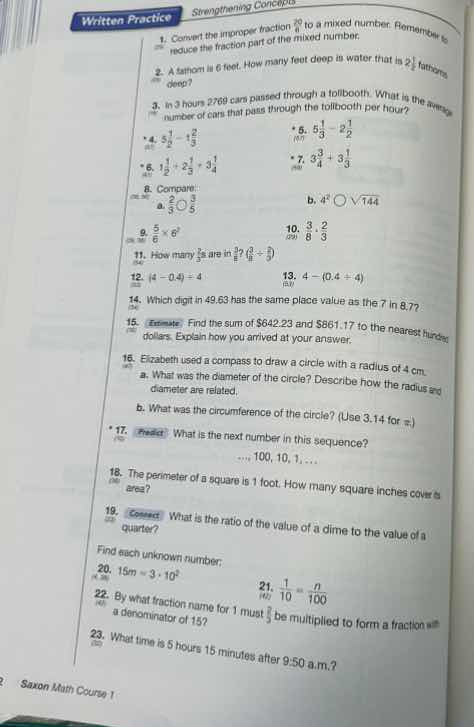
strengthening concepts written practice 1. convert the improper fraction \\(\frac{29}{8}\\) to a mixed number. remember to reduce the fraction part of the mixed number. 2. a fathom is 6 feet. how many feet deep is water that is \\(2\frac{1}{2}\\) fathoms deep? 3. in 3 hours 3769 cars passed through a tollbooth. what is the average number of cars that pass through the tollbooth per hour? 4. \\(5\frac{1}{2} + 2\frac{4}{5}\\) 6. \\(5\frac{1}{3} - 1\frac{2}{2}\\) 6. \\(5\frac{1}{2} + 2\frac{3}{5} + 3\frac{1}{4}\\) 7. \\(3\frac{9}{4} + 3\frac{1}{5}\\) 8. compare a. \\(\frac{3}{5} \circ \frac{3}{8}\\) b. \\(4^2 \circ \sqrt{144}\\) 9. \\(\frac{5}{8} \div 6^2\\) 10. \\(\frac{3}{8} \div \frac{2}{3}\\) 11. how many \\(\frac{3}{8}\\)s are in \\(3\frac{3}{4}\\)? 12. \\((4 - 0.4) \div 4\\) 13. \\(4 - (0.4 \div 4)\\) 14. which digit in 49.63 has the same place value as the 7 in 8.77? 15. estimate: find the sum of \\$642.23 and \\$861.17 to the nearest hundred dollars. explain how you arrived at your answer. 16. elizabeth used a compass to draw a circle with a radius of 4 cm. a. what was the diameter of the circle? describe how the radius and diameter are related. b. what was the circumference of the circle? (use 3.14 for \\(\pi\\)) * 17. predict: what is the next number in this sequence? \\(\dots, 100, 10, 1, \dots\\) 18. the perimeter of a square is 1 foot. how many square inches cover its area? 19. connect: what is the ratio of the value of a dime to the value of a quarter? find each unknown number. 20. \\(15m = 3 \cdot 10^2\\) 21. \\(\frac{1}{10} = \frac{n}{100}\\) 22. by what fraction name for 1 must \\(\frac{5}{8}\\) be multiplied to form a fraction with a denominator of 15? 23. what time is 5 hours 15 minutes after 9:50 a.m.? saxon math course 1
Let's solve some of these problems one by one. We'll start with problem 16a as it's about circles, radius, and diameter.
Problem 16a
Step 1: Recall the relationship between radius and diameter
The diameter \( d \) of a circle is twice the radius \( r \), so the formula is \( d = 2r \).
Step 2: Substitute the given radius
Given that the radius \( r = 4 \) cm, we substitute into the formula: \( d = 2\times4 = 8 \) cm. The radius is a line segment from the center of the circle to any point on the circle, and the diameter is a line segment that passes through the center and has endpoints on the circle, so the diameter is twice as long as the radius.
Step 1: Recall the formula for the circumference of a circle
The circumference \( C \) of a circle can be calculated using the formula \( C = \pi d \) (or \( C = 2\pi r \)). We are given to use \( \pi = 3.14 \) and we found the diameter \( d = 8 \) cm from part (a).
Step 2: Substitute the values into the formula
Substitute \( d = 8 \) cm and \( \pi = 3.14 \) into \( C = \pi d \): \( C = 3.14\times8 \).
Step 3: Calculate the product
\( 3.14\times8 = 25.12 \) cm.
Step 1: Identify the pattern in the sequence
Looking at the sequence \( 100, 10, 1, \dots \), we can see that each term is divided by 10 to get the next term. \( 100\div10 = 10 \), \( 10\div10 = 1 \).
Step 2: Find the next term
To find the next term, we divide the last given term (1) by 10: \( 1\div10 = 0.1 \) (or \( \frac{1}{10} \)).

Snap & solve any problem in the app
Get step-by-step solutions on Sovi AI
Photo-based solutions with guided steps
Explore more problems and detailed explanations
The diameter of the circle is 8 cm. The radius is half of the diameter (or the diameter is twice the radius), so if the radius is 4 cm, multiplying by 2 gives the diameter.