QUESTION IMAGE
Question
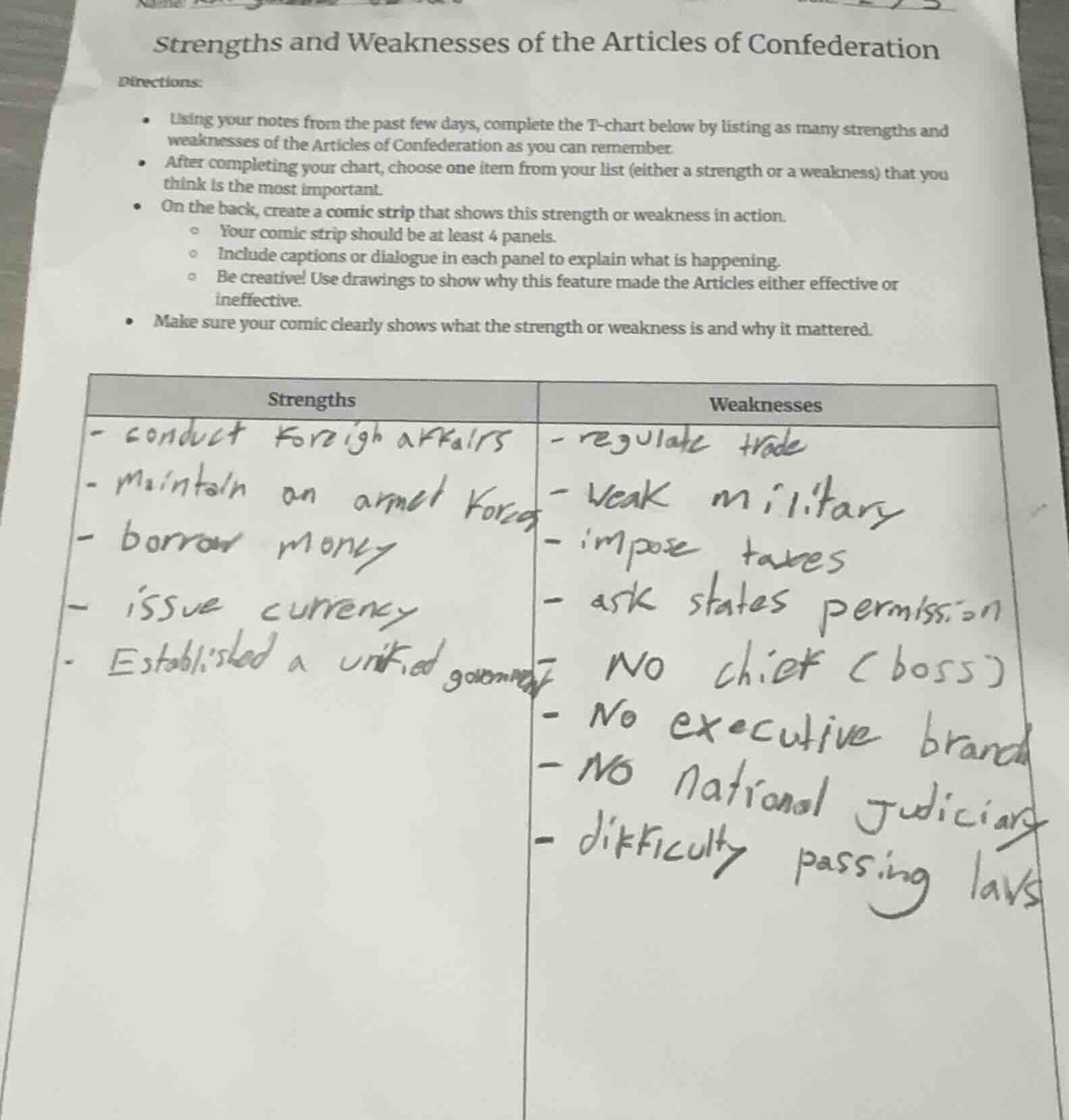
strengths and weaknesses of the articles of confederation
directions:
- using your notes from the past few days, complete the t - chart below by listing as many strengths and weaknesses of the articles of confederation as you can remember.
- after completing your chart, choose one item from your list (either a strength or a weakness) that you think is the most important.
- on the back, create a comic strip that shows this strength or weakness in action.
- your comic strip should be at least 4 panels.
- include captions or dialogue in each panel to explain what is happening.
- be creative! use drawings to show why this feature made the articles either effective or ineffective.
- make sure your comic clearly shows what the strength or weakness is and why it mattered.
strengths
- conduct foreign affairs
- maintain an armed force
- borrow money
- issue currency
- established a united government
weaknesses
- regulate trade
- weak military
- impose taxes
- ask states permission
- no chief (boss)
- no executive branch
- no national judiciary
- difficulty passing laws
To address this task, we'll first analyze the strengths and weaknesses of the Articles of Confederation from the provided T - chart and then create a comic strip for one key item.
Step 1: Select a Key Item
From the weaknesses, "No chief (boss)" (lack of an executive branch) is a fundamental flaw. It led to a lack of centralized leadership, which is crucial for enforcing laws and making timely decisions.
Step 2: Design the Comic Strip (4 Panels)
Panel 1: Setting the Scene
- Visual: A group of people (representing the states) sitting around a table with a document (Articles of Confederation) in the center. There's a big, empty chair at the head of the table.
- Caption/Dialogue: "The Articles of Confederation: No one in charge!"
Panel 2: A Problem Arises
- Visual: A messenger runs in, holding a letter. The states - people look confused.
- Caption/Dialogue: Messenger: "We need to respond to Britain's trade restrictions!" State 1: "Who will decide our response?" State 2: "There's no chief to lead us!"
Panel 3: Chaos Ensues
- Visual: The states - people start arguing among themselves. Some want to ignore Britain, some want to negotiate, and some want to fight.
- Caption/Dialogue: State 3: "I say we fight!" State 4: "No, negotiation is better!" State 5: "We don't have the money for a fight!"
Panel 4: The Consequence
- Visual: Britain's ships are shown imposing trade restrictions on American ports. The states - people look defeated.
- Caption/Dialogue: "Without a chief, we can't act together. Britain takes advantage of our disunity."
If we were to answer the first part (listing strengths and weaknesses more comprehensively):
Strengths (from the chart and historical knowledge)
- Conduct Foreign Affairs: The Confederation Congress could deal with other nations, which was important for establishing the new country on the international stage. For example, it negotiated the Treaty of Paris (1783) to end the Revolutionary War.
- Maintain an Armed Force (for defense): It could raise an army, although it had trouble getting states to contribute troops or funds.
- Borrow Money: The government could borrow money to pay off war debts, though it struggled to repay.
- Issue Currency: It provided a common currency for the states, which helped with trade (even though the currency was often devalued).
- Established a United Government: It was the first attempt at a national government for the newly independent states, uniting them under one system.
Weaknesses (from the chart and historical knowledge)
- Regulate Trade: It couldn't control interstate or foreign trade. States could impose their own tariffs, leading to trade wars between states and problems with foreign nations.
- Weak Military: The national army was small and dependent on state militias, which were often reluctant to serve or follow orders.
- Impose Taxes: It had no power to tax states or citizens directly. It had to request money from states, which rarely paid in full, leading to a lack of funds for the government.
- Ask States Permission: For many actions, like amending the Articles, it needed unanimous state approval, making it very difficult to make changes.
- No chief (boss) (No Executive Branch): Without a president or executive leader, there was no one to enforce laws, make quick decisions, or represent the nation as a single entity.
- No Executive Branch: As mentioned, this lack of centralized leadership was a major issue.
- No National Judiciary: There was no fed…

Snap & solve any problem in the app
Get step-by-step solutions on Sovi AI
Photo-based solutions with guided steps
Explore more problems and detailed explanations
To address this task, we'll first analyze the strengths and weaknesses of the Articles of Confederation from the provided T - chart and then create a comic strip for one key item.
Step 1: Select a Key Item
From the weaknesses, "No chief (boss)" (lack of an executive branch) is a fundamental flaw. It led to a lack of centralized leadership, which is crucial for enforcing laws and making timely decisions.
Step 2: Design the Comic Strip (4 Panels)
Panel 1: Setting the Scene
- Visual: A group of people (representing the states) sitting around a table with a document (Articles of Confederation) in the center. There's a big, empty chair at the head of the table.
- Caption/Dialogue: "The Articles of Confederation: No one in charge!"
Panel 2: A Problem Arises
- Visual: A messenger runs in, holding a letter. The states - people look confused.
- Caption/Dialogue: Messenger: "We need to respond to Britain's trade restrictions!" State 1: "Who will decide our response?" State 2: "There's no chief to lead us!"
Panel 3: Chaos Ensues
- Visual: The states - people start arguing among themselves. Some want to ignore Britain, some want to negotiate, and some want to fight.
- Caption/Dialogue: State 3: "I say we fight!" State 4: "No, negotiation is better!" State 5: "We don't have the money for a fight!"
Panel 4: The Consequence
- Visual: Britain's ships are shown imposing trade restrictions on American ports. The states - people look defeated.
- Caption/Dialogue: "Without a chief, we can't act together. Britain takes advantage of our disunity."
If we were to answer the first part (listing strengths and weaknesses more comprehensively):
Strengths (from the chart and historical knowledge)
- Conduct Foreign Affairs: The Confederation Congress could deal with other nations, which was important for establishing the new country on the international stage. For example, it negotiated the Treaty of Paris (1783) to end the Revolutionary War.
- Maintain an Armed Force (for defense): It could raise an army, although it had trouble getting states to contribute troops or funds.
- Borrow Money: The government could borrow money to pay off war debts, though it struggled to repay.
- Issue Currency: It provided a common currency for the states, which helped with trade (even though the currency was often devalued).
- Established a United Government: It was the first attempt at a national government for the newly independent states, uniting them under one system.
Weaknesses (from the chart and historical knowledge)
- Regulate Trade: It couldn't control interstate or foreign trade. States could impose their own tariffs, leading to trade wars between states and problems with foreign nations.
- Weak Military: The national army was small and dependent on state militias, which were often reluctant to serve or follow orders.
- Impose Taxes: It had no power to tax states or citizens directly. It had to request money from states, which rarely paid in full, leading to a lack of funds for the government.
- Ask States Permission: For many actions, like amending the Articles, it needed unanimous state approval, making it very difficult to make changes.
- No chief (boss) (No Executive Branch): Without a president or executive leader, there was no one to enforce laws, make quick decisions, or represent the nation as a single entity.
- No Executive Branch: As mentioned, this lack of centralized leadership was a major issue.
- No National Judiciary: There was no federal court system to settle disputes between states or interpret laws, leading to confusion and injustice.
- Difficulty Passing Laws: It needed 9 out of 13 states to approve a law, which was often hard to achieve, leading to a gridlocked government.