QUESTION IMAGE
Question
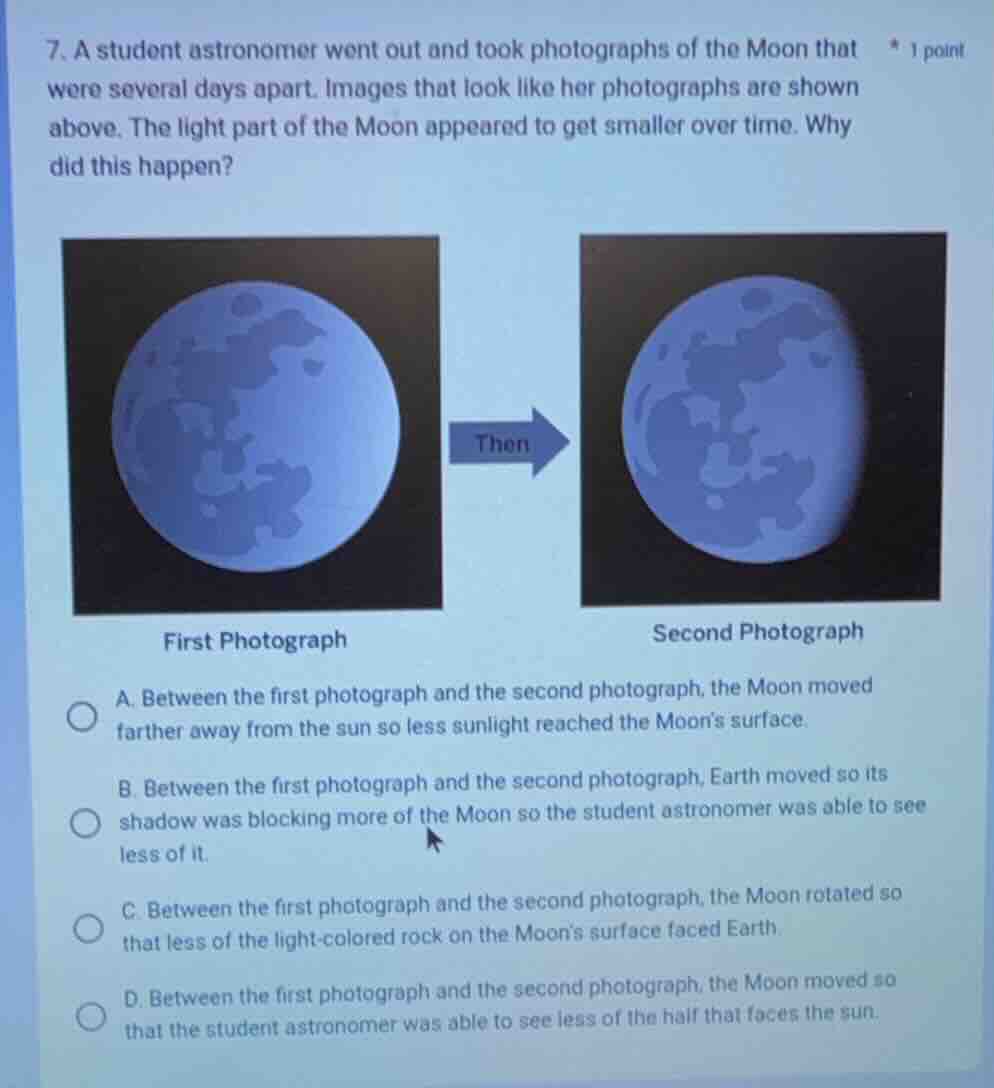
- a student astronomer went out and took photographs of the moon that were several days apart. images that look like her photographs are shown above. the light part of the moon appeared to get smaller over time. why did this happen?first photographsecond photographa. between the first photograph and the second photograph, the moon moved farther away from the sun so less sunlight reached the moons surface.b. between the first photograph and the second photograph, earth moved so its shadow was blocking more of the moon so the student astronomer was able to see less of it.c. between the first photograph and the second photograph, the moon rotated so that less of the light-colored rock on the moons surface faced earth.d. between the first photograph and the second photograph, the moon moved so that the student astronomer was able to see less of the half that faces the sun.
Brief Explanations
The Moon's phases change because of its orbital position relative to Earth and the Sun. When the illuminated part we see shrinks (waning phase), it is because as the Moon orbits Earth, we see less of the sunlit half of the Moon.
- Option A is wrong: the Moon's distance from the Sun does not change enough in a few days to reduce sunlight reaching it.
- Option B is wrong: this describes a lunar eclipse, which is a rare event, not the gradual daily shrinking of the illuminated Moon.
- Option C is wrong: the Moon is tidally locked, so it does not rotate to show different surface rocks in this way; we always see the same face of the Moon.
- Option D is correct: the Moon's orbit changes our view of its sunlit half, leading to a smaller visible illuminated portion.

Snap & solve any problem in the app
Get step-by-step solutions on Sovi AI
Photo-based solutions with guided steps
Explore more problems and detailed explanations
D. Between the first photograph and the second photograph, the Moon moved so that the student astronomer was able to see less of the half that faces the sun.