QUESTION IMAGE
Question
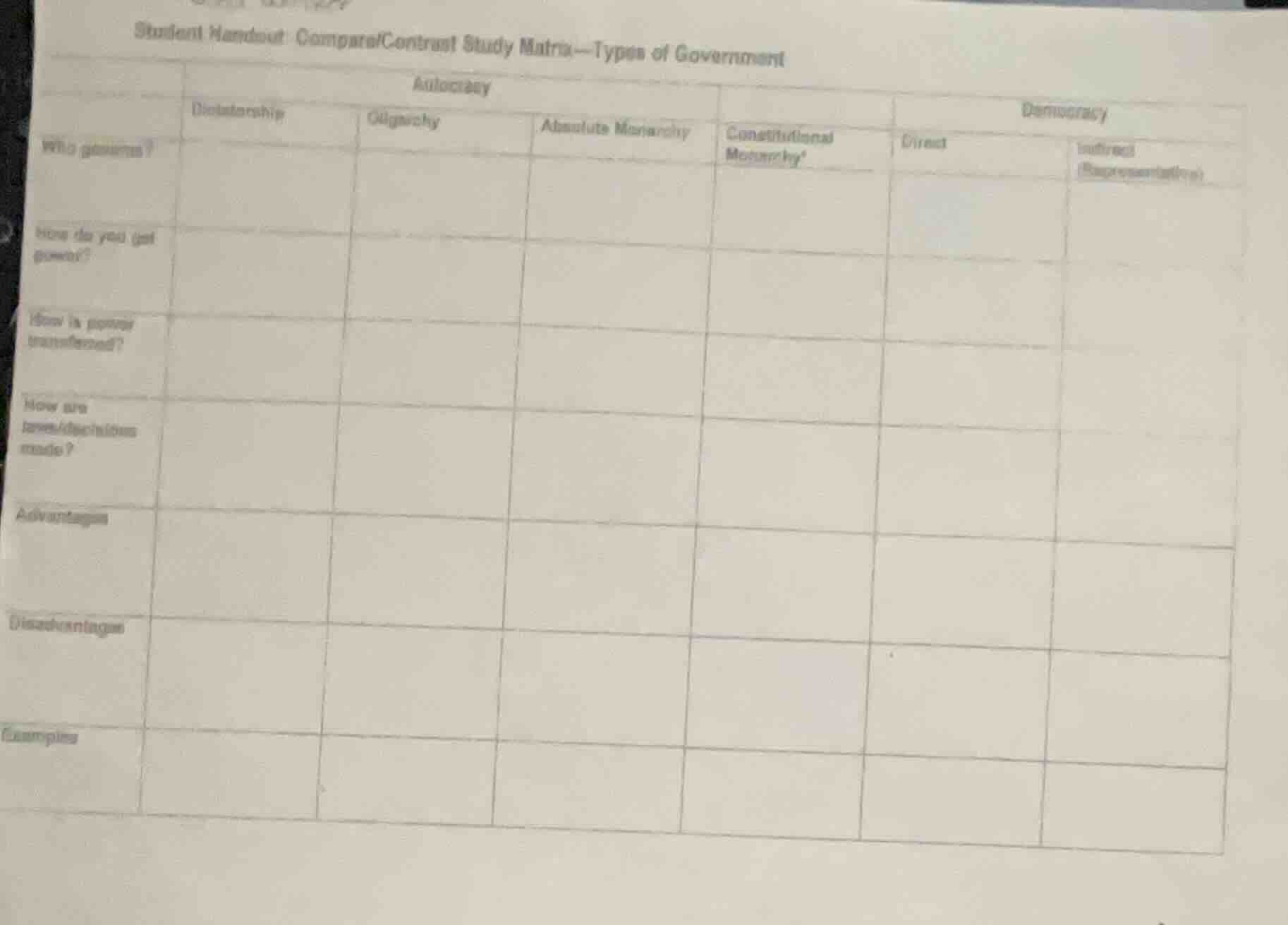
student handout: compare/contrast study matrix—types of government
authoritarian\t\t\t\t\t\tdemocracy
dictatorship\toligarchy\tabsolute monarchy\tconstitutional monarchy\tdirect\tindirect (representative)
who governs?
how do you get power?
how is power transferred?
how are laws/decisions made?
advantages
disadvantages
examples
Brief Explanations
This matrix compares key traits of autocratic and democratic government systems, with details filled based on core political science definitions and real-world examples.

Snap & solve any problem in the app
Get step-by-step solutions on Sovi AI
Photo-based solutions with guided steps
Explore more problems and detailed explanations
| Category | Dictatorship | Oligarchy | Absolute Monarchy | Constitutional Monarchy | Direct Democracy | Indirect (Representative) Democracy |
|---|---|---|---|---|---|---|
| How do you get power? | Force, coup, or coercion | Wealth, family, or military control | Hereditary succession | Monarch: hereditary; legislature: election | Citizen eligibility (age, citizenship) | Win competitive elections |
| How is power transferred? | Force, coup, or self-appointment | Elite internal selection | Hereditary (parent to child) | Hereditary (monarch); election (legislature) | No transfer (citizens retain power) | Election of new representatives |
| How are rules/decisions made? | Ruler's unilateral decree | Elite group consensus | Ruler's unilateral decree | Legislature passes laws; monarch signs | Citizen votes on all laws | Legislature debates and passes laws |
| Advantages | Fast decision-making | Stable elite expertise | Clear line of succession | Balanced tradition and democracy | Full citizen input | Efficient large-scale governance |
| Disadvantages | No citizen input; repression | Ignores majority needs | No citizen input | Monarch can block reforms | Slow for large populations | Representatives may prioritize self-interest |
| Examples | North Korea (Kim Jong-un) | Russian oligarchy | Saudi Arabia | United Kingdom | Ancient Athens; Switzerland (local) | United States; Canada; Germany |