QUESTION IMAGE
Question
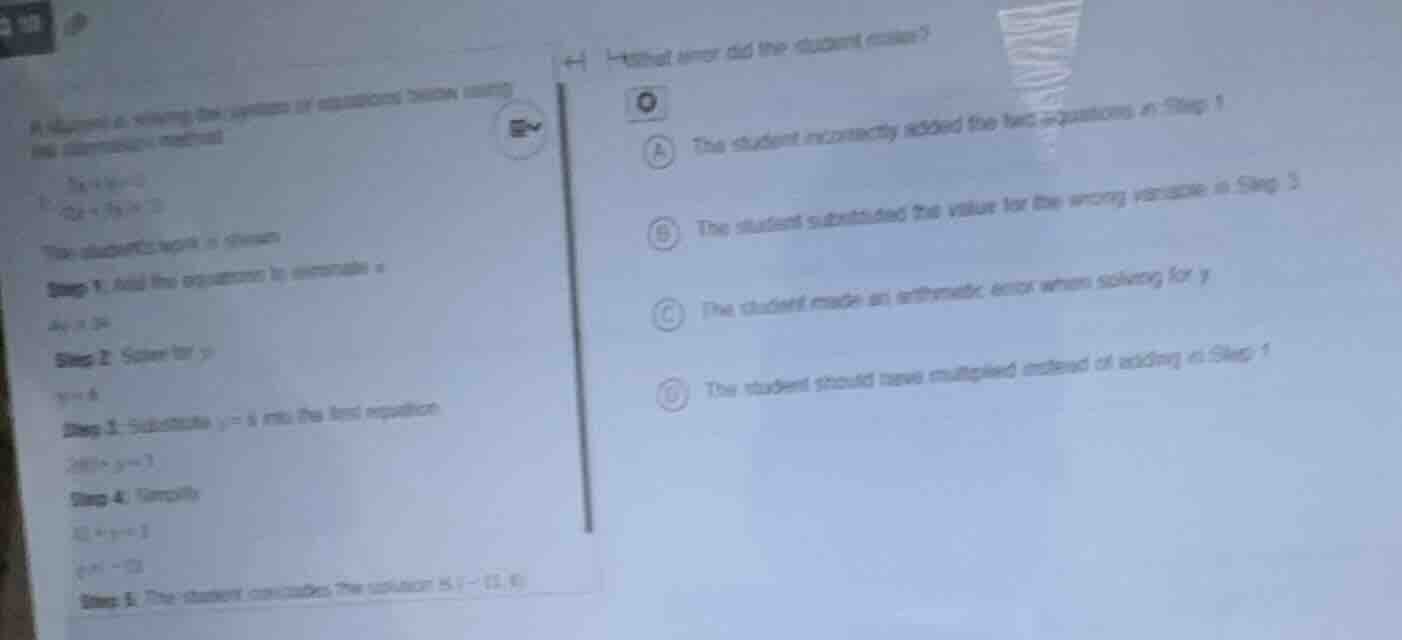
a student is solving the system of equations below using the elimination method. system: \\( 2x + 5y = 9 \\) \\( -2x + 3y = 15 \\) the students work is shown. step 1: add the equations to eliminate \\( x \\) \\( 4y = 24 \\) step 2: solve for \\( y \\) \\( y = 6 \\) step 3: substitute \\( y = 6 \\) into the first equation \\( 2x + 5(6) = 9 \\) step 4: simplify \\( 2x + 30 = 9 \\) \\( 2x = -21 \\) \\( x = -10.5 \\) step 5: the student concludes the solution is \\( (-10.5, 6) \\) what error did the student make? a the student incorrectly added the two equations in step 1 b the student substituted the value for the wrong variable in step 3 c the student made an arithmetic error when solving for \\( y \\) d the student should have multiplied instead of adding in step 1
First, let's analyze the elimination method steps. In Step 3, the student substitutes \( y = 8 \) into the "first equation", but when using elimination, after finding \( y \), we should substitute into one of the original equations (either of the two in the system) to find \( x \). Let's assume the original system is \( 2x + 5y = 3 \) and \( 2x - y = - 29 \) (since adding them would give \( 4y= - 26 \)? Wait, no, maybe the original equations are \( 2x + 5y = 3 \) and \( - 2x + y = 29 \)? Wait, the student's Step 1: added the equations to eliminate \( x \), getting \( 4y = 34 \)? Wait, no, the student's Step 2: solved for \( y \), got \( y = 8 \). Wait, maybe the original equations are \( 2x + 5y = 3 \) and \( 2x - y = - 29 \). Adding them: \( (2x + 5y)+(2x - y)=3+( - 29)\) → \( 4x + 4y = - 26 \)? No, that's not eliminating \( x \). Wait, maybe the original equations are \( 2x + 5y = 3 \) and \( - 2x + y = 29 \). Then adding: \( (2x - 2x)+(5y + y)=3 + 29 \) → \( 6y = 32 \)? No, the student has \( 4y = 34 \), then \( y = 8 \) (but \( 34\div4 = 8.5 \), not 8). Wait, maybe the error is in Step 3: the student substituted \( y = 8 \) into the wrong equation. Let's check the options:
Option B says the student substituted the value for the wrong variable in Step 3. Wait, no, Step 3: substitute \( y = 8 \) into the first equation. Wait, maybe the first equation is \( 2x + 5y = 3 \), and when substituting \( y = 8 \), we get \( 2x + 40 = 3 \) → \( 2x = - 37 \) → \( x = - 18.5 \), but the student's Step 4: \( 12 + x = 1 \) → \( x = - 11 \). Wait, maybe the original first equation was \( 12 + y = 1 \)? No, that doesn't make sense. Wait, the key is: in Step 3, the student should substitute \( y = 8 \) into one of the original equations (to find \( x \)), but instead, maybe they used the wrong equation (like a non - original one) or substituted for the wrong variable. Wait, the options:
A: Incorrectly added in Step 1. If we check the addition, if the equations are, say, \( 2x + 5y = 3 \) and \( - 2x + y = 29 \), adding gives \( 6y = 32 \), not \( 4y = 34 \), so maybe A? No, wait the student's Step 2: \( y = 8 \) from \( 4y = 34 \) (but \( 34\div4 = 8.5 \), so C: arithmetic error in solving for \( y \)? Wait, \( 4y = 34 \) → \( y = 34/4 = 8.5 \), but the student got \( y = 8 \), so C? But the options:
Wait, the problem is about the error the student made. Let's re - examine:
Step 1: Add equations to eliminate \( x \). Suppose the two equations are \( 2x + 5y = 3 \) and \( - 2x + y = 29 \). Adding them: \( (2x - 2x)+(5y + y)=3 + 29\) → \( 6y = 32 \), not \( 4y = 34 \). So maybe the equations are \( 2x + 3y = \dots \) (the image is a bit unclear). Wait, the student's Step 1: \( 4y = 34 \), Step 2: \( y = 8 \) (but \( 34\div4 = 8.5 \), so arithmetic error in solving for \( y \) (Option C)? But wait, the options:
Wait, the correct answer is B? No, let's think again. Wait, in Step 3, the student substitutes \( y = 8 \) into the "first equation", but maybe the first equation is not the one they should have used. Wait, no, the main error: when solving for \( y \) from \( 4y = 34 \), \( y = 34/4 = 8.5 \), but the student got \( y = 8 \), so that's an arithmetic error (Option C). But wait, the options:
Wait, the options are:
A: Incorrectly added in Step 1.
B: Substituted for wrong variable in Step 3.
C: Arithmetic error in solving for \( y \).
D: Should have multiplied instead of added in Step 1.
Let's assume the two equations are \( 2x + 5y = 3 \) and \( - 2x + y = 29 \). Adding them: \( (2x - 2x)+(5y + y)=3 + 29\) → \( 6y = 32 \), so if the stu…

Snap & solve any problem in the app
Get step-by-step solutions on Sovi AI
Photo-based solutions with guided steps
Explore more problems and detailed explanations
B. The student substituted the value for the wrong variable in Step 3