QUESTION IMAGE
Question
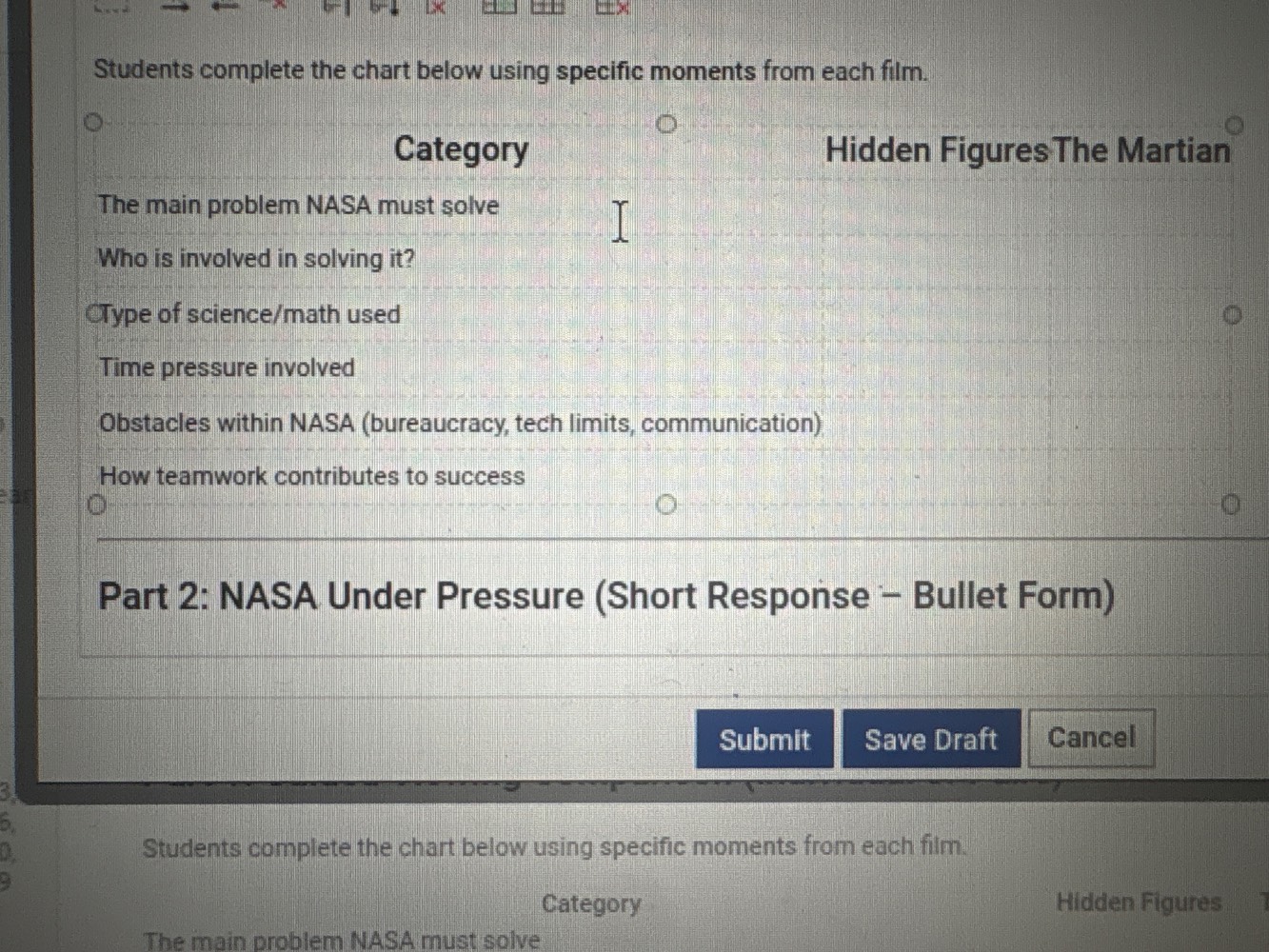
students complete the chart below using specific moments from each film.
category\thidden figures\tthe martian
the main problem nasa must solve\t\t
who is involved in solving it?\t\t
type of science/math used\t\t
time pressure involved\t\t
obstacles within nasa (bureaucracy, tech limits, communication)\t\t
how teamwork contributes to success\t\t
part 2: nasa under pressure (short response - bullet form)
submit\tsave draft\tcancel
students complete the chart below using specific moments from each fim.
category\thidden figures\t
the main problem nasa must solve\t
To complete the chart, we analyze each film:
For Hidden Figures:
- The main problem NASA must solve: Successfully launch and safely return John Glenn’s Friendship 7 mission (calculating orbital mechanics for a safe orbit and re - entry).
- Who is involved in solving it?: Katherine Johnson (for orbital calculations), Dorothy Vaughan (with IBM computer/team management), Mary Jackson (engineering support), plus NASA engineers, astronauts, and administrative staff.
- Type of science/math used: Orbital mechanics (calculus, trigonometry), computer science (early computing), engineering (aerospace).
- Time pressure involved: Tight deadline before Glenn’s launch; need for precise calculations quickly to ensure mission success.
- Obstacles within NASA (bureaucracy, tech limits, communication): Racial segregation (bureaucracy limiting Black employees’ roles), early computer technology limitations, communication gaps between departments.
- How teamwork contributes to success: Katherine’s calculations + Dorothy’s team’s computer work + Mary’s engineering + cross - department collaboration (e.g., engineers trusting Katherine’s math) enabled the launch.
For The Martian:
- The main problem NASA must solve: Rescue Mark Watney, who is stranded on Mars, and ensure a successful Mars - Earth return mission (including Mars ascent vehicle design, trajectory calculations, and Earth - Mars communication).
- Who is involved in solving it?: Mark Watney (self - reliance on Mars), NASA scientists (astrophysics, engineering), JPL (Jet Propulsion Laboratory) teams, astronauts (Hermes crew), and international space agencies (e.g., Chinese space program for booster support).
- Type of science/math used: Astrophysics (trajectory calculations, orbital mechanics), botany (Watney’s potato farm), engineering (Mars ascent vehicle design), chemistry (resource utilization on Mars).
- Time pressure involved: Watney’s limited resources (food, oxygen) on Mars; need to adjust mission timelines rapidly to intercept Watney.
- Obstacles within NASA (bureaucracy, tech limits, communication): Bureaucracy in approving risky rescue plans, technical limits of Mars - Earth communication (delay), and engineering challenges of modifying spacecraft.
- How teamwork contributes to success: Watney’s ingenuity + NASA’s global collaboration (e.g., JPL’s engineering, Chinese space agency’s help) + Hermes crew’s willingness to adjust mission led to rescue.
For Part 2 (NASA Under Pressure - Bullet Form), examples could be:
- Hidden Figures:
- Racial barriers slowed decision - making and resource allocation.
- Time - sensitive launch window forced rapid, accurate calculations.
- Interdepartmental communication gaps (e.g., between “colored” computing and engineering) needed bridging.
- The Martian:
- Technical limits (Mars - Earth communication delay) hindered real - time problem - solving.
- Bureaucracy in approving unorthodox rescue methods (e.g., risky trajectory changes) caused delays.
- Resource scarcity on Mars (food, oxygen) for Watney created urgent timelines.
If you need to fill the chart or focus on a specific section, clarify the exact requirement (e.g., one film, one category) for more targeted help!

Snap & solve any problem in the app
Get step-by-step solutions on Sovi AI
Photo-based solutions with guided steps
Explore more problems and detailed explanations
To complete the chart, we analyze each film:
For Hidden Figures:
- The main problem NASA must solve: Successfully launch and safely return John Glenn’s Friendship 7 mission (calculating orbital mechanics for a safe orbit and re - entry).
- Who is involved in solving it?: Katherine Johnson (for orbital calculations), Dorothy Vaughan (with IBM computer/team management), Mary Jackson (engineering support), plus NASA engineers, astronauts, and administrative staff.
- Type of science/math used: Orbital mechanics (calculus, trigonometry), computer science (early computing), engineering (aerospace).
- Time pressure involved: Tight deadline before Glenn’s launch; need for precise calculations quickly to ensure mission success.
- Obstacles within NASA (bureaucracy, tech limits, communication): Racial segregation (bureaucracy limiting Black employees’ roles), early computer technology limitations, communication gaps between departments.
- How teamwork contributes to success: Katherine’s calculations + Dorothy’s team’s computer work + Mary’s engineering + cross - department collaboration (e.g., engineers trusting Katherine’s math) enabled the launch.
For The Martian:
- The main problem NASA must solve: Rescue Mark Watney, who is stranded on Mars, and ensure a successful Mars - Earth return mission (including Mars ascent vehicle design, trajectory calculations, and Earth - Mars communication).
- Who is involved in solving it?: Mark Watney (self - reliance on Mars), NASA scientists (astrophysics, engineering), JPL (Jet Propulsion Laboratory) teams, astronauts (Hermes crew), and international space agencies (e.g., Chinese space program for booster support).
- Type of science/math used: Astrophysics (trajectory calculations, orbital mechanics), botany (Watney’s potato farm), engineering (Mars ascent vehicle design), chemistry (resource utilization on Mars).
- Time pressure involved: Watney’s limited resources (food, oxygen) on Mars; need to adjust mission timelines rapidly to intercept Watney.
- Obstacles within NASA (bureaucracy, tech limits, communication): Bureaucracy in approving risky rescue plans, technical limits of Mars - Earth communication (delay), and engineering challenges of modifying spacecraft.
- How teamwork contributes to success: Watney’s ingenuity + NASA’s global collaboration (e.g., JPL’s engineering, Chinese space agency’s help) + Hermes crew’s willingness to adjust mission led to rescue.
For Part 2 (NASA Under Pressure - Bullet Form), examples could be:
- Hidden Figures:
- Racial barriers slowed decision - making and resource allocation.
- Time - sensitive launch window forced rapid, accurate calculations.
- Interdepartmental communication gaps (e.g., between “colored” computing and engineering) needed bridging.
- The Martian:
- Technical limits (Mars - Earth communication delay) hindered real - time problem - solving.
- Bureaucracy in approving unorthodox rescue methods (e.g., risky trajectory changes) caused delays.
- Resource scarcity on Mars (food, oxygen) for Watney created urgent timelines.
If you need to fill the chart or focus on a specific section, clarify the exact requirement (e.g., one film, one category) for more targeted help!