QUESTION IMAGE
Question
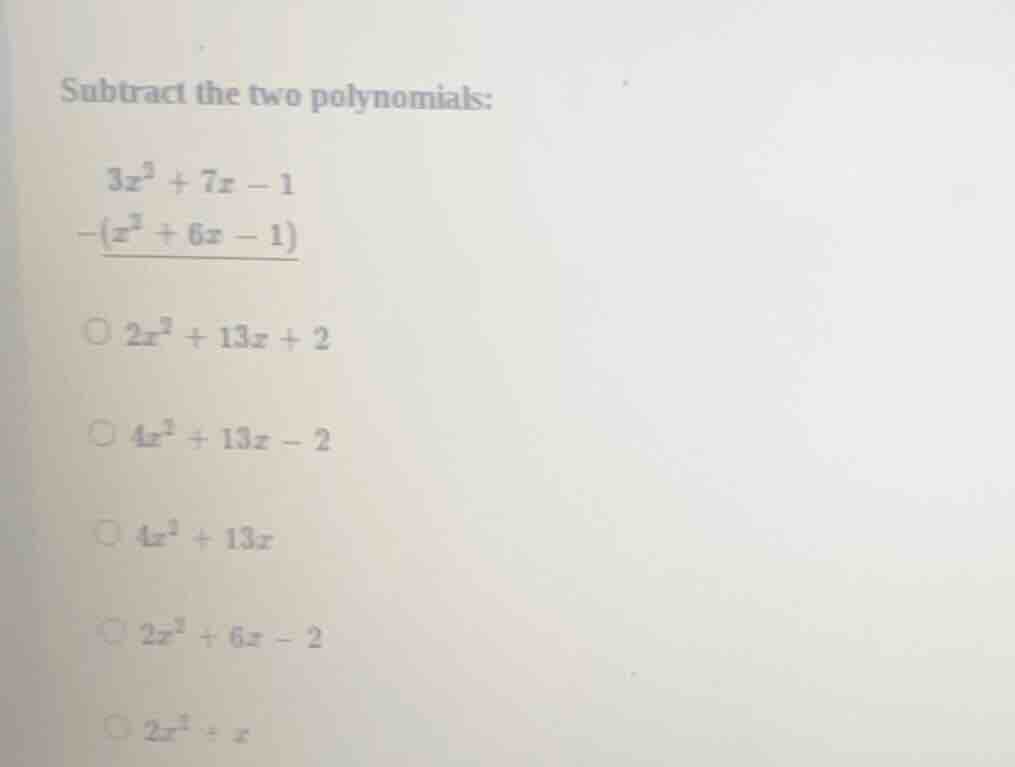
subtract the two polynomials:
\\( 3x^2 + 7x - 1
-(x^2 + 6x - 1)
\\)
\\( 2x^2 + 13x + 2
\\)
\\( 4x^2 + 13x - 2
\\)
\\( 4x^2 + 13x
\\)
\\( 2x^2 + 6x - 2
\\)
\\( 2x^2 + x
\\)
Step1: Distribute the negative sign
We have to subtract the second polynomial from the first. First, distribute the negative sign to each term in the second polynomial:
\(3x^2 + 7x - 1 - x^2 - 6x + 1\)
Step2: Combine like terms for \(x^2\) terms
The \(x^2\) terms are \(3x^2\) and \(-x^2\). Combining them: \(3x^2 - x^2 = 2x^2\) Wait, wait, no, wait the first polynomial is \(3x^2 + 7x - 1\) and we are subtracting \((x^2 + 6x - 1)\), so actually, let's re - do the sign distribution correctly. The problem is \(3x^2+7x - 1-(x^2 + 6x - 1)=3x^2+7x - 1 - x^2-6x + 1\)
Wait, maybe I misread the first polynomial. Wait, looking at the problem again, the first polynomial is \(3x^2+7x - 1\)? Wait no, maybe it's \(3x^2\)? Wait no, the user wrote:
Wait the first polynomial is \(3x^2 + 7x-1\) and we are subtracting \((x^2 + 6x - 1)\)? Wait no, maybe the first polynomial is \(3x^2+7x - 1\) and the second is \(x^2 + 6x - 1\), so when we subtract:
\((3x^2+7x - 1)-(x^2 + 6x - 1)=3x^2+7x - 1 - x^2-6x + 1\)
Now combine \(x^2\) terms: \(3x^2 - x^2=2x^2\)
Combine \(x\) terms: \(7x-6x = x\)
Combine constant terms: \(-1 + 1=0\)
Wait that gives \(2x^2+x\), which is one of the options (the last one, but written as \(2x^2 + x\) maybe a typo in the original problem's option, maybe the first polynomial was \(3x^2\) or maybe I misread. Wait no, maybe the first polynomial is \(3x^2+7x - 1\) and the second is \(-(x^2 + 6x - 1)\) but the way it's written is a subtraction. Wait, maybe the original problem has a typo, but let's check the options. Wait the last option is \(2x^2 + x\) (maybe written as \(2x^2 + x\) instead of \(2x^2\div x\) which is a typo). Let's re - do the calculation:
\((3x^2+7x - 1)-(x^2 + 6x - 1)\)
\(=3x^2+7x - 1 - x^2-6x + 1\)
\(=(3x^2 - x^2)+(7x-6x)+(-1 + 1)\)
\(=2x^2+x+0=2x^2 + x\)
Which matches the last option (assuming the \(\div\) is a typo for \(+\)).
Wait but maybe I misread the first polynomial. Wait if the first polynomial was \(3x^2+7x - 1\) and the second is \(x^2 + 6x - 1\), then the subtraction gives \(2x^2+x\). Let's check the options:
The last option is \(2x^2 + x\) (probably a typo in the original, maybe the \(\div\) is \(+\)).

Snap & solve any problem in the app
Get step-by-step solutions on Sovi AI
Photo-based solutions with guided steps
Explore more problems and detailed explanations
The correct option is the last one (assuming the \(\div\) is a typo), which should be written as \(2x^2 + x\) (the option with \(2x^2 + x\), likely a typo in the original problem's option formatting). If we strictly follow the calculation:
\((3x^2 + 7x-1)-(x^2 + 6x - 1)=3x^2+7x - 1 - x^2-6x + 1=2x^2+x\)
So the answer is the option \(2x^2 + x\) (the last option, assuming the \(\div\) is a typo for \(+\)).