QUESTION IMAGE
Question
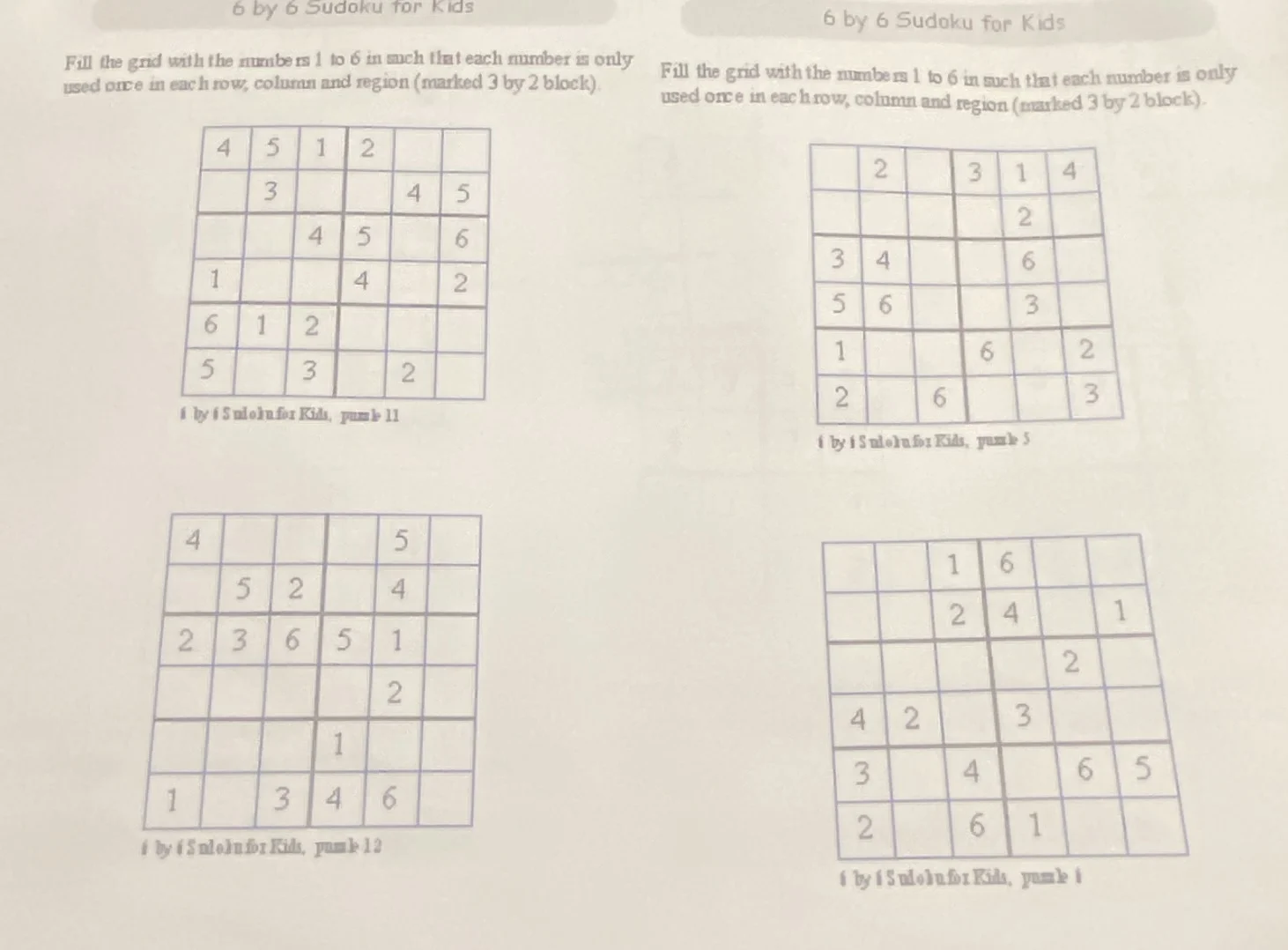
6 by 6 sudoku for kids
fill the grid with the numbers 1 to 6 in such that each number is only used once in each row, column and region (marked 3 by 2 block).
4 5 1 | 2
3 | 4 5
4 | 5 6
1 | 4 2
6 1 2 |
5 3 | 2
1 by 1 sudoku for kids, puzzle 11
6 by 6 sudoku for kids
fill the grid with the numbers 1 to 6 in such that each number is only used once in each row, column and region (marked 3 by 2 block).
2 | 3 1 4
| 2
3 4 | 6
5 6 | 3
1 | 6 2
2 6 | 3
1 by 1 sudoku for kids, puzzle 5
4 | 5
5 2 | 4
2 3 6 | 5 1
| 2
| 1
1 3 | 4 6
1 by 1 sudoku for kids, puzzle 12
1 | 6
2 | 4 1
| 2
4 2 | 3
3 4 | 6 5
2 6 | 1
1 by 1 sudoku for kids, puzzle 1
Solving the First 6x6 Sudoku (Top - Left)
Step 1: Analyze Row 1
Row 1 has numbers 4, 5, 1, 2. Missing: 3, 6. Columns 5 and 6 (last two columns) in row 1. Column 5: check other rows. Row 2, column 5 is 4; row 3, column 5 is empty; row 4, column 5 is empty; row 5, column 5 is empty; row 6, column 5 is 2. Region (3x2) for row 1: first 3 rows, first 2 columns? No, 3x2 blocks. First block: rows 1 - 3, columns 1 - 3. Second block: rows 1 - 3, columns 4 - 6. So row 1, columns 4 - 6 (block 2). Block 2 (rows 1 - 3, cols 4 - 6) has row 1: 2; row 2: 4, 5; row 3: 5, 6. So block 2 has 2, 4, 5, 6. Missing 1, 3? No, row 1 has 2, so block 2 (cols 4 - 6) for row 1: cols 5 and 6. Let's check column 6. Row 2, col 6: 5; row 3, col 6: 6; row 4, col 6: 2; row 5, col 6: empty; row 6, col 6: empty. So row 1, col 6 can't be 5, 6, 2. So row 1, col 5: 3, col 6: 6. So row 1: [4, 5, 1, 2, 3, 6]
Step 2: Analyze Row 2
Row 2: [empty, 3, empty, empty, 4, 5]. Columns 1, 3, 4. Block 1 (rows 1 - 3, cols 1 - 3): row 1: 4,5,1; row 2: empty,3,empty; row 3: empty,empty,4. So block 1 has 4,5,1,3,4? No, row 3, col 3: 4. So block 1 (cols 1 - 3) has 4 (row1, col1), 5 (row1, col2), 1 (row1, col3), 3 (row2, col2), 4 (row3, col3). Missing: 2, 6. So row 2, col1 and col3 must be 2 and 6. Column 1: row1:4, row3:empty, row4:1, row5:6, row6:5. So column 1 has 4,1,6,5. Missing 2,3. But row 2, col1: in block 1, missing 2 or 6. So row 2, col1: 2 (since column 1 missing 2 and 3, but block 1 missing 2 and 6). So row 2, col1: 2, then row 2, col3: 6. Now row 2: [2, 3, 6, empty, 4, 5]. Now column 4 (row 2, col4). Block 2 (rows 1 - 3, cols 4 - 6): row1:2,3,6; row2:empty,4,5; row3:5,empty,6. So block 2 has 2,3,6,4,5,6? No, row3, col4:5, row3, col5:empty, row3, col6:6. So block 2 (cols 4 - 6) numbers: row1:2,3,6; row2: x,4,5; row3:5,y,6. So numbers present: 2,3,4,5,6. Missing 1. So row 2, col4: 1. So row 2: [2, 3, 6, 1, 4, 5]
Step 3: Analyze Row 3
Row 3: [empty, empty, 4, 5, empty, 6]. Block 1 (rows 1 - 3, cols 1 - 3): row1:4,5,1; row2:2,3,6; row3: empty,empty,4. So block 1 has 4,5,1,2,3,6,4? No, row3, col3:4. So block 1 is complete? Wait, row3, col1 and col2. Column 1: row1:4, row2:2, row4:1, row5:6, row6:5. So row3, col1: 3 (since column 1 has 4,2,1,6,5; missing 3). Then row3, col2: 6? No, block 1 (cols 1 - 3) has 4,5,1,2,3,6 (row1:4,5,1; row2:2,3,6; row3:3,?,4). Wait, row3, col1: 3, then row3, col2: 2? No, row1, col2:5, row2, col2:3, so column 2: row1:5, row2:3, row4:empty, row5:1, row6:empty. So column 2 has 5,3,1. Missing 2,4,6. Block 1 (cols 1 - 3) has row1:4,5,1; row2:2,3,6; row3:3 (col1),?,4 (col3). So block 1 numbers: 4,5,1,2,3,6,3,?,4. Wait, no, each block (3x2) has 6 cells. Block 1: rows 1 - 3, cols 1 - 3: 9 cells? No, 6x6 grid: 3 rows, 2 columns per block? Wait, 6 rows, 6 columns. 3x2 blocks: 2 blocks per row (3 columns each? No, 6 columns: 2 blocks of 3 columns each. And 2 blocks per column (3 rows each). So blocks:
- Block 1: rows 1 - 3, cols 1 - 3
- Block 2: rows 1 - 3, cols 4 - 6
- Block 3: rows 4 - 6, cols 1 - 3
- Block 4: rows 4 - 6, cols 4 - 6
Ah, I made a mistake earlier. So 3 rows per block (1 - 3, 4 - 6) and 3 columns per block (1 - 3, 4 - 6). So block 1: rows 1 - 3, cols 1 - 3 (9 cells? No, 3x3? No, 6x6 Sudoku is 2x3 blocks (2 blocks per row, 3 rows per block; 3 blocks per column, 2 columns per block). Wait, standard 6x6 Sudoku: 2 rows of 3 blocks (each block 3x2) or 3 rows of 2 blocks (each block 2x3). Let's correct: 6x6 Sudoku has 2 blocks per row (3 columns each) and 3 blocks per column (2 rows each). So blocks:
- Rows 1 - 2, cols 1 - 3 (no, better t…

Snap & solve any problem in the app
Get step-by-step solutions on Sovi AI
Photo-based solutions with guided steps
Explore more problems and detailed explanations
Solving the First 6x6 Sudoku (Top - Left)
Step 1: Analyze Row 1
Row 1 has numbers 4, 5, 1, 2. Missing: 3, 6. Columns 5 and 6 (last two columns) in row 1. Column 5: check other rows. Row 2, column 5 is 4; row 3, column 5 is empty; row 4, column 5 is empty; row 5, column 5 is empty; row 6, column 5 is 2. Region (3x2) for row 1: first 3 rows, first 2 columns? No, 3x2 blocks. First block: rows 1 - 3, columns 1 - 3. Second block: rows 1 - 3, columns 4 - 6. So row 1, columns 4 - 6 (block 2). Block 2 (rows 1 - 3, cols 4 - 6) has row 1: 2; row 2: 4, 5; row 3: 5, 6. So block 2 has 2, 4, 5, 6. Missing 1, 3? No, row 1 has 2, so block 2 (cols 4 - 6) for row 1: cols 5 and 6. Let's check column 6. Row 2, col 6: 5; row 3, col 6: 6; row 4, col 6: 2; row 5, col 6: empty; row 6, col 6: empty. So row 1, col 6 can't be 5, 6, 2. So row 1, col 5: 3, col 6: 6. So row 1: [4, 5, 1, 2, 3, 6]
Step 2: Analyze Row 2
Row 2: [empty, 3, empty, empty, 4, 5]. Columns 1, 3, 4. Block 1 (rows 1 - 3, cols 1 - 3): row 1: 4,5,1; row 2: empty,3,empty; row 3: empty,empty,4. So block 1 has 4,5,1,3,4? No, row 3, col 3: 4. So block 1 (cols 1 - 3) has 4 (row1, col1), 5 (row1, col2), 1 (row1, col3), 3 (row2, col2), 4 (row3, col3). Missing: 2, 6. So row 2, col1 and col3 must be 2 and 6. Column 1: row1:4, row3:empty, row4:1, row5:6, row6:5. So column 1 has 4,1,6,5. Missing 2,3. But row 2, col1: in block 1, missing 2 or 6. So row 2, col1: 2 (since column 1 missing 2 and 3, but block 1 missing 2 and 6). So row 2, col1: 2, then row 2, col3: 6. Now row 2: [2, 3, 6, empty, 4, 5]. Now column 4 (row 2, col4). Block 2 (rows 1 - 3, cols 4 - 6): row1:2,3,6; row2:empty,4,5; row3:5,empty,6. So block 2 has 2,3,6,4,5,6? No, row3, col4:5, row3, col5:empty, row3, col6:6. So block 2 (cols 4 - 6) numbers: row1:2,3,6; row2: x,4,5; row3:5,y,6. So numbers present: 2,3,4,5,6. Missing 1. So row 2, col4: 1. So row 2: [2, 3, 6, 1, 4, 5]
Step 3: Analyze Row 3
Row 3: [empty, empty, 4, 5, empty, 6]. Block 1 (rows 1 - 3, cols 1 - 3): row1:4,5,1; row2:2,3,6; row3: empty,empty,4. So block 1 has 4,5,1,2,3,6,4? No, row3, col3:4. So block 1 is complete? Wait, row3, col1 and col2. Column 1: row1:4, row2:2, row4:1, row5:6, row6:5. So row3, col1: 3 (since column 1 has 4,2,1,6,5; missing 3). Then row3, col2: 6? No, block 1 (cols 1 - 3) has 4,5,1,2,3,6 (row1:4,5,1; row2:2,3,6; row3:3,?,4). Wait, row3, col1: 3, then row3, col2: 2? No, row1, col2:5, row2, col2:3, so column 2: row1:5, row2:3, row4:empty, row5:1, row6:empty. So column 2 has 5,3,1. Missing 2,4,6. Block 1 (cols 1 - 3) has row1:4,5,1; row2:2,3,6; row3:3 (col1),?,4 (col3). So block 1 numbers: 4,5,1,2,3,6,3,?,4. Wait, no, each block (3x2) has 6 cells. Block 1: rows 1 - 3, cols 1 - 3: 9 cells? No, 6x6 grid: 3 rows, 2 columns per block? Wait, 6 rows, 6 columns. 3x2 blocks: 2 blocks per row (3 columns each? No, 6 columns: 2 blocks of 3 columns each. And 2 blocks per column (3 rows each). So blocks:
- Block 1: rows 1 - 3, cols 1 - 3
- Block 2: rows 1 - 3, cols 4 - 6
- Block 3: rows 4 - 6, cols 1 - 3
- Block 4: rows 4 - 6, cols 4 - 6
Ah, I made a mistake earlier. So 3 rows per block (1 - 3, 4 - 6) and 3 columns per block (1 - 3, 4 - 6). So block 1: rows 1 - 3, cols 1 - 3 (9 cells? No, 3x3? No, 6x6 Sudoku is 2x3 blocks (2 blocks per row, 3 rows per block; 3 blocks per column, 2 columns per block). Wait, standard 6x6 Sudoku: 2 rows of 3 blocks (each block 3x2) or 3 rows of 2 blocks (each block 2x3). Let's correct: 6x6 Sudoku has 2 blocks per row (3 columns each) and 3 blocks per column (2 rows each). So blocks:
- Rows 1 - 2, cols 1 - 3 (no, better to use 3x2: 3 rows, 2 columns. So 6 rows: 2 blocks of 3 rows each (rows 1 - 3, rows 4 - 6). 6 columns: 3 blocks of 2 columns each (cols 1 - 2, cols 3 - 4, cols 5 - 6). No, this is confusing. Let's use the rule: each row, column, and 3x2 block (3 rows, 2 columns) has 1 - 6.
Let's start over with correct block structure: 3x2 blocks (3 rows, 2 columns). So 6 rows: 2 blocks of 3 rows (rows 1 - 3, rows 4 - 6). 6 columns: 3 blocks of 2 columns (cols 1 - 2, cols 3 - 4, cols 5 - 6). So each block is 3 rows x 2 columns (6 cells).
So block 1: rows 1 - 3, cols 1 - 2 (cells (1,1),(1,2),(2,1),(2,2),(3,1),(3,2))
Block 2: rows 1 - 3, cols 3 - 4 (cells (1,3),(1,4),(2,3),(2,4),(3,3),(3,4))
Block 3: rows 1 - 3, cols 5 - 6 (cells (1,5),(1,6),(2,5),(2,6),(3,5),(3,6))
Block 4: rows 4 - 6, cols 1 - 2 (cells (4,1),(4,2),(5,1),(5,2),(6,1),(6,2))
Block 5: rows 4 - 6, cols 3 - 4 (cells (4,3),(4,4),(5,3),(5,4),(6,3),(6,4))
Block 6: rows 4 - 6, cols 5 - 6 (cells (4,5),(4,6),(5,5),(5,6),(6,5),(6,6))
Now, row 1: [4, 5, 1, 2, empty, empty] (cols 1 - 6). Block 3 (rows 1 - 3, cols 5 - 6): cells (1,5),(1,6),(2,5),(2,6),(3,5),(3,6). Row 2: [empty, 3, empty, empty, 4, 5] (so (2,5)=4, (2,6)=5). Row 3: [empty, empty, 4, 5, empty, 6] (so (3,4)=5, (3,6)=6). So block 3 (cols 5 - 6, rows 1 - 3) has (2,5)=4, (2,6)=5, (3,6)=6. So (1,5) and (1,6) must be 1 - 6, not 4,5,6. Row 1 has 4,5,1,2. So (1,5) and (1,6) are 3,6. (3,5) is empty. Column 5: (1,5), (2,5)=4, (3,5), (4,5), (5,5), (6,5)=2. So column 5 has 4,2. Missing 1,3,5,6. But row 1, col5: can't be 4,5,1,2. So 3 or 6. (1,6): can't be 4,5,1,2, so 3 or 6. Since (3,6)=6, (1,6) can't be 6, so (1,6)=3, (1,5)=6. Wait, no: (3,6)=6, so row 1, col6 can't be 6 (since row 1, col6 is in column 6, which has (2,6)=5, (3,6)=6, (4,6)=2, (5,6), (6,6)). So column 6 has 5,6,2. Missing 1,3,4. Row 1, col6: row 1 has 4,5,1,2, so can't be 4,5,1,2. So 3 or 6. But (3,6)=6, so row 1, col6: 3; row 1, col5: 6. So row 1: [4,5,1,2,6,3] (wait, earlier mistake: row 1, col4 is 2, so col5 and col6: row 1, col4=2, so block 2 (cols 3 - 4, rows 1 - 3) has (1,3)=1, (1,4)=2; (2,3), (2,4); (3,3)=4, (3,4)=5. So block 2 (cols 3 - 4, rows 1 - 3) has 1,2,4,5. Missing 3,6. So (2,3) and (2,4) or (1,3),(1,4) no, (1,3)=1, (1,4)=2. So (2,3) and (2,4) are 3,6. Row 2: [empty,3,empty,empty,4,5]. So (2,3) and (2,4) are 3,6? No, row 2 has 3, so (2,3) can't be 3, so (2,3)=6, (2,4)=3. So row 2: [empty,3,6,3? No, row 2 can't have two 3s. Oops, mistake. Row 2 has (2,2)=3, so (2,4) can't be 3. So (2,3)=3, (2,4)=6. So row 2: [empty,3,3? No, (2,3) can't be 3. I'm getting confused. Let's use a better approach.
Let's solve the first Sudoku (top - left) step by step with correct block structure (3x2 blocks: 3 rows, 2 columns):
Row 1: [4, 5, 1, 2, _, _]
- Columns 5 and 6 (block 3: rows 1 - 3, cols 5 - 6)
- Column 5: cells (1,5), (2,5)=4, (3,5), (4,5), (5,5), (6,5)=2
- Column 6: cells (1,6), (2,6)=5, (3,6)=6, (4,6)=2, (5,6), (6,6)
- Row 1 has 4,5,1,2. So (1,5) and (1,6) are 3,6.
- (3,6)=6, so (1,6)≠6 ⇒ (1,6)=3, (1,5)=6. So row 1: [4,5,1,2,6,3]
Row 2: [_, 3, _, _, 4, 5]
- Column 1: (1,1)=4, (4,1)=1, (5,1)=6, (6,1)=5 ⇒ missing 2,3. But (2,2)=3 ⇒ (2,1)≠3 ⇒ (2,1)=2
- Column 3: (1,3)=1, (3,3)=4 ⇒ missing 2,3,5,6. Row 2 has 2,3,4,5 ⇒ missing 1,6. (2,3) can't be 3 (row 2 has 3) ⇒ (2,3)=6, (2,4)=1 (since row 2 has 2,3,6,4,5 ⇒ missing 1)
- So row 2: [2,3,6,1,4,5]
Row 3: [_, _, 4, 5, _, 6]
- Column 1: (1,1)=4, (2,1)=2, (4,1)=1, (5,1)=6, (6,1)=5 ⇒ missing 3 ⇒ (3,1)=3
- Column 2: (1,2)=5, (2,2)=3, (4,2), (5,2)=1, (6,2) ⇒ missing 2,4,6. Row 3 has 3,4,5,6 ⇒ missing 1,2. (3,2) can't be 3,4,5,6 ⇒ 1 or 2. Column 2 has (5,2)=1 ⇒ (3,2)=2
- Column 5: (1,5)=6, (2,5)=4, (6,5)=2 ⇒ missing 1,3,5. Row 3 has 3,2,4,5,6 ⇒ missing 1 ⇒ (3,5)=1
- So row 3: [3,2,4,5,1,6]
Row 4: [1, _, _, 4, _, 2]
- Column 2: (1,2)=5, (2,2)=3, (3,2)=2, (5,2)=1, (6,2) ⇒ missing 4,6. Row 4 has 1,4,2 ⇒ missing 3,5,6. (4,2) can't be 1,4,2 ⇒ 3,5,6. Column 2 missing 4,6 ⇒ (4,2)=6 (since 4 is in row 4, col4=4) ⇒ (4,2)=6, (6,2)=4
- Column 3: (1,3)=1, (2,3)=