QUESTION IMAGE
Question
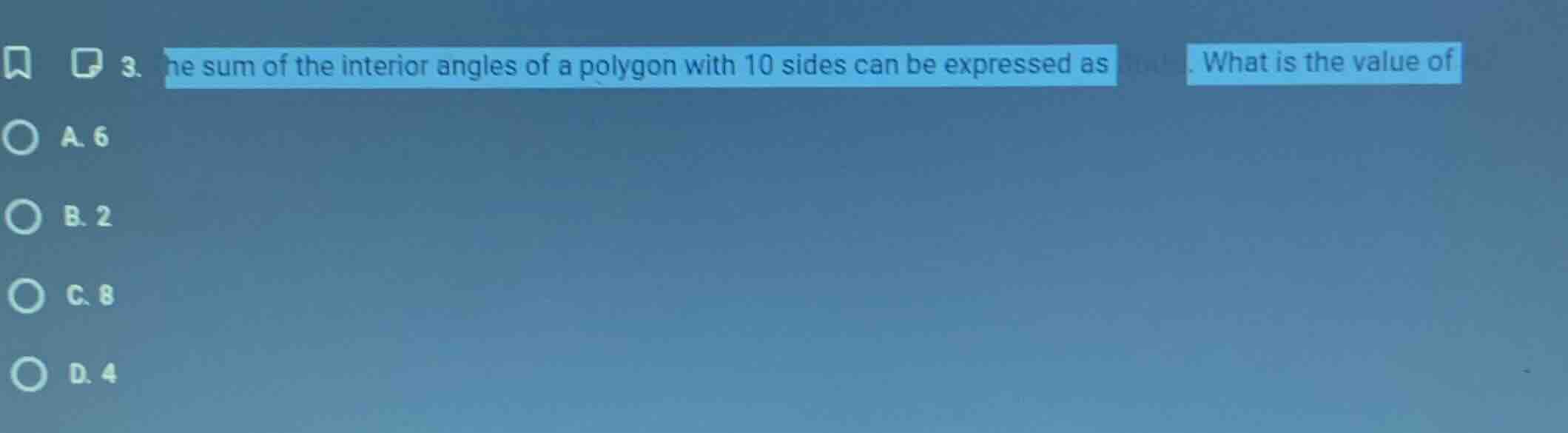
- the sum of the interior angles of a polygon with 10 sides can be expressed as. what is the value of
a. 6
b. 2
c. 8
d. 4
Step1: Recall the formula for the sum of interior angles of a polygon
The formula for the sum of the interior angles of a polygon with \( n \) sides is \( (n - 2)\times180^{\circ} \). For a 10 - sided polygon, \( n = 10 \).
Step2: Identify the relevant part for the unknown value
We assume the expression for the sum is in the form related to \( (n - 2) \) (since the sum formula has \( n-2 \) as a factor). When \( n = 10 \), \( n - 2=10 - 2 = 8 \)? Wait, no, maybe there is a typo or mis - expression. Wait, if we consider the formula \( (n - 2)\times180^{\circ} \), for \( n = 10 \), \( n-2 = 8 \)? But the options are 6,2,8,4. Wait, maybe the question is about the number of triangles formed? Wait, the sum of interior angles of a polygon can also be thought of as the sum of angles of \( (n - 2) \) triangles. For a polygon with \( n \) sides, the number of triangles formed by drawing diagonals from one vertex is \( n - 2 \). For \( n = 10 \), \( n-2=8 \)? But the options have 8 as option C. Wait, maybe the original question was about the number of triangles or the coefficient. Wait, let's re - evaluate. If the sum is \( (n - 2)\times180 \), for \( n = 10 \), \( n - 2=8 \). So if the expression was related to \( (n - 2) \), then the value is 8.

Snap & solve any problem in the app
Get step-by-step solutions on Sovi AI
Photo-based solutions with guided steps
Explore more problems and detailed explanations
C. 8