QUESTION IMAGE
Question
summarizing: informational text — quiz — level h
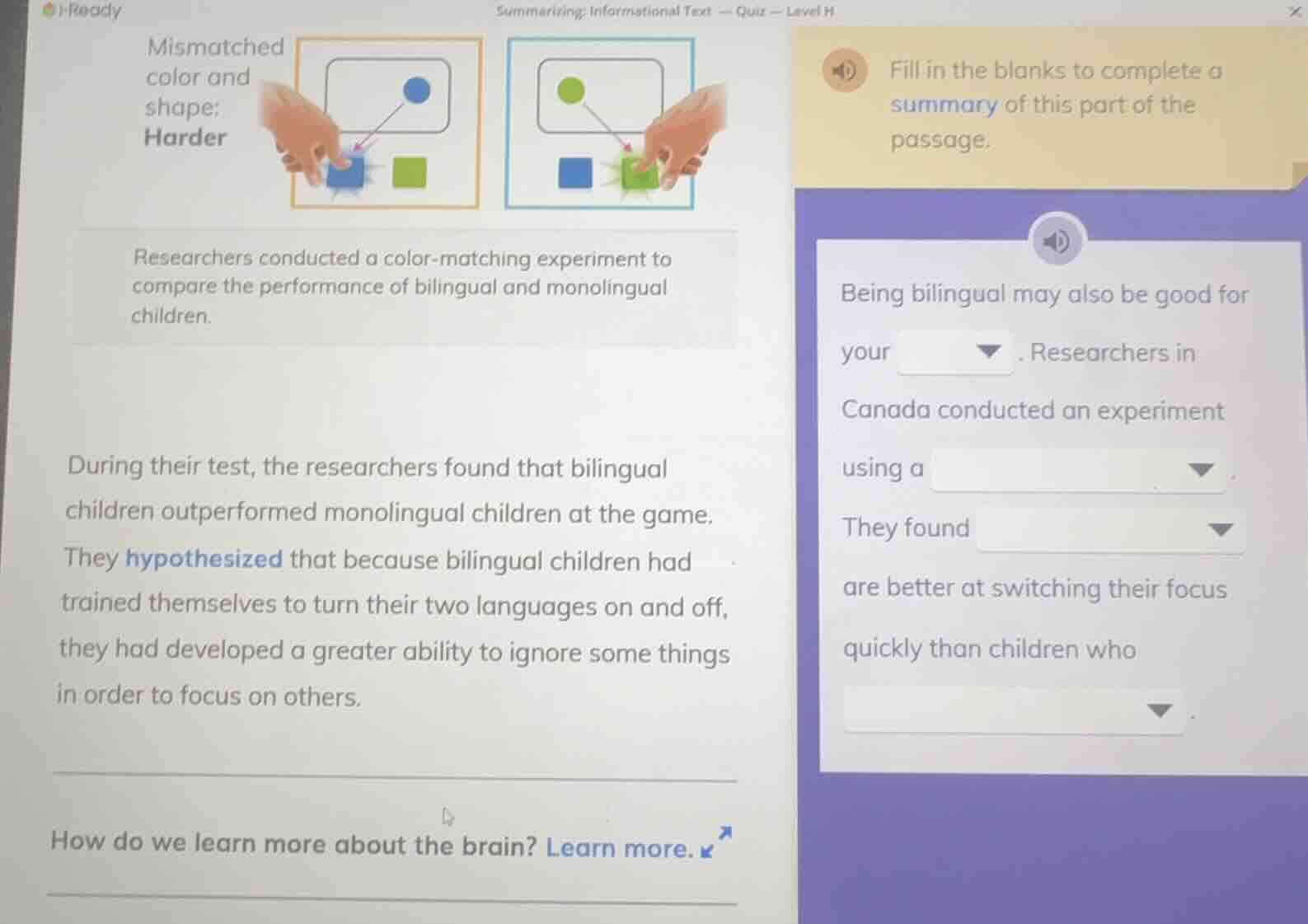
mismatched color and shape:
harder
researchers conducted a color-matching experiment to compare the performance of bilingual and monolingual children.
during their test, the researchers found that bilingual children outperformed monolingual children at the game. they hypothesized that because bilingual children had trained themselves to turn their two languages on and off, they had developed a greater ability to ignore some things in order to focus on others.
how do we learn more about the brain? learn more.
fill in the blanks to complete a summary of this part of the passage.
being bilingual may also be good for your ▼. researchers in canada conducted an experiment using a ▼. they found ▼ are better at switching their focus quickly than children who ▼.
The passage focuses on how bilingualism relates to cognitive ability, using a color-matching experiment with mismatched shapes/colors. The blanks are filled by extracting key details from the provided text:
- The experiment links bilingualism to brain/cognitive benefits, so "brain" fits the first blank.
- The experiment uses a harder mismatched color-and-shape game, which is the test tool.
- The core finding is that bilingual children outperformed monolingual peers in this task.
- The comparison group is monolingual children, who only speak one language.

Snap & solve any problem in the app
Get step-by-step solutions on Sovi AI
Photo-based solutions with guided steps
Explore more problems and detailed explanations
Being bilingual may also be good for your brain. Researchers in Canada conducted an experiment using a harder mismatched color and shape game. They found bilingual children are better at switching their focus quickly than children who are monolingual (speak only one language).