QUESTION IMAGE
Question
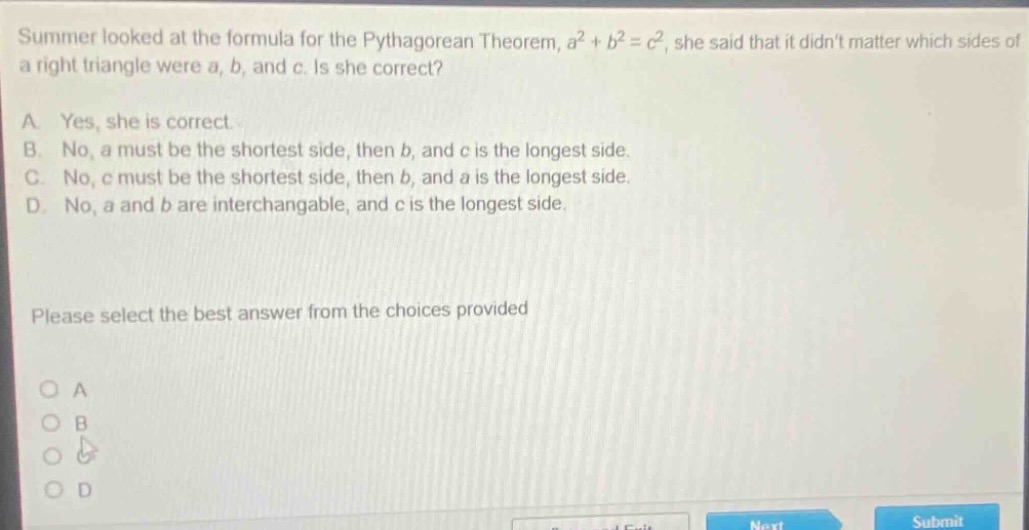
summer looked at the formula for the pythagorean theorem, $a^2 + b^2 = c^2$, she said that it didnt matter which sides of a right triangle were $a$, $b$, and $c$. is she correct?
a. yes, she is correct.
b. no, $a$ must be the shortest side, then $b$, and $c$ is the longest side.
c. no, $c$ must be the shortest side, then $b$, and $a$ is the longest side.
d. no, $a$ and $b$ are interchangeable, and $c$ is the longest side.
please select the best answer from the choices provided
a
b
c
d
Step1: Recall Pythagorean Theorem definition
In a right triangle, the Pythagorean Theorem states $a^2 + b^2 = c^2$, where $c$ is the hypotenuse (the longest side opposite the right angle), and $a, b$ are the two shorter legs.
Step2: Analyze variable interchangeability
Addition is commutative, so $a^2 + b^2 = b^2 + a^2$. This means $a$ and $b$ can be swapped without changing the equation. However, $c$ must always be the hypotenuse (longest side), as it represents the square root of the sum of the squares of the legs, making it larger than either $a$ or $b$.
Step3: Evaluate options
Option A is wrong because $c$ cannot be any side. Options B and C are wrong because $a$ and $b$ do not need a specific length order, and $c$ cannot be the shortest side. Option D matches the correct properties.

Snap & solve any problem in the app
Get step-by-step solutions on Sovi AI
Photo-based solutions with guided steps
Explore more problems and detailed explanations
D. No, a and b are interchangable, and c is the longest side.