QUESTION IMAGE
Question
suppose that each point in the coordinate plane is shifted 4 units to the right and 5 units upward. (a) the point (6, 8) is shifted to what new point? ((x,y)=left(10,13
ight)) (b) the point ((a, b)) is shifted to what new point? ((x,y)=left(a + 4,b + 5
ight)) (c) what point is shifted to ((4, 3))? ((x,y)=left(0,-2
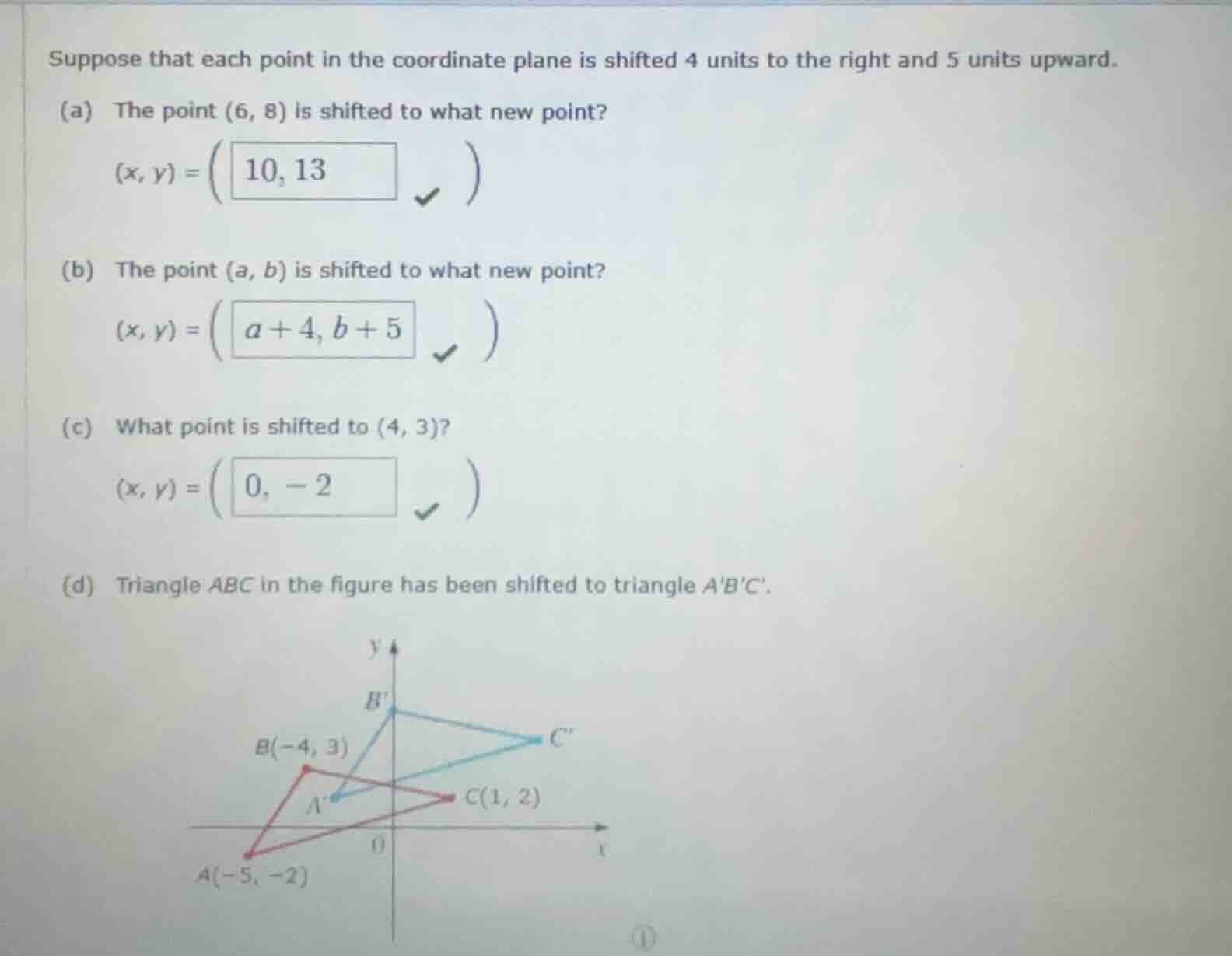
ight)) (d) triangle (abc) in the figure has been shifted to triangle (abc). figure with triangle (abc) and (abc) on coordinate plane, points (a(-5,-2)), (b(-4,3)), (c(1,2)) and (b), (c), (a) shown
Part (a)
Step1: Shift x - coordinate (right)
To shift a point \((x,y)\) 4 units to the right, we add 4 to the \(x\) - coordinate. For the point \((6,8)\), the new \(x\) - coordinate is \(6 + 4=10\).
Step2: Shift y - coordinate (upward)
To shift a point \((x,y)\) 5 units upward, we add 5 to the \(y\) - coordinate. For the point \((6,8)\), the new \(y\) - coordinate is \(8 + 5 = 13\).
Step1: Shift x - coordinate (right)
For a general point \((a,b)\), when we shift it 4 units to the right, the new \(x\) - coordinate is obtained by adding 4 to the original \(x\) - coordinate. So the new \(x\) - coordinate is \(a + 4\).
Step2: Shift y - coordinate (upward)
When we shift the point \((a,b)\) 5 units upward, the new \(y\) - coordinate is obtained by adding 5 to the original \(y\) - coordinate. So the new \(y\) - coordinate is \(b+5\).
Step1: Find original x - coordinate
If a point is shifted 4 units to the right to get \(x = 4\), then to find the original \(x\) - coordinate, we subtract 4 from 4. Let the original \(x\) - coordinate be \(x_0\). We have the equation \(x_0+4 = 4\), so \(x_0=4 - 4=0\).
Step2: Find original y - coordinate
If a point is shifted 5 units upward to get \(y = 3\), then to find the original \(y\) - coordinate, we subtract 5 from 3. Let the original \(y\) - coordinate be \(y_0\). We have the equation \(y_0 + 5=3\), so \(y_0=3 - 5=- 2\).

Snap & solve any problem in the app
Get step-by-step solutions on Sovi AI
Photo-based solutions with guided steps
Explore more problems and detailed explanations
\((10,13)\)