QUESTION IMAGE
Question
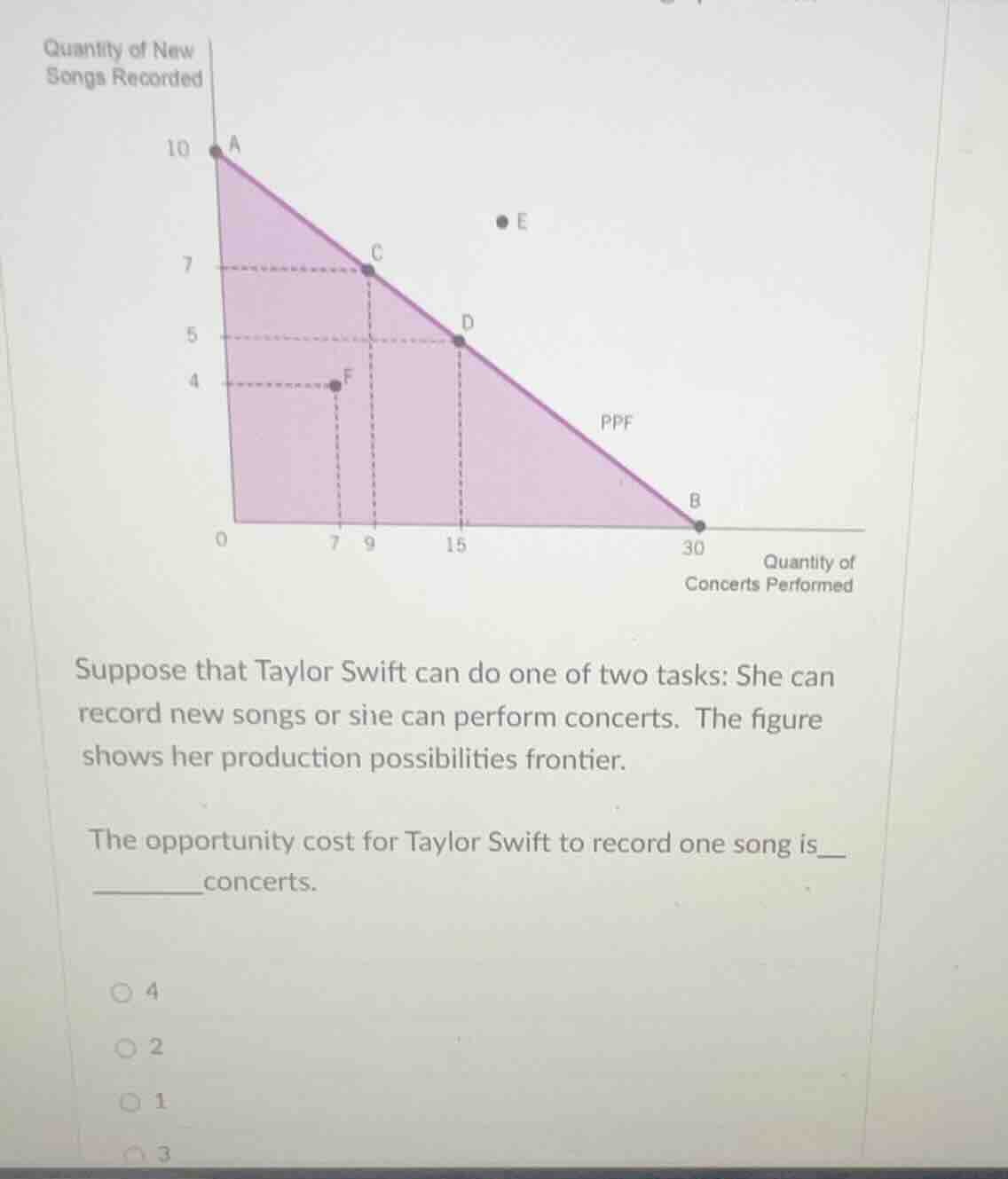
suppose that taylor swift can do one of two tasks: she can record new songs or she can perform concerts. the figure shows her production possibilities frontier. the opportunity cost for taylor swift to record one song is______concerts. \bigcirc 4 \bigcirc 2 \bigcirc 1 \bigcirc 3
Step1: Identify total trade - off
From point A (0 concerts, 10 songs) to point B (30 concerts, 0 songs), when Taylor Swift stops recording all 10 songs, she can perform 30 more concerts. So the trade - off between songs and concerts is 10 songs for 30 concerts.
Step2: Calculate opportunity cost per song
To find the opportunity cost of 1 song, we divide the number of concerts gained by the number of songs given up. The formula is $\text{Opportunity Cost of 1 song}=\frac{\text{Change in concerts}}{\text{Change in songs}}$. Here, change in concerts is 30 and change in songs is 10. So $\frac{30}{10} = 3$? Wait, no, wait. Wait, actually, when moving from A to B, if we consider the production of songs: when she produces 10 songs, she produces 0 concerts. When she produces 0 songs, she produces 30 concerts. So the opportunity cost of producing 1 song is the number of concerts she has to give up to produce 1 more song. So the slope of the PPF (Production Possibility Frontier) is $\frac{\Delta\text{Concerts}}{\Delta\text{Songs}}$. But actually, the PPF is a straight line, so we can take two points. Let's take point A (0,10) and point D (15,5). The change in songs is $5 - 10=- 5$ (a decrease of 5 songs) and the change in concerts is $15 - 0 = 15$ (an increase of 15 concerts). So the opportunity cost of 1 song is $\frac{15}{5}=3$? Wait, no, wait. Wait, if we want to find the opportunity cost of recording 1 song, we need to see how many concerts we give up for 1 song. Let's take the two extreme points: A (0 concerts, 10 songs) and B (30 concerts, 0 songs). So to go from 10 songs to 0 songs (a decrease of 10 songs), we gain 30 concerts. So for 1 song (a decrease of 1 song), the number of concerts we gain is $\frac{30}{10}=3$? Wait, no, that's the opportunity cost of not recording a song. Wait, no, opportunity cost of recording a song is what you give up. So if you record 1 more song, how many concerts do you have to give up. Let's take the slope of the PPF. The PPF goes from (0,10) to (30,0). The slope is $\frac{0 - 10}{30 - 0}=-\frac{10}{30}=-\frac{1}{3}$. The absolute value of the slope gives the opportunity cost of 1 concert in terms of songs, but we want the opportunity cost of 1 song in terms of concerts. So we take the reciprocal. The opportunity cost of 1 song is $\frac{30}{10}=3$? Wait, no, wait, let's do it again. Let's say when she produces 10 songs, she produces 0 concerts. When she produces 0 songs, she produces 30 concerts. So the trade - off is 10 songs = 30 concerts. So 1 song = $\frac{30}{10}=3$ concerts? Wait, but let's check with another point. Point A (0,10) and point C (9,7). The change in songs is $7 - 10=-3$ (decrease of 3 songs), change in concerts is $9 - 0 = 9$ (increase of 9 concerts). So $\frac{9}{3}=3$. So for each song she gives up (decreases production by 1), she can do 3 more concerts. So the opportunity cost of recording 1 song (increasing song production by 1) is 3 concerts? Wait, but the options have 3 as an option. Wait, but let's check the points again. Wait, point A is (0,10) (concerts = 0, songs = 10), point B is (30,0) (concerts = 30, songs = 0). So the PPF is a straight line, so the opportunity cost is constant. So the opportunity cost of 1 song is $\frac{30}{10}=3$ concerts. Wait, but let's see the options: 4,2,1,3. So 3 is an option.

Snap & solve any problem in the app
Get step-by-step solutions on Sovi AI
Photo-based solutions with guided steps
Explore more problems and detailed explanations
3