QUESTION IMAGE
Question
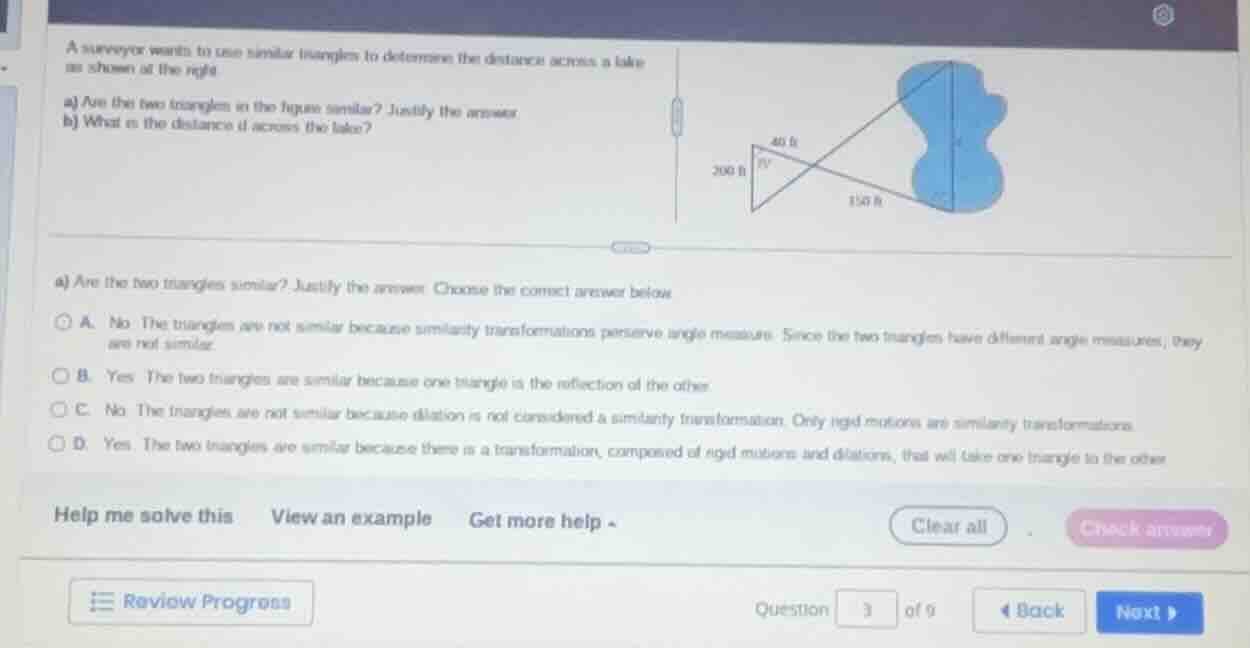
a surveyor wants to use similar triangles to determine the distance across a lake as shown at the right
a) are the two triangles in the figure similar? justify the answer
b) what is the distance d across the lake?
a) are the two triangles similar? justify the answer. choose the correct answer below
a. no. the triangles are not similar because similarity transformations preserve angle measures. since the two triangles have different angle measures, they are not similar.
b. yes. the two triangles are similar because one triangle is the reflection of the other
c. no. the triangles are not similar because dilation is not considered a similarity transformation. only rigid motions are similarity transformations.
d. yes. the two triangles are similar because there is a transformation, composed of rigid motions and dilations, that will take one triangle to the other
Step1: Analyze triangle similarity
First, identify the angles: the vertical angles formed by the intersecting lines are equal, and we are told one pair of corresponding angles is equal (75°). By the AA (Angle-Angle) Similarity Criterion, the two triangles are similar. Additionally, similarity transformations include rigid motions (reflection, rotation, translation) and dilations, which map one triangle to the other.
Step2: Set up proportion for distance
Let $d$ be the distance across the lake. Since the triangles are similar, the ratios of corresponding sides are equal:
$\frac{d}{200} = \frac{150}{40}$
Step3: Solve for $d$
Multiply both sides by 200 to isolate $d$:
$d = 200 \times \frac{150}{40}$
Simplify the right-hand side:
$d = 5 \times 150 = 750$

Snap & solve any problem in the app
Get step-by-step solutions on Sovi AI
Photo-based solutions with guided steps
Explore more problems and detailed explanations
a) D. Yes. The two triangles are similar because there is a transformation, composed of rigid motions and dilations, that will take one triangle to the other
b) 750 ft