QUESTION IMAGE
Question
svlc algebra 1a - standard (15260)
linear equations and inequalities
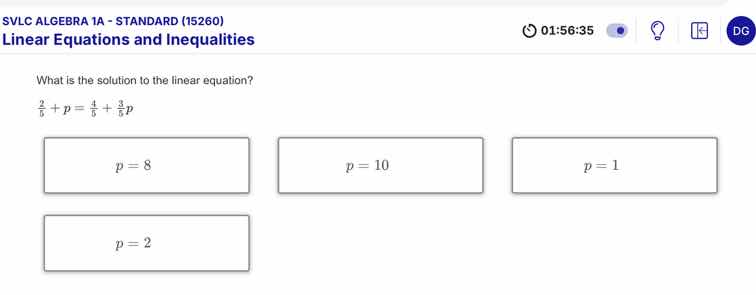
what is the solution to the linear equation?
\\(\frac{2}{5} + p = \frac{4}{5} + \frac{3}{5}p\\)
\\(p = 8\\)
\\(p = 10\\)
\\(p = 1\\)
\\(p = 2\\)
Step1: Subtract \(\frac{3}{5}p\) from both sides
To get all the \(p\) terms on one side, we subtract \(\frac{3}{5}p\) from both sides of the equation \(\frac{2}{5}+p=\frac{4}{5}+\frac{3}{5}p\). This gives us \(\frac{2}{5}+p - \frac{3}{5}p=\frac{4}{5}+\frac{3}{5}p-\frac{3}{5}p\). Simplifying the \(p\) terms, \(p-\frac{3}{5}p=\frac{5}{5}p - \frac{3}{5}p=\frac{2}{5}p\), so the equation becomes \(\frac{2}{5}+\frac{2}{5}p=\frac{4}{5}\).
Step2: Subtract \(\frac{2}{5}\) from both sides
Now, we want to isolate the term with \(p\). Subtract \(\frac{2}{5}\) from both sides: \(\frac{2}{5}+\frac{2}{5}p-\frac{2}{5}=\frac{4}{5}-\frac{2}{5}\). The \(\frac{2}{5}\) terms on the left cancel out, and on the right, \(\frac{4}{5}-\frac{2}{5}=\frac{2}{5}\). So we have \(\frac{2}{5}p=\frac{2}{5}\).
Step3: Multiply both sides by \(\frac{5}{2}\)
To solve for \(p\), multiply both sides of the equation \(\frac{2}{5}p=\frac{2}{5}\) by the reciprocal of \(\frac{2}{5}\), which is \(\frac{5}{2}\). So \(p=\frac{2}{5}\times\frac{5}{2}\). The \(5\)s and \(2\)s cancel out, leaving \(p = 1\). Wait, no, wait, let's check again. Wait, in step 2, \(\frac{4}{5}-\frac{2}{5}=\frac{2}{5}\)? Wait, no, \(\frac{4}{5}-\frac{2}{5}=\frac{2}{5}\)? Wait, no, \(\frac{4 - 2}{5}=\frac{2}{5}\)? Wait, but then \(\frac{2}{5}p=\frac{2}{5}\), so multiplying both sides by \(\frac{5}{2}\), we get \(p = 1\)? Wait, but let's check with the original equation. Let's plug \(p = 1\) into the original equation: left side \(\frac{2}{5}+1=\frac{2}{5}+\frac{5}{5}=\frac{7}{5}\). Right side \(\frac{4}{5}+\frac{3}{5}(1)=\frac{4}{5}+\frac{3}{5}=\frac{7}{5}\). Wait, but wait, maybe I made a mistake in step 1. Wait, original equation: \(\frac{2}{5}+p=\frac{4}{5}+\frac{3}{5}p\). Let's try another approach. Let's multiply both sides by 5 to eliminate denominators.
Step1 (Alternative): Multiply both sides by 5
Multiply each term in the equation \(\frac{2}{5}+p=\frac{4}{5}+\frac{3}{5}p\) by 5. This gives \(5\times\frac{2}{5}+5\times p=5\times\frac{4}{5}+5\times\frac{3}{5}p\). Simplifying each term: \(2 + 5p=4 + 3p\).
Step2 (Alternative): Subtract \(3p\) from both sides
Subtract \(3p\) from both sides: \(2 + 5p-3p=4 + 3p-3p\), which simplifies to \(2 + 2p=4\).
Step3 (Alternative): Subtract 2 from both sides
Subtract 2 from both sides: \(2 + 2p-2=4 - 2\), so \(2p=2\).
Step4 (Alternative): Divide by 2
Divide both sides by 2: \(p = 1\). Wait, but when we plug \(p = 1\) into the original equation, left side \(\frac{2}{5}+1=\frac{7}{5}\), right side \(\frac{4}{5}+\frac{3}{5}(1)=\frac{7}{5}\), so it works. Wait, but let's check the options. One of the options is \(p = 1\). Wait, but let's re - do the first method correctly.
Original equation: \(\frac{2}{5}+p=\frac{4}{5}+\frac{3}{5}p\)
Subtract \(\frac{3}{5}p\) from both sides: \(\frac{2}{5}+p-\frac{3}{5}p=\frac{4}{5}\)
\(p-\frac{3}{5}p=\frac{2}{5}p\), so \(\frac{2}{5}+\frac{2}{5}p=\frac{4}{5}\)
Subtract \(\frac{2}{5}\) from both sides: \(\frac{2}{5}p=\frac{4}{5}-\frac{2}{5}=\frac{2}{5}\)
Now, multiply both sides by \(\frac{5}{2}\): \(p=\frac{2}{5}\times\frac{5}{2}=1\). So the solution is \(p = 1\).

Snap & solve any problem in the app
Get step-by-step solutions on Sovi AI
Photo-based solutions with guided steps
Explore more problems and detailed explanations
\(p = 1\) (corresponding to the option with \(p = 1\))