QUESTION IMAGE
Question
svlc algebra 1a - standard (15260)
linear functions
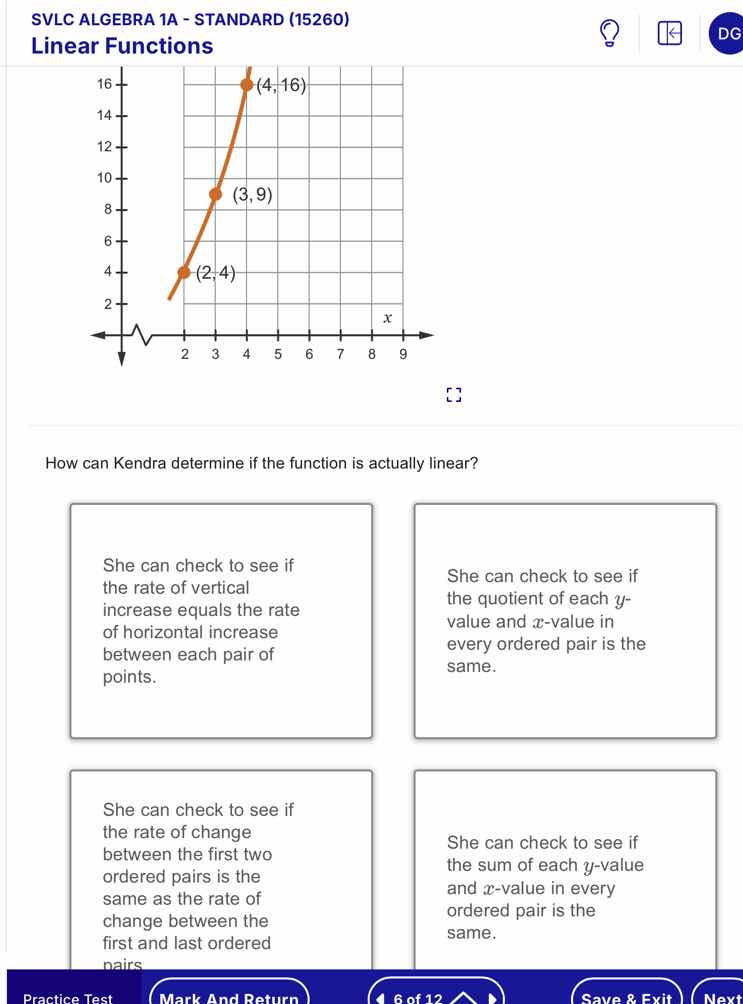
(4,16)
(3,9)
(2,4)
x
how can kendra determine if the function is actually linear?
she can check to see if
the rate of vertical
increase equals the rate
of horizontal increase
between each pair of
points.
she can check to see if
the quotient of each y-
value and x-value in
every ordered pair is the
same.
she can check to see if
the rate of change
between the first two
ordered pairs is the
same as the rate of
change between the
first and last ordered
pairs
she can check to see if
the sum of each y-value
and x-value in every
ordered pair is the
same.
practice test mark and return 6 of 12 save & exit next
To determine if a function is linear, the key is to check the rate of change (slope) between consecutive points. The rate of change formula is \( \frac{\Delta y}{\Delta x} \). For a linear function, the rate of change between any two points should be constant.
- Checking the quotient of \( y \)-value and \( x \)-value (like \( \frac{y}{x} \)) isn't a test for linearity (e.g., \( y = 2x + 1 \) has different \( \frac{y}{x} \) for different \( x \)).
- Checking the sum of \( y \) and \( x \) is irrelevant to linearity.
- The first option's description is a bit off (linearity is about constant slope, not equal vertical and horizontal increase rates in general, but the third option correctly focuses on checking if the rate of change between different pairs of points is the same. For the given points \((2,4)\), \((3,9)\), \((4,16)\), let's check the slope between \((2,4)\) and \((3,9)\): \( \frac{9 - 4}{3 - 2} = 5 \). Between \((3,9)\) and \((4,16)\): \( \frac{16 - 9}{4 - 3} = 7 \). Wait, but the question is about how to determine if it's linear (the process, not if these specific points are linear). The correct method is to check if the rate of change (slope) between any two pairs of ordered pairs is the same. So the third option ("She can check to see if the rate of change between the first two ordered pairs is the same as the rate of change between the first and last ordered pairs") is the correct approach because for a linear function, the slope between any two points should be equal, so checking between different pairs (like first - second and first - third) will confirm if the slope is constant.

Snap & solve any problem in the app
Get step-by-step solutions on Sovi AI
Photo-based solutions with guided steps
Explore more problems and detailed explanations
The correct option is the third one (the bottom - left box): She can check to see if the rate of change between the first two ordered pairs is the same as the rate of change between the first and last ordered pairs.