QUESTION IMAGE
Question
svlc algebra 1a - standard (15260)
representing relationships
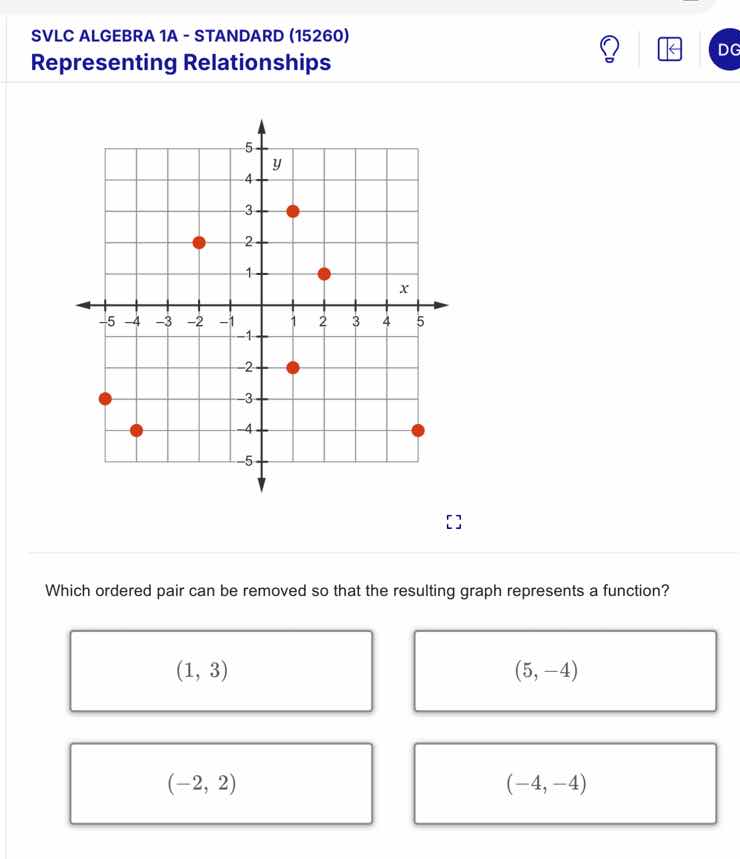
graph with coordinate plane and red dots at various points
which ordered pair can be removed so that the resulting graph represents a function?
(1, 3) (5, -4)
(-2, 2) (-4, -4)
Step1: Recall the definition of a function
A function is a relation where each input (x - value) has exactly one output (y - value). So, we need to check which ordered pair has an x - value that is repeated with a different y - value.
Step2: Identify the x - values of each ordered pair
- For \((1,3)\), the x - value is \(1\). Let's check other points with \(x = 1\). There is another point \((1,-2)\) (from the graph, we can see that at \(x = 1\), there are two points: \((1,3)\) and \((1,-2)\)).
- For \((5,-4)\), the x - value is \(5\). Looking at the graph, there is no other point with \(x = 5\) except \((5,-4)\).
- For \((-2,2)\), the x - value is \(-2\). There is no other point with \(x=-2\) (from the given points and the graph).
- For \((-4,-4)\), the x - value is \(-4\). There is another point with \(x = - 4\) (the point \((-4,-3)\) or similar? Wait, looking at the graph, the points with \(x=-4\): one is \((-4,-3)\) (the red dot) and \((-4,-4)\)? Wait, no, let's re - examine. Wait, the ordered pairs: the points on the graph: let's list the x - values:
- \(x=-5\): one point.
- \(x = - 4\): two points? Wait, no, the given options: \((-4,-4)\) and the other point at \(x=-4\) (the red dot at \(y=-3\)? Wait, maybe I made a mistake. Wait, the key is that for a function, each x must have only one y. So, let's check the x - values of the options:
- \((1,3)\): x = 1. Is there another point with x = 1? From the graph, there is a point \((1,-2)\) (since at x = 1, we have two points: (1,3) and (1, - 2)). So, x = 1 has two y - values (3 and - 2).
- \((5,-4)\): x = 5, only one point.
- \((-2,2)\): x=-2, only one point.
- \((-4,-4)\): Let's check x=-4. The other point at x=-4: from the graph, there is a point ( - 4,-3) (the red dot) and \((-4,-4)\)? Wait, no, maybe the points: let's see the x - values:
- x=-5: one point.
- x=-4: two points? Wait, the option is \((-4,-4)\) and the other point at x=-4 (the red dot) has y=-3? Wait, maybe I misread. Wait, the problem is about the given options. Let's re - evaluate:
- For \((1,3)\): x = 1. If we remove \((1,3)\), then x = 1 will have only one y - value (the other point at x = 1, which is (1,-2)). So, by removing \((1,3)\), we ensure that x = 1 has only one y - value.
- For \((5,-4)\): x = 5 has only one y - value, so removing it won't help with the function definition (since it's not causing a violation).
- For \((-2,2)\): x=-2 has only one y - value, so removing it is not necessary.
- For \((-4,-4)\): x=-4, if we remove it, but does x=-4 have another y - value? The other point at x=-4 (the red dot) has a different y - value? Wait, maybe the initial graph has two points with the same x - value for x = 1. So, the x - value 1 is repeated (with y = 3 and y=-2). So, to make it a function, we need to remove one of the points with x = 1. Among the options, \((1,3)\) is the one with x = 1. So, removing \((1,3)\) will make the relation a function because then each x - value will have only one y - value.

Snap & solve any problem in the app
Get step-by-step solutions on Sovi AI
Photo-based solutions with guided steps
Explore more problems and detailed explanations
\((1, 3)\)