QUESTION IMAGE
Question
svlc algebra 1a - standard (15260)
solving linear equations:
distributive property
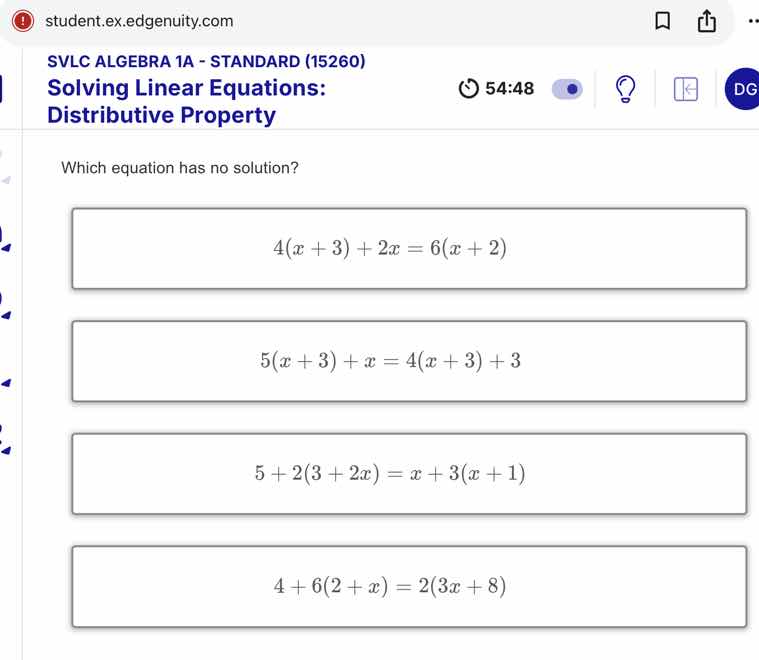
which equation has no solution?
$4(x + 3) + 2x = 6(x + 2)$
$5(x + 3) + x = 4(x + 3) + 3$
$5 + 2(3 + 2x) = x + 3(x + 1)$
$4 + 6(2 + x) = 2(3x + 8)$
Step1: Analyze the first equation \(4(x + 3)+2x = 6(x + 2)\)
Expand both sides: \(4x+12 + 2x=6x + 12\)
Combine like terms: \(6x+12 = 6x + 12\)
Subtract \(6x\) from both sides: \(12 = 12\) (always true, infinite solutions)
Step2: Analyze the second equation \(5(x + 3)+x = 4(x + 3)+3\)
Expand both sides: \(5x+15 + x=4x + 12 + 3\)
Combine like terms: \(6x+15 = 4x + 15\)
Subtract \(4x\) and \(15\): \(2x = 0\) → \(x = 0\) (one solution)
Step3: Analyze the third equation \(5 + 2(3 + 2x)=x + 3(x + 1)\)
Expand both sides: \(5 + 6 + 4x=x + 3x + 3\)
Combine like terms: \(11 + 4x=4x + 3\)
Subtract \(4x\): \(11 = 3\) (false, no solution)
Step4: Analyze the fourth equation \(4 + 6(2 + x)=2(3x + 8)\)
Expand both sides: \(4 + 12 + 6x=6x + 16\)
Combine like terms: \(16 + 6x=6x + 16\)
Subtract \(6x\): \(16 = 16\) (always true, infinite solutions)

Snap & solve any problem in the app
Get step-by-step solutions on Sovi AI
Photo-based solutions with guided steps
Explore more problems and detailed explanations
\(5 + 2(3 + 2x)=x + 3(x + 1)\)