QUESTION IMAGE
Question
svlc algebra 1a - standard (15260)
solving linear equations:
distributive property
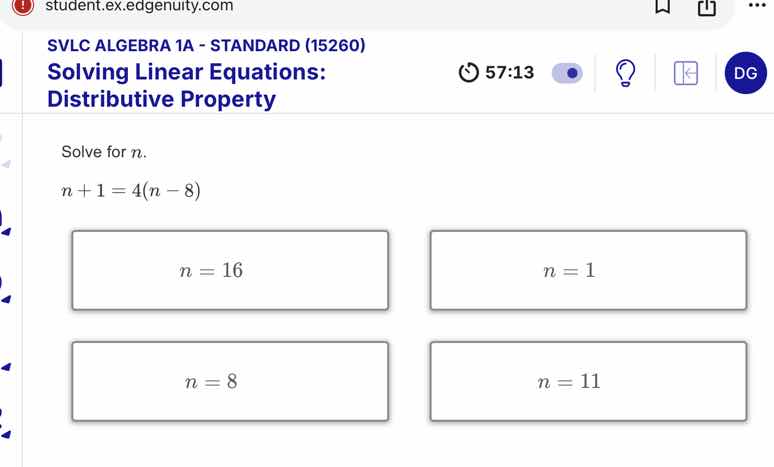
solve for n.
$n + 1 = 4(n - 8)$
$n = 16$
$n = 1$
$n = 8$
$n = 11$
Step1: Apply distributive property
First, we apply the distributive property to the right - hand side of the equation \(n + 1=4(n - 8)\). The distributive property states that \(a(b - c)=ab - ac\). So, \(4(n - 8)=4\times n-4\times8 = 4n-32\). The equation becomes \(n + 1=4n-32\).
Step2: Move variable terms to one side
Subtract \(n\) from both sides of the equation to get all the \(n\) terms on one side. \((n + 1)-n=(4n-32)-n\). Simplifying the left - hand side: \(n - n+1 = 1\). Simplifying the right - hand side: \(4n - n-32=3n - 32\). So, the equation is \(1 = 3n-32\).
Step3: Solve for n
Add 32 to both sides of the equation \(1+32=3n - 32 + 32\). The left - hand side is \(33\) and the right - hand side is \(3n\). So, \(33 = 3n\). Then divide both sides by 3: \(\frac{33}{3}=\frac{3n}{3}\), which gives \(n = 11\).

Snap & solve any problem in the app
Get step-by-step solutions on Sovi AI
Photo-based solutions with guided steps
Explore more problems and detailed explanations
\(n = 11\) (corresponding to the option \(n = 11\))