QUESTION IMAGE
Question
svlc algebra 1a - standard (15260)
solving systems of linear inequalities
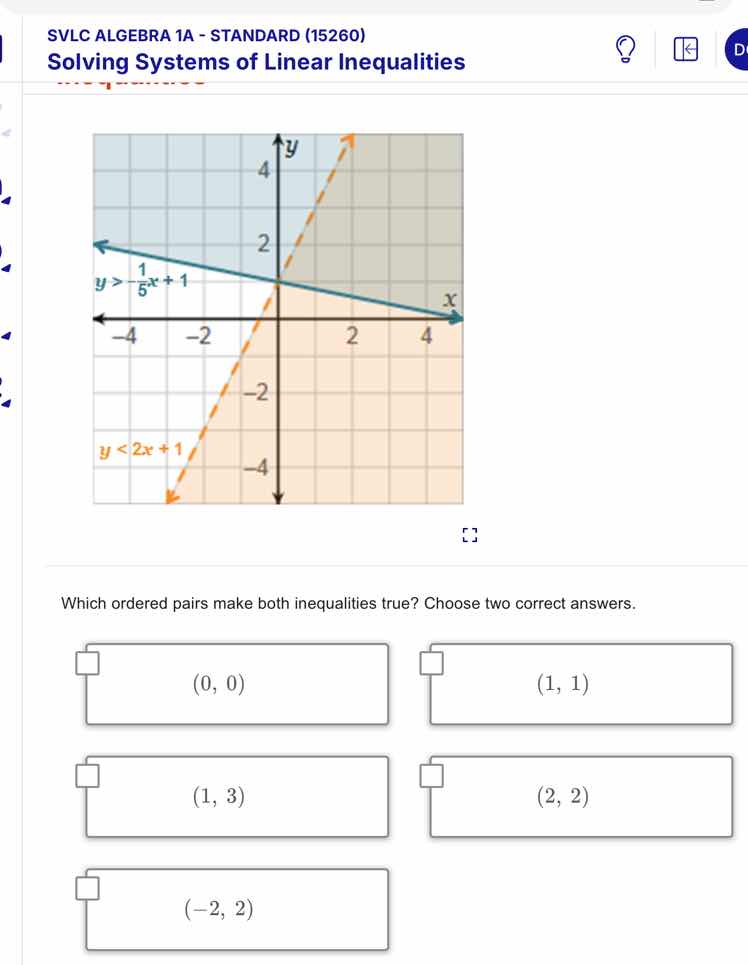
which ordered pairs make both inequalities true? choose two correct answers.
(0, 0)
(1, 1)
(1, 3)
(2, 2)
(-2, 2)
To determine which ordered pairs satisfy both inequalities \( y > -\frac{1}{5}x + 1 \) and \( y < 2x + 1 \), we substitute each ordered pair \((x, y)\) into both inequalities and check if they hold true.
Step 1: Test \((0, 0)\)
- For \( y > -\frac{1}{5}x + 1 \):
Substitute \( x = 0 \), \( y = 0 \):
\( 0 > -\frac{1}{5}(0) + 1 \implies 0 > 1 \). False.
Step 2: Test \((1, 1)\)
- For \( y > -\frac{1}{5}x + 1 \):
Substitute \( x = 1 \), \( y = 1 \):
\( 1 > -\frac{1}{5}(1) + 1 \implies 1 > \frac{4}{5} \). True.
- For \( y < 2x + 1 \):
Substitute \( x = 1 \), \( y = 1 \):
\( 1 < 2(1) + 1 \implies 1 < 3 \). True.
Step 3: Test \((1, 3)\)
- For \( y > -\frac{1}{5}x + 1 \):
Substitute \( x = 1 \), \( y = 3 \):
\( 3 > -\frac{1}{5}(1) + 1 \implies 3 > \frac{4}{5} \). True.
- For \( y < 2x + 1 \):
Substitute \( x = 1 \), \( y = 3 \):
\( 3 < 2(1) + 1 \implies 3 < 3 \). False (since \( 3 \) is not less than \( 3 \)).
Step 4: Test \((2, 2)\)
- For \( y > -\frac{1}{5}x + 1 \):
Substitute \( x = 2 \), \( y = 2 \):
\( 2 > -\frac{1}{5}(2) + 1 \implies 2 > \frac{3}{5} \). True.
- For \( y < 2x + 1 \):
Substitute \( x = 2 \), \( y = 2 \):
\( 2 < 2(2) + 1 \implies 2 < 5 \). True.
Step 5: Test \((-2, 2)\)
- For \( y > -\frac{1}{5}x + 1 \):
Substitute \( x = -2 \), \( y = 2 \):
\( 2 > -\frac{1}{5}(-2) + 1 \implies 2 > \frac{7}{5} \) (since \( \frac{7}{5} = 1.4 \)). True.
- For \( y < 2x + 1 \):
Substitute \( x = -2 \), \( y = 2 \):
\( 2 < 2(-2) + 1 \implies 2 < -3 \). False.
Final Answer
The ordered pairs that satisfy both inequalities are:
\(\boldsymbol{(1, 1)}\) and \(\boldsymbol{(2, 2)}\)

Snap & solve any problem in the app
Get step-by-step solutions on Sovi AI
Photo-based solutions with guided steps
Explore more problems and detailed explanations
To determine which ordered pairs satisfy both inequalities \( y > -\frac{1}{5}x + 1 \) and \( y < 2x + 1 \), we substitute each ordered pair \((x, y)\) into both inequalities and check if they hold true.
Step 1: Test \((0, 0)\)
- For \( y > -\frac{1}{5}x + 1 \):
Substitute \( x = 0 \), \( y = 0 \):
\( 0 > -\frac{1}{5}(0) + 1 \implies 0 > 1 \). False.
Step 2: Test \((1, 1)\)
- For \( y > -\frac{1}{5}x + 1 \):
Substitute \( x = 1 \), \( y = 1 \):
\( 1 > -\frac{1}{5}(1) + 1 \implies 1 > \frac{4}{5} \). True.
- For \( y < 2x + 1 \):
Substitute \( x = 1 \), \( y = 1 \):
\( 1 < 2(1) + 1 \implies 1 < 3 \). True.
Step 3: Test \((1, 3)\)
- For \( y > -\frac{1}{5}x + 1 \):
Substitute \( x = 1 \), \( y = 3 \):
\( 3 > -\frac{1}{5}(1) + 1 \implies 3 > \frac{4}{5} \). True.
- For \( y < 2x + 1 \):
Substitute \( x = 1 \), \( y = 3 \):
\( 3 < 2(1) + 1 \implies 3 < 3 \). False (since \( 3 \) is not less than \( 3 \)).
Step 4: Test \((2, 2)\)
- For \( y > -\frac{1}{5}x + 1 \):
Substitute \( x = 2 \), \( y = 2 \):
\( 2 > -\frac{1}{5}(2) + 1 \implies 2 > \frac{3}{5} \). True.
- For \( y < 2x + 1 \):
Substitute \( x = 2 \), \( y = 2 \):
\( 2 < 2(2) + 1 \implies 2 < 5 \). True.
Step 5: Test \((-2, 2)\)
- For \( y > -\frac{1}{5}x + 1 \):
Substitute \( x = -2 \), \( y = 2 \):
\( 2 > -\frac{1}{5}(-2) + 1 \implies 2 > \frac{7}{5} \) (since \( \frac{7}{5} = 1.4 \)). True.
- For \( y < 2x + 1 \):
Substitute \( x = -2 \), \( y = 2 \):
\( 2 < 2(-2) + 1 \implies 2 < -3 \). False.
Final Answer
The ordered pairs that satisfy both inequalities are:
\(\boldsymbol{(1, 1)}\) and \(\boldsymbol{(2, 2)}\)