QUESTION IMAGE
Question
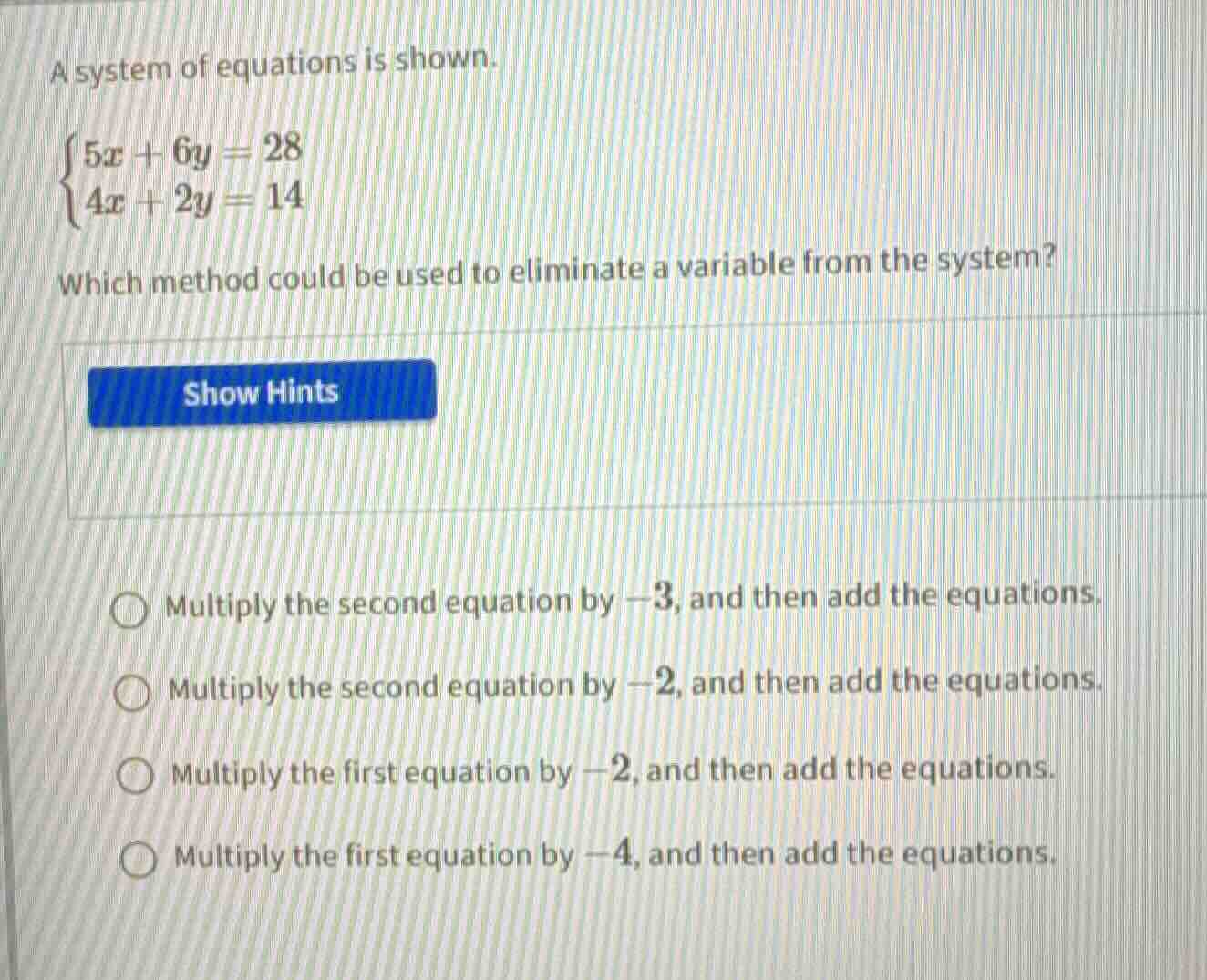
a system of equations is shown.\
\
which method could be used to eliminate a variable from the system?\
\
\bigcirc multiply the second equation by $-3$, and then add the equations.\
\bigcirc multiply the second equation by $-2$, and then add the equations.\
\bigcirc multiply the first equation by $-2$, and then add the equations.\
\bigcirc multiply the first equation by $-4$, and then add the equations.
Step1: Analyze the coefficients of y
The system is \(
\). The coefficients of \(y\) are \(6\) (in first equation) and \(2\) (in second equation). If we multiply the second equation by \(- 3\), the coefficient of \(y\) in the second equation becomes \(2\times(-3)=-6\).
Step2: Check the effect of adding after multiplication
After multiplying the second equation \(4x + 2y = 14\) by \(-3\), we get \(-12x-6y=-42\). Now, add this new equation to the first equation \(5x + 6y = 28\): \((5x+6y)+(-12x - 6y)=28+(-42)\). The \(y\)-terms (\(6y\) and \(-6y\)) will cancel out (be eliminated), leaving us with an equation in terms of \(x\) only.
Let's check other options:
- For multiplying second equation by \(-2\): New second equation is \(-8x-4y = - 28\). Adding to first equation \(5x + 6y=28\) gives \((5x-8x)+(6y-4y)=28 - 28\), \(y\) is not eliminated.
- For multiplying first equation by \(-2\): New first equation is \(-10x-12y=-56\). Adding to second equation \(4x + 2y = 14\) gives \((-10x + 4x)+(-12y+2y)=-56 + 14\), neither \(x\) nor \(y\) is eliminated (coefficients of \(x\) is \(-6\), \(y\) is \(-10\)).
- For multiplying first equation by \(-4\): New first equation is \(-20x-24y=-112\). Adding to second equation \(4x + 2y = 14\) gives \((-20x + 4x)+(-24y+2y)=-112 + 14\), neither \(x\) nor \(y\) is eliminated.

Snap & solve any problem in the app
Get step-by-step solutions on Sovi AI
Photo-based solutions with guided steps
Explore more problems and detailed explanations
Multiply the second equation by \(-3\), and then add the equations.