QUESTION IMAGE
Question
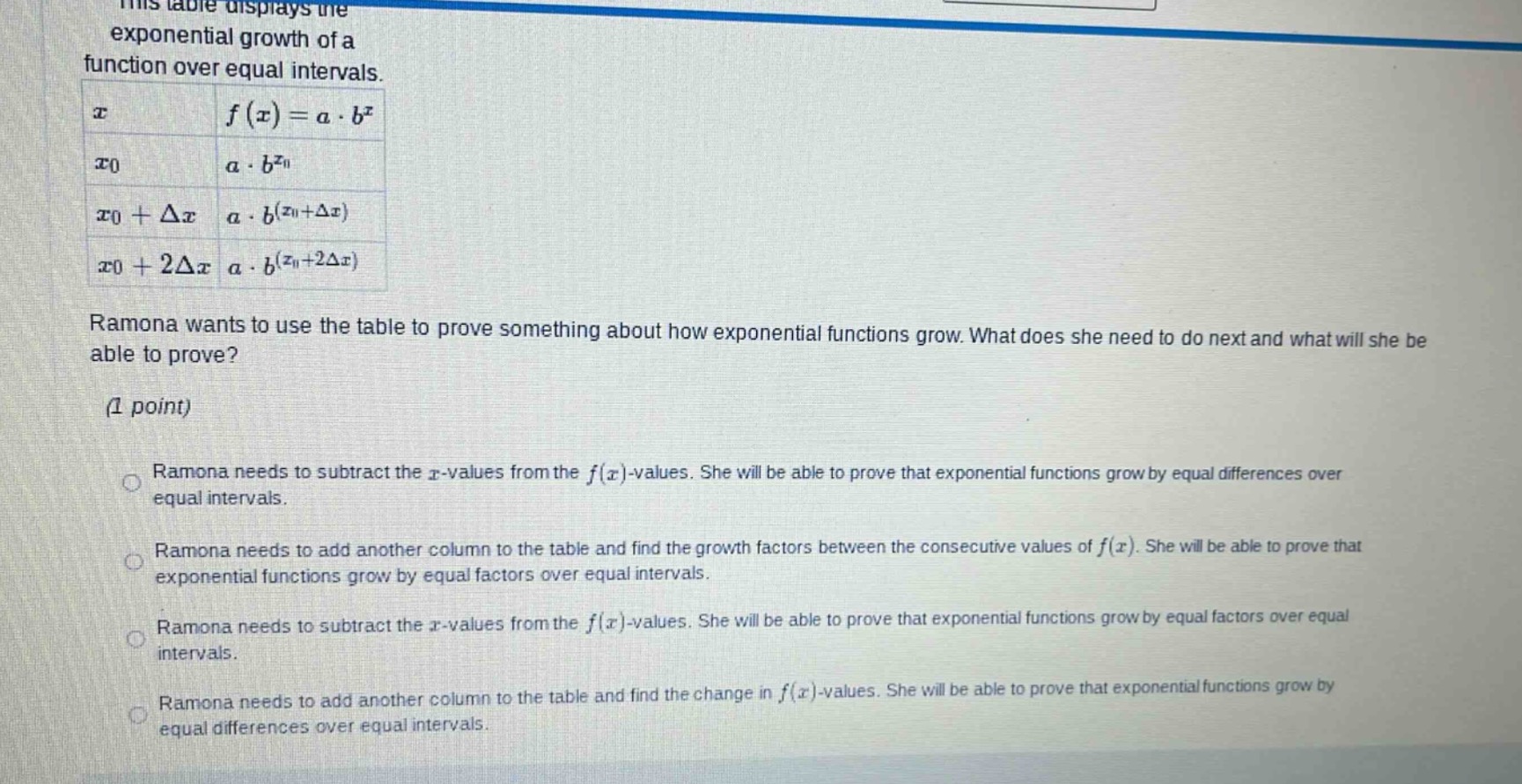
this table displays the exponential growth of a function over equal intervals.
| $x$ | $f(x)=a\cdot b^x$ |
|---|---|
| $x_0+\delta x$ | $a\cdot b^{(x_0+\delta x)}$ |
| $x_0+2\delta x$ | $a\cdot b^{(x_0+2\delta x)}$ |
ramona wants to use the table to prove something about how exponential functions grow. what does she need to do next and what will she be able to prove?
(1 point)
- ramona needs to subtract the $x$-values from the $f(x)$-values. she will be able to prove that exponential functions grow by equal differences over equal intervals.
- ramona needs to add another column to the table and find the growth factors between the consecutive values of $f(x)$. she will be able to prove that exponential functions grow by equal factors over equal intervals.
- ramona needs to subtract the $x$-values from the $f(x)$-values. she will be able to prove that exponential functions grow by equal factors over equal intervals.
- ramona needs to add another column to the table and find the change in $f(x)$-values. she will be able to prove that exponential functions grow by equal differences over equal intervals.
To analyze exponential growth, we recall that exponential functions have the form \( f(x)=a\cdot b^{x} \), and their growth is characterized by equal factors (multipliers) over equal intervals. Let's evaluate each option:
- First Option: Subtracting \( x \)-values from \( f(x) \)-values is not relevant for exponential growth analysis. Also, exponential functions do not grow by equal differences (that's linear growth), so this is incorrect.
- Second Option: To prove exponential growth, we check the ratio (growth factor) between consecutive \( f(x) \)-values. Adding a column for growth factors (by dividing consecutive \( f(x) \)-values) will show that the ratio is constant (\( b^{\Delta x} \), since \( \frac{a\cdot b^{(x_0 + \Delta x)}}{a\cdot b^{x_0}} = b^{\Delta x} \) and \( \frac{a\cdot b^{(x_0 + 2\Delta x)}}{a\cdot b^{(x_0+\Delta x)}} = b^{\Delta x} \)), proving equal factors over equal intervals. This matches the nature of exponential growth.
- Third Option: Subtracting \( x \)-values from \( f(x) \)-values is not a valid method for analyzing exponential growth, and the claim about equal factors is incorrectly associated with this operation.
- Fourth Option: Finding the change (difference) in \( f(x) \)-values would show linear growth (equal differences), but exponential growth is about equal factors, so this is incorrect.

Snap & solve any problem in the app
Get step-by-step solutions on Sovi AI
Photo-based solutions with guided steps
Explore more problems and detailed explanations
B. Ramona needs to add another column to the table and find the growth factors between the consecutive values of \( f(x) \). She will be able to prove that exponential functions grow by equal factors over equal intervals.