QUESTION IMAGE
Question
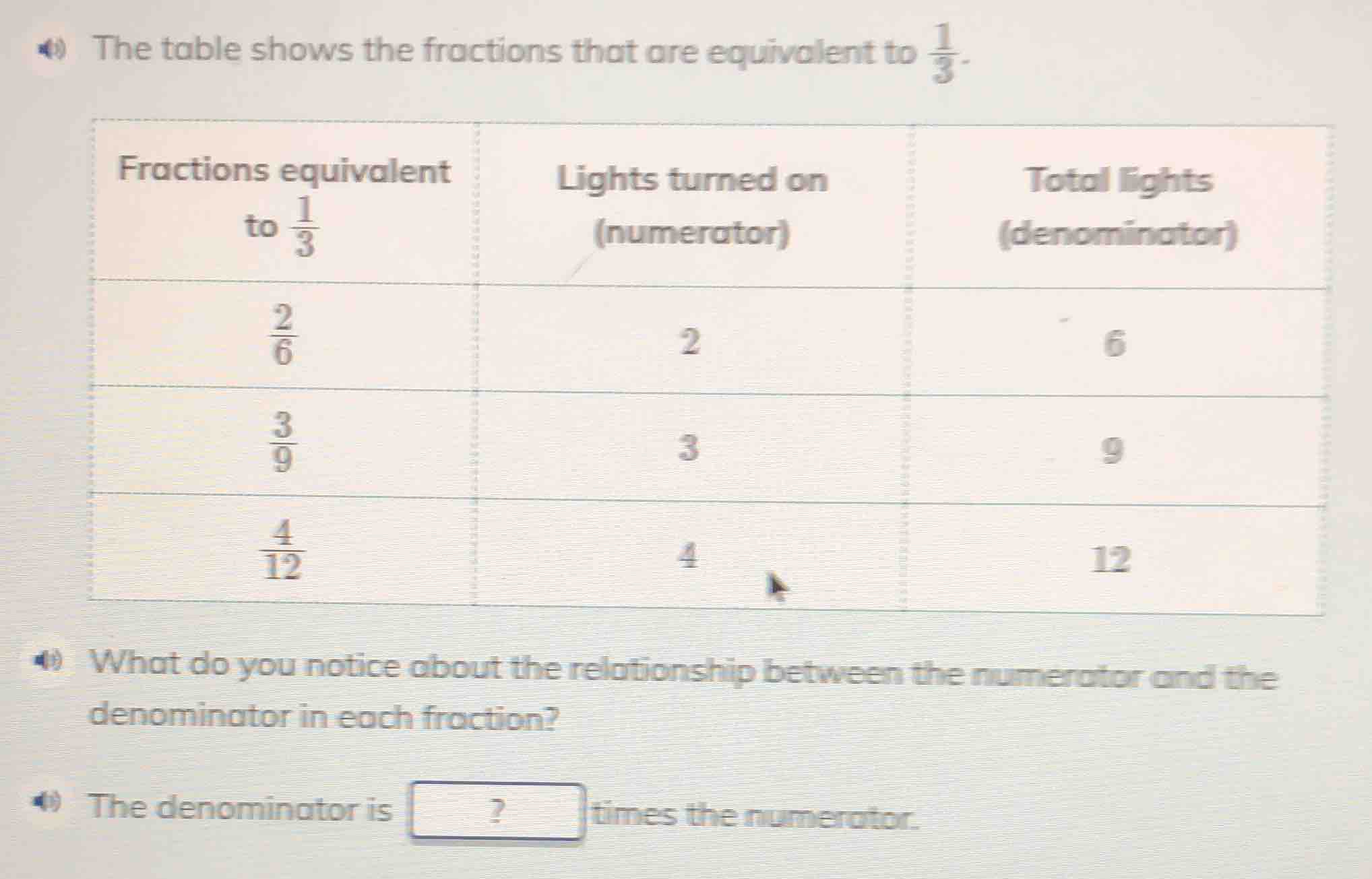
- the table shows the fractions that are equivalent to \\(\frac{1}{3}\\).
fractions equivalent to \\(\frac{1}{3}\\) | lights turned on (numerator) | total lights (denominator)
--- | --- | ---
\\(\frac{2}{6}\\) | 2 | 6
\\(\frac{3}{9}\\) | 3 | 9
\\(\frac{4}{12}\\) | 4 | 12
- what do you notice about the relationship between the numerator and the denominator in each fraction?
- the denominator is \\(\boldsymbol{?}\\) times the numerator.
Step1: Analyze the first fraction
For the fraction $\frac{2}{6}$, the numerator is 2 and the denominator is 6. Calculate the ratio of denominator to numerator: $\frac{6}{2} = 3$.
Step2: Analyze the second fraction
For the fraction $\frac{3}{9}$, the numerator is 3 and the denominator is 9. Calculate the ratio: $\frac{9}{3} = 3$.
Step3: Analyze the third fraction
For the fraction $\frac{4}{12}$, the numerator is 4 and the denominator is 12. Calculate the ratio: $\frac{12}{4} = 3$.

Snap & solve any problem in the app
Get step-by-step solutions on Sovi AI
Photo-based solutions with guided steps
Explore more problems and detailed explanations
3