QUESTION IMAGE
Question
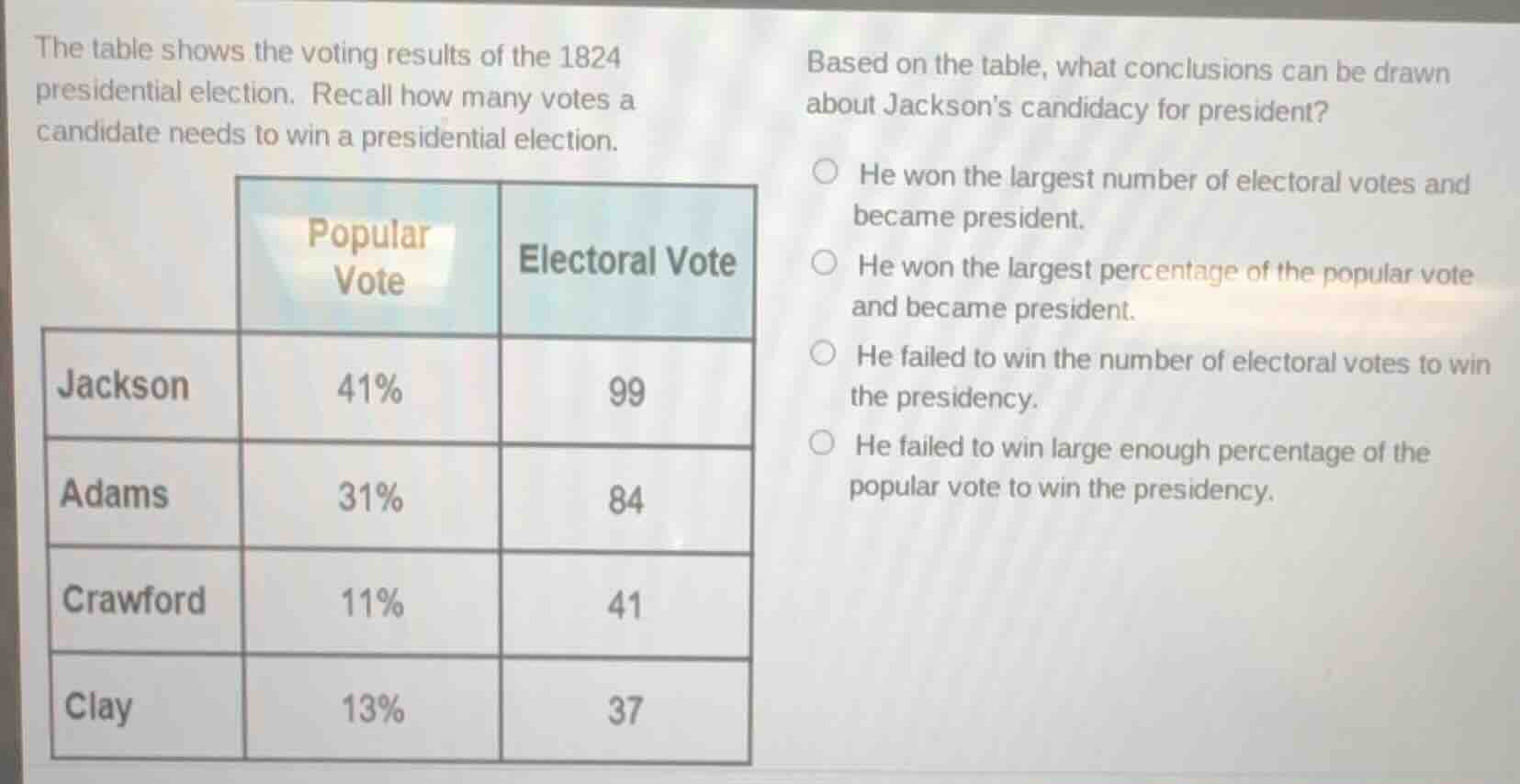
the table shows the voting results of the 1824 presidential election. recall how many votes a candidate needs to win a presidential election.
| popular vote | electoral vote | |
|---|---|---|
| adams | 31% | 84 |
| crawford | 11% | 41 |
| clay | 13% | 37 |
based on the table, what conclusions can be drawn about jacksons candidacy for president?
- he won the largest number of electoral votes and became president.
- he won the largest percentage of the popular vote and became president.
- he failed to win the number of electoral votes to win the presidency.
- he failed to win large enough percentage of the popular vote to win the presidency.
To win a presidential election, a candidate needs a majority of electoral votes (more than half of the total electoral votes). First, calculate the total electoral votes: \(99 + 84 + 41 + 37 = 261\). The majority would be more than \(\frac{261}{2}=130.5\), so at least 131 electoral votes. Jackson got 99 electoral votes, which is less than 131.
- Option 1: Jackson didn't become president (the election went to the House), so this is wrong.
- Option 2: Jackson didn't become president, so this is wrong.
- Option 3: Since 99 < 131, he failed to get enough electoral votes to win, this is correct.
- Option 4: Jackson had the highest popular vote percentage (41%), so this is wrong.

Snap & solve any problem in the app
Get step-by-step solutions on Sovi AI
Photo-based solutions with guided steps
Explore more problems and detailed explanations
He failed to win the number of electoral votes to win the presidency.