QUESTION IMAGE
Question
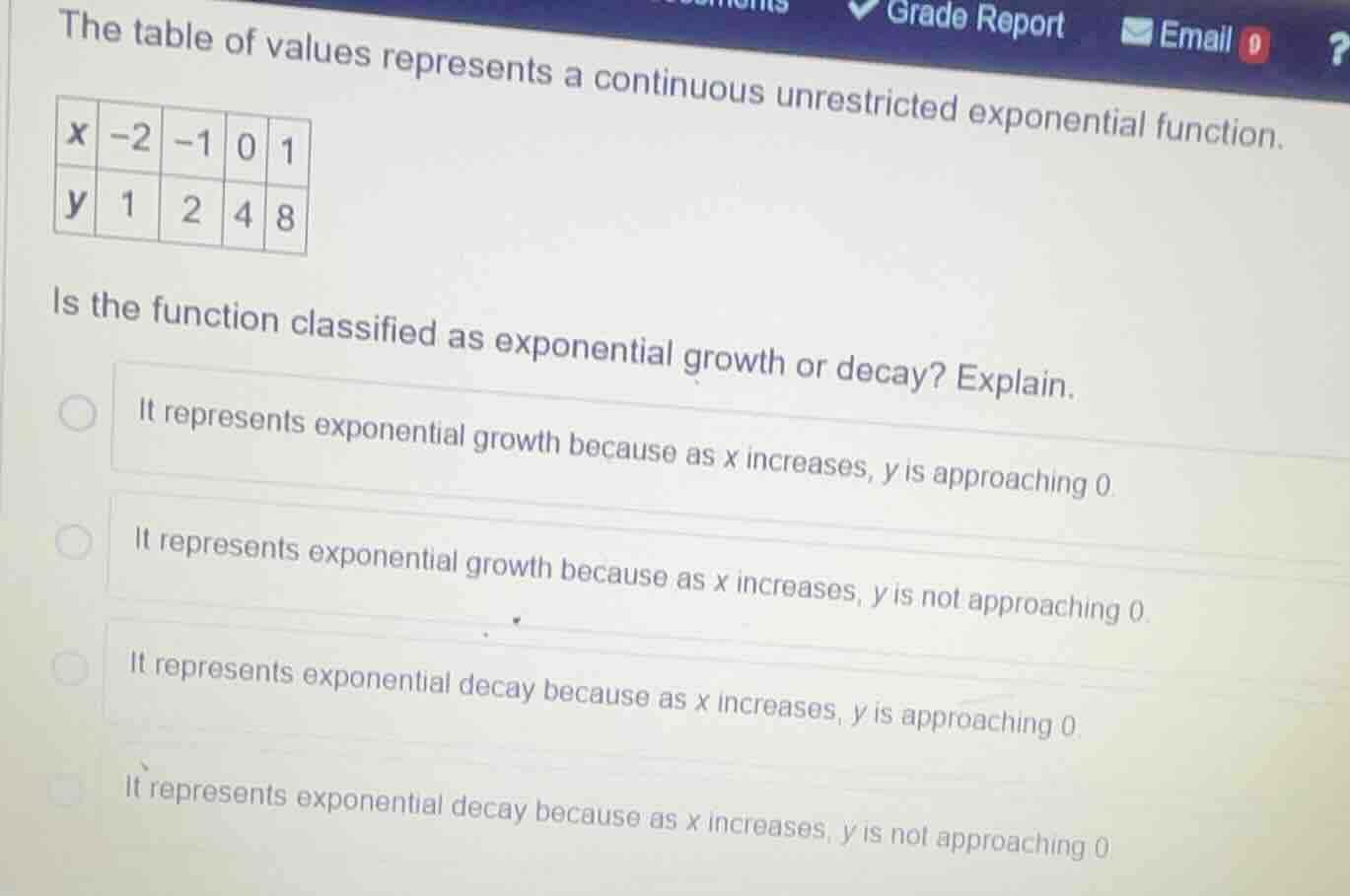
the table of values represents a continuous unrestricted exponential function.
| x | -2 | -1 | 0 | 1 |
| y | 1 | 2 | 4 | 8 |
is the function classified as exponential growth or decay? explain.
- it represents exponential growth because as x increases, y is approaching 0.
- it represents exponential growth because as x increases, y is not approaching 0.
- it represents exponential decay because as x increases, y is approaching 0.
- it represents exponential decay because as x increases, y is not approaching 0.
To determine if the exponential function is growth or decay, we analyze the \( y \)-values as \( x \) increases. From the table, when \( x = -2 \), \( y = 1 \); \( x = -1 \), \( y = 2 \); \( x = 0 \), \( y = 4 \); \( x = 1 \), \( y = 8 \). As \( x \) increases (from -2 to 1), \( y \) values are \( 1, 2, 4, 8 \), which are increasing (not approaching 0). Exponential growth occurs when \( y \) increases with \( x \) (base \( > 1 \)), and decay when \( y \) decreases (base between 0 and 1). Here, \( y \) is increasing, so it's growth. The first option's reasoning is wrong ( \( y \) isn't approaching 0), the second option correctly states growth because \( y \) increases (not approaching 0). The decay options are incorrect as \( y \) is increasing, not decreasing.

Snap & solve any problem in the app
Get step-by-step solutions on Sovi AI
Photo-based solutions with guided steps
Explore more problems and detailed explanations
It represents exponential growth because as \( x \) increases, \( y \) is not approaching 0.