QUESTION IMAGE
Question
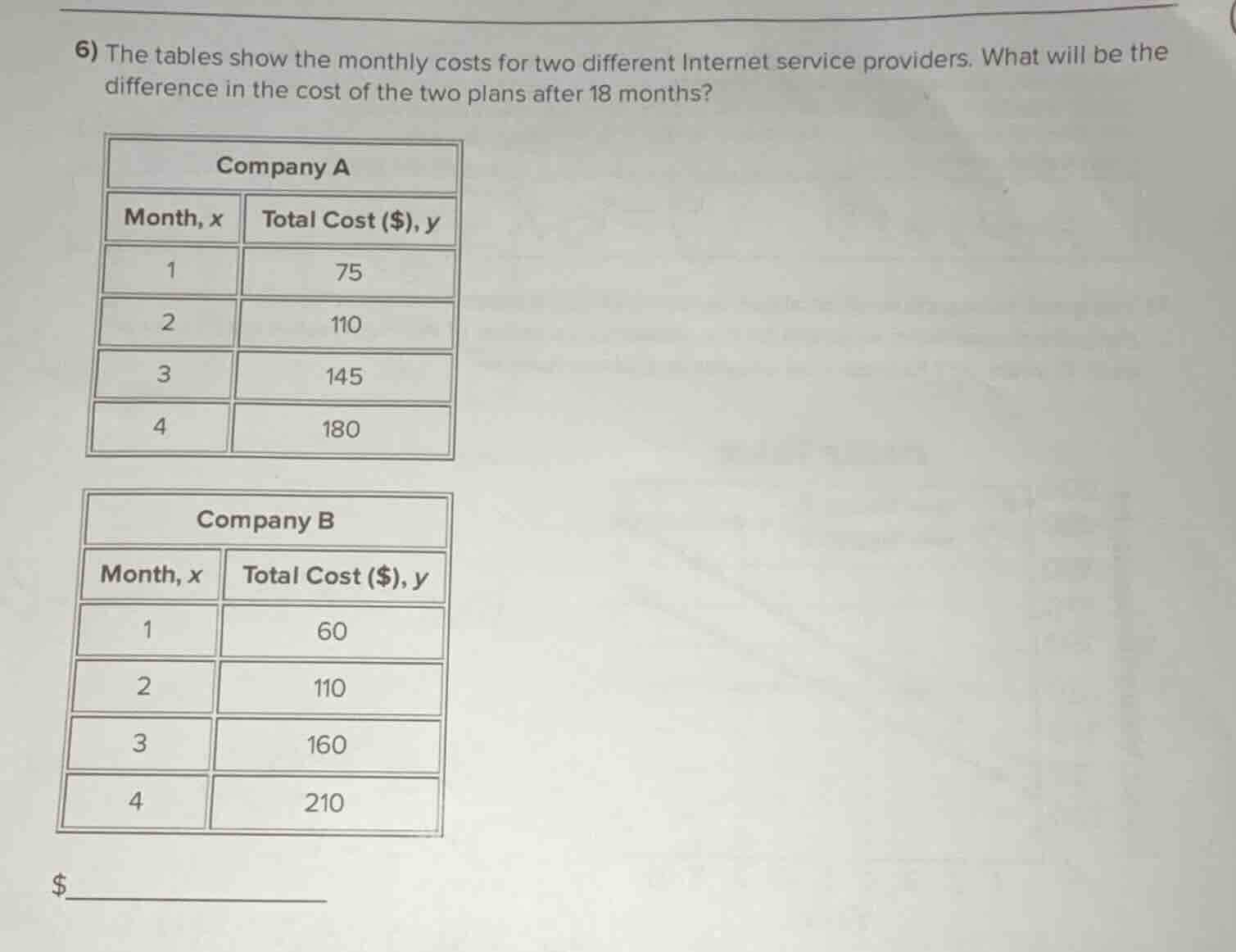
- the tables show the monthly costs for two different internet service providers. what will be the difference in the cost of the two plans after 18 months?
company a
| month, x | total cost ($), y |
|---|---|
| 2 | 110 |
| 3 | 145 |
| 4 | 180 |
company b
| month, x | total cost ($), y |
|---|---|
| 2 | 110 |
| 3 | 160 |
| 4 | 210 |
$\underline{quadquadquadquadquadquad}$
Step1: Find the pattern for Company A
First, we check the difference between consecutive total costs for Company A.
From month 1 to 2: \(110 - 75 = 35\)
From month 2 to 3: \(145 - 110 = 35\)
From month 3 to 4: \(180 - 145 = 35\)
So the cost for Company A increases by $35 each month. This is an arithmetic sequence with first term \(a_1 = 75\) and common difference \(d = 35\).
The formula for the \(n\)-th term of an arithmetic sequence is \(y_A = a_1 + (n - 1)d\).
For \(n = 18\), \(y_A = 75 + (18 - 1)\times35\)
\(y_A = 75 + 17\times35\)
\(y_A = 75 + 595 = 670\)
Step2: Find the pattern for Company B
Now, we check the difference between consecutive total costs for Company B.
From month 1 to 2: \(110 - 60 = 50\)
From month 2 to 3: \(160 - 110 = 50\)
From month 3 to 4: \(210 - 160 = 50\)
So the cost for Company B increases by $50 each month. This is an arithmetic sequence with first term \(a_1 = 60\) and common difference \(d = 50\).
The formula for the \(n\)-th term of an arithmetic sequence is \(y_B = a_1 + (n - 1)d\).
For \(n = 18\), \(y_B = 60 + (18 - 1)\times50\)
\(y_B = 60 + 17\times50\)
\(y_B = 60 + 850 = 910\)
Step3: Find the difference
Now we find the difference between the total costs of Company B and Company A after 18 months.
Difference \(= y_B - y_A = 910 - 670 = 240\) (Wait, no, wait. Wait, maybe I mixed up. Wait, let's recalculate. Wait, maybe I made a mistake in the first term. Wait, for Company A, at month 1, cost is 75. Let's check the formula again. Wait, the \(n\)-th term formula: when \(n = 1\), \(y = 75\). So \(y_A = 75 + (n - 1)\times35\). For \(n = 1\), \(75 + 0 = 75\), correct. For \(n = 2\), \(75 + 35 = 110\), correct. For \(n = 3\), \(75 + 2\times35 = 75 + 70 = 145\), correct. For \(n = 4\), \(75 + 3\times35 = 75 + 105 = 180\), correct. So that's right.
For Company B, at month 1, cost is 60. \(y_B = 60 + (n - 1)\times50\). For \(n = 1\), \(60 + 0 = 60\), correct. For \(n = 2\), \(60 + 50 = 110\), correct. For \(n = 3\), \(60 + 2\times50 = 60 + 100 = 160\), correct. For \(n = 4\), \(60 + 3\times50 = 60 + 150 = 210\), correct. So that's right.
Now, for \(n = 18\):
\(y_A = 75 + (18 - 1)\times35 = 75 + 17\times35 = 75 + 595 = 670\)
\(y_B = 60 + (18 - 1)\times50 = 60 + 17\times50 = 60 + 850 = 910\)
Now, the difference is \(|y_A - y_B| = |670 - 910| = 240\)? Wait, no, wait. Wait, maybe I got the direction wrong. Wait, let's check again. Wait, maybe the problem is to find the difference between the two plans, so we can also calculate the difference per month and then multiply by 18, adjusting for the initial difference.
Wait, another approach: Find the monthly increase and the initial cost.
For Company A:
Initial cost (month 1): $75
Monthly increase: $35 (as 110 - 75 = 35, 145 - 110 = 35, etc.)
So total cost after \(x\) months: \(y_A = 75 + 35(x - 1) = 35x + 40\) (simplify: \(75 - 35 + 35x = 40 + 35x\))
For Company B:
Initial cost (month 1): $60
Monthly increase: $50 (110 - 60 = 50, 160 - 110 = 50, etc.)
Total cost after \(x\) months: \(y_B = 60 + 50(x - 1) = 50x + 10\) (simplify: \(60 - 50 + 50x = 10 + 50x\))
Now, find the difference \(y_B - y_A\) (or \(y_A - y_B\), take absolute value) after \(x = 18\) months.
\(y_B - y_A = (50x + 10) - (35x + 40) = 15x - 30\)
Now, substitute \(x = 18\):
\(15\times18 - 30 = 270 - 30 = 240\)
Wait, but let's check with the first method. \(y_A = 670\), \(y_B = 910\), \(910 - 670 = 240\). So that's correct.
Wait, but let's verify with month 2. For \(x = 2\), \(y_A = 110\), \(y_B = 110\), difference is 0. Using the formula \(15x - 30\), \(15\times2 - 30 = 30…

Snap & solve any problem in the app
Get step-by-step solutions on Sovi AI
Photo-based solutions with guided steps
Explore more problems and detailed explanations
\(\$240\)