QUESTION IMAGE
Question
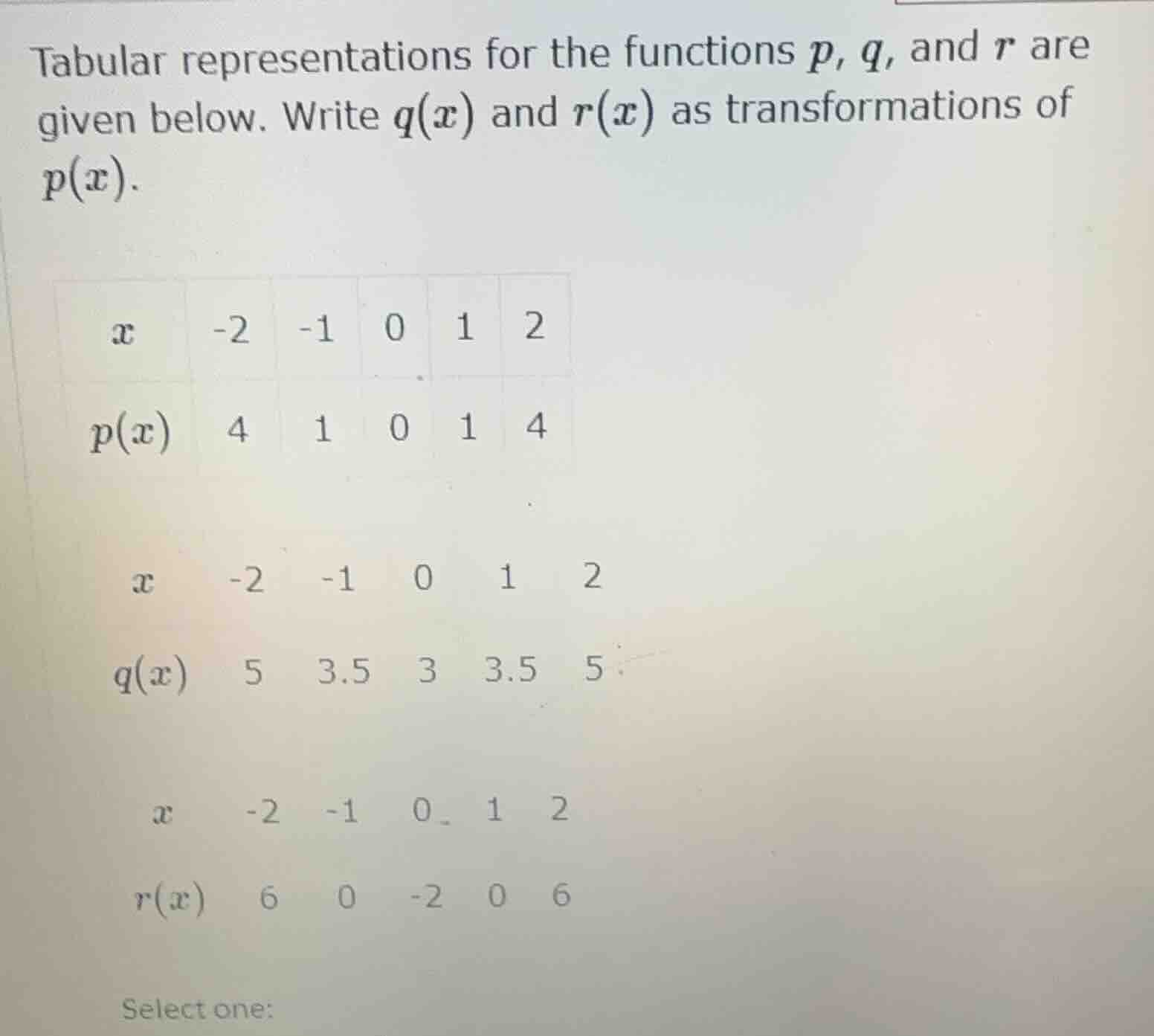
tabular representations for the functions ( p ), ( q ), and ( r ) are given below. write ( q(x) ) and ( r(x) ) as transformations of ( p(x) ).
| ( x ) | -2 | -1 | 0 | 1 | 2 |
|---|
| ( x ) | -2 | -1 | 0 | 1 | 2 |
|---|
| ( x ) | -2 | -1 | 0 | 1 | 2 |
|---|
select one:
Step1: Analyze q(x) vs p(x)
Compare corresponding values:
For each $x$, $q(x) - p(x) = 3$ (e.g., $5-4=3$, $3.5-1=2.5$? Correction: $3.5-1=2.5$ no, wait $p(x)$ is $x^2$, $q(x)$: at $x=0$, $q(0)=3$, $p(0)=0$; $x=1$, $q(1)=3.5$, $p(1)=1$: $3.5 = 1 + 2.5$? No, wait $q(x) = \frac{1}{2}p(x) + 3$: $\frac{1}{2}(4)+3=2+3=5$, $\frac{1}{2}(1)+3=0.5+3=3.5$, $\frac{1}{2}(0)+3=3$. Correct.
Step2: Define q(x) transformation
$q(x) = \frac{1}{2}p(x) + 3$
Step3: Analyze r(x) vs p(x)
Compare corresponding values:
$r(x) - p(x) = 2$? No: $6-4=2$, $0-1=-1$ no. $r(x) = 2p(x) - 2$: $2(4)-2=8-2=6$, $2(1)-2=2-2=0$, $2(0)-2=-2$. Correct.
Step4: Define r(x) transformation
$r(x) = 2p(x) - 2$

Snap & solve any problem in the app
Get step-by-step solutions on Sovi AI
Photo-based solutions with guided steps
Explore more problems and detailed explanations
$q(x) = \frac{1}{2}p(x) + 3$
$r(x) = 2p(x) - 2$