QUESTION IMAGE
Question
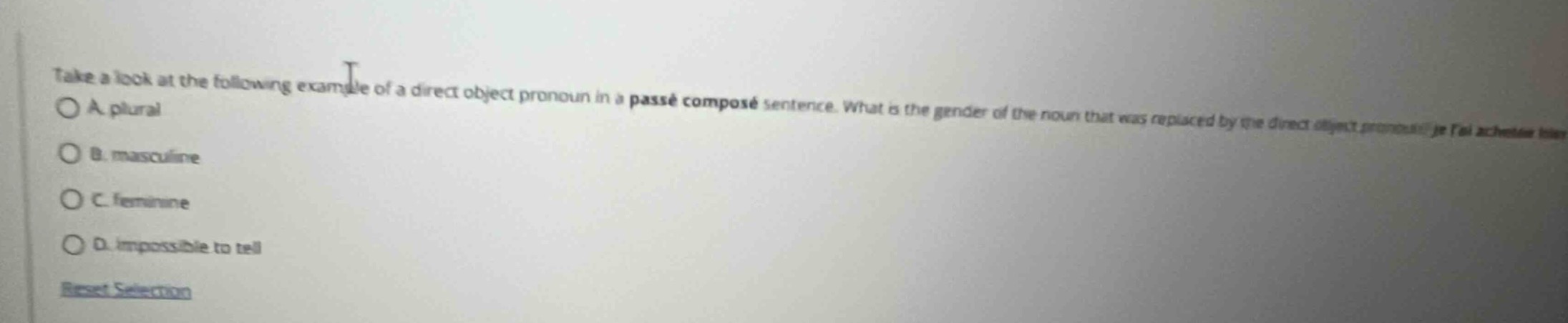
take a look at the following example of a direct object pronoun in a passé composé sentence. what is the gender of the noun that was replaced by the direct object pronoun in je lai acheté hier?
a. plural
b. masculine
c. feminine
d. impossible to tell
reset selection
In French, the direct object pronoun "leur" is used for plural (but here the pronoun in the sentence "je l'ai acheté" – wait, maybe a typo, but if we consider "le" (masculine direct object pronoun) or "la" (feminine). Wait, the sentence might be "je l'ai acheté" (I bought it (masculine)). Wait, the options: if the pronoun is "le" (masculine), then the noun is masculine. Wait, the options are A. plural, B. masculine, C. feminine, D. impossible. Wait, the direct object pronoun "le" (masculine singular), "la" (feminine singular), "les" (plural). So if the pronoun is "le" (masculine), then the noun is masculine. So the correct option is B. masculine.

Snap & solve any problem in the app
Get step-by-step solutions on Sovi AI
Photo-based solutions with guided steps
Explore more problems and detailed explanations
B. masculine