QUESTION IMAGE
Question
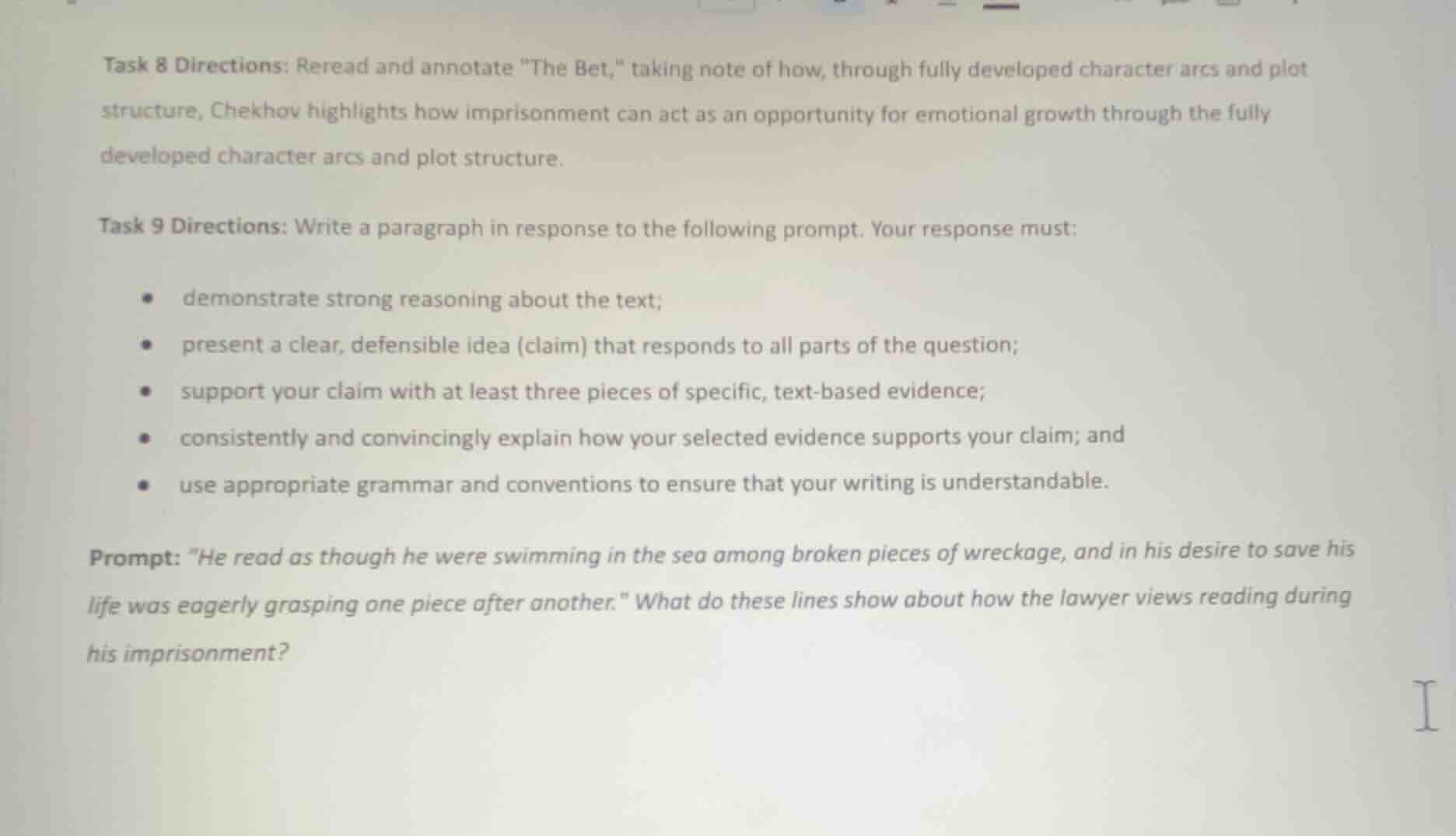
task 8 directions: reread and annotate \the bet,\ taking note of how, through fully developed character arcs and plot structure, chekhov highlights how imprisonment can act as an opportunity for emotional growth through the fully developed character arcs and plot structure.
task 9 directions: write a paragraph in response to the following prompt. your response must:
- demonstrate strong reasoning about the text;
- present a clear, defensible idea (claim) that responds to all parts of the question;
- support your claim with at least three pieces of specific, text - based evidence;
- consistently and convincingly explain how your selected evidence supports your claim; and
- use appropriate grammar and conventions to ensure that your writing is understandable.
prompt: \he read as though he were swimming in the sea among broken pieces of wreckage, and in his desire to save his life was eagerly grasping one piece after another.\ what do these lines show about how the lawyer views reading during his imprisonment?
To answer this, we analyze the metaphor in the quote. The lawyer’s reading is compared to swimming among wreckage and grasping pieces to save his life. This shows he views reading as a vital, urgent means of survival (emotional/intellectual) in imprisonment. He’s eager, treating each book/idea as a “piece” to cling to, implying reading is his way to stay mentally alive, grow, and escape the isolation’s “wreckage.” Specific evidence: the metaphor of “swimming in the sea among broken pieces” (imprisonment as a chaotic, threatening sea) and “eagerly grasping one piece after another” (reading as urgent, life - saving action). His desperation to “save his life” via reading shows he sees it as essential for mental sustenance, growth, and overcoming the imprisonment’s psychological toll.

Snap & solve any problem in the app
Get step-by-step solutions on Sovi AI
Photo-based solutions with guided steps
Explore more problems and detailed explanations
In “The Bet,” the lines show the lawyer views reading as a desperate, life - saving act of intellectual and emotional survival during imprisonment. The metaphor of swimming “among broken pieces of wreckage” likens his imprisoned state to a chaotic, threatening sea, where reading is his way to “save his life.” By “eagerly grasping one piece after another,” he treats each text (or idea within it) as a vital “piece” to cling to—implying reading is his urgent, essential means of mental sustenance, growth, and escape from the psychological “wreckage” of isolation. This eagerness and the survival - driven imagery reveal he sees reading not as a passive pastime, but as a lifeline to stay mentally alive, develop emotionally, and overcome the dehumanizing effects of his confinement.