QUESTION IMAGE
Question
task 3
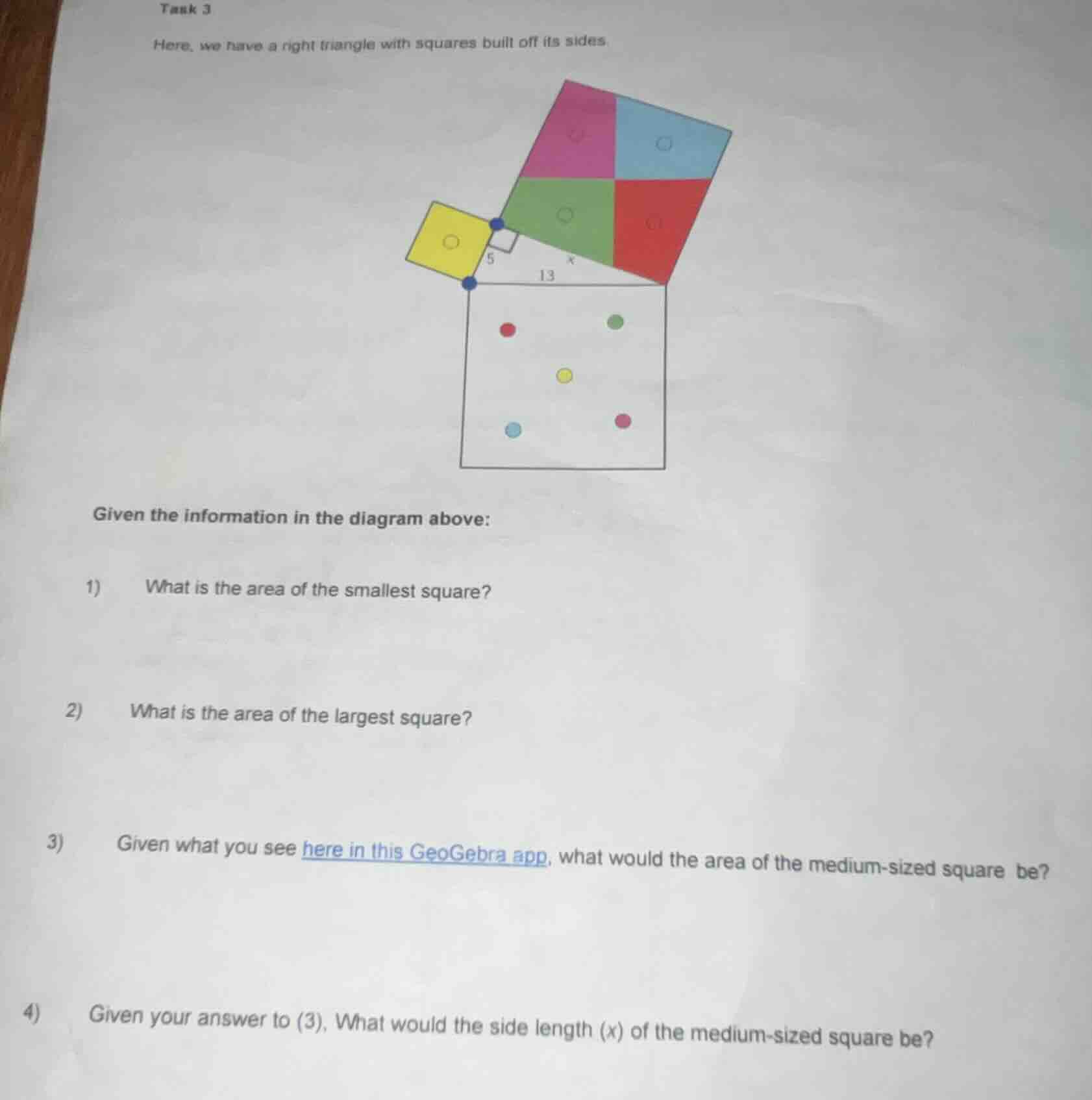
here, we have a right triangle with squares built off its sides.
given the information in the diagram above:
- what is the area of the smallest square?
- what is the area of the largest square?
- given what you see here in this geogebra app, what would the area of the medium - sized square be?
- given your answer to (3), what would the side length (x) of the medium - sized square be?
1)
Step1: Identify side of smallest square
The smallest square is built on the side of length 5. For a square, area = side².
$Area = 5^2 = 25$
Step1: Identify side of largest square
The largest square is built on the side of length 13. Area of square = side².
$Area = 13^2 = 169$
Step1: Recall Pythagorean theorem for areas
In a right triangle, the sum of the areas of the squares on the legs equals the area of the square on the hypotenuse. Let \( A_{small} = 25 \), \( A_{large} = 169 \), and \( A_{medium} \) be the area of the medium - sized square. Then \( A_{small}+A_{medium}=A_{large} \) (wait, no, actually the two legs' squares sum to the hypotenuse's square. Wait, the right triangle has legs 5 and \( x \), hypotenuse 13? Wait, no, looking at the diagram, the right triangle has one leg 5, hypotenuse 13, and the other leg \( x \). Wait, no, the squares: the smallest square (side 5), medium square (side \( x \)), largest square (side 13). By Pythagorean theorem, \( 5^{2}+x^{2}=13^{2} \), so the area of the medium square \( A = x^{2}=13^{2}-5^{2} \).
Step2: Calculate \( 13^{2}-5^{2} \)
\( 13^{2}=169 \), \( 5^{2}=25 \), so \( 169 - 25=144 \)

Snap & solve any problem in the app
Get step-by-step solutions on Sovi AI
Photo-based solutions with guided steps
Explore more problems and detailed explanations
25