QUESTION IMAGE
Question
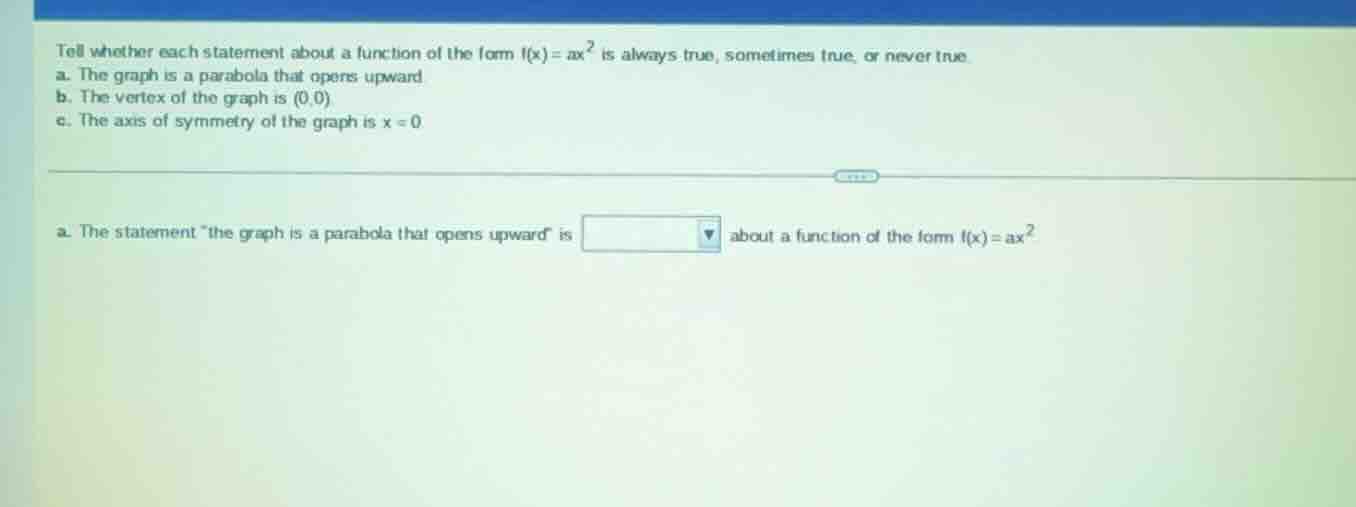
tell whether each statement about a function of the form ( f(x) = ax^2 ) is always true, sometimes true, or never true.
a. the graph is a parabola that opens upward
b. the vertex of the graph is ( (0, 0) )
c. the axis of symmetry of the graph is ( x = 0 )
a. the statement \the graph is a parabola that opens upward\ is (\boldsymbol{\text{dropdown}}) about a function of the form ( f(x) = ax^2 )
Step1: Recall the properties of \( f(x) = ax^2 \)
The graph of \( f(x)=ax^2 \) is a parabola. The direction it opens depends on the sign of \( a \). If \( a>0 \), the parabola opens upward; if \( a < 0 \), it opens downward. If \( a = 0 \), the function is not a quadratic function (it becomes \( f(x)=0 \), a horizontal line), but typically in the context of \( f(x)=ax^2 \) as a quadratic function, \( a
eq0 \). However, since \( a \) can be positive or negative, the statement "the graph is a parabola that opens upward" is not always true (because \( a \) could be negative, making it open downward) but is sometimes true (when \( a>0 \)).

Snap & solve any problem in the app
Get step-by-step solutions on Sovi AI
Photo-based solutions with guided steps
Explore more problems and detailed explanations
sometimes true