QUESTION IMAGE
Question
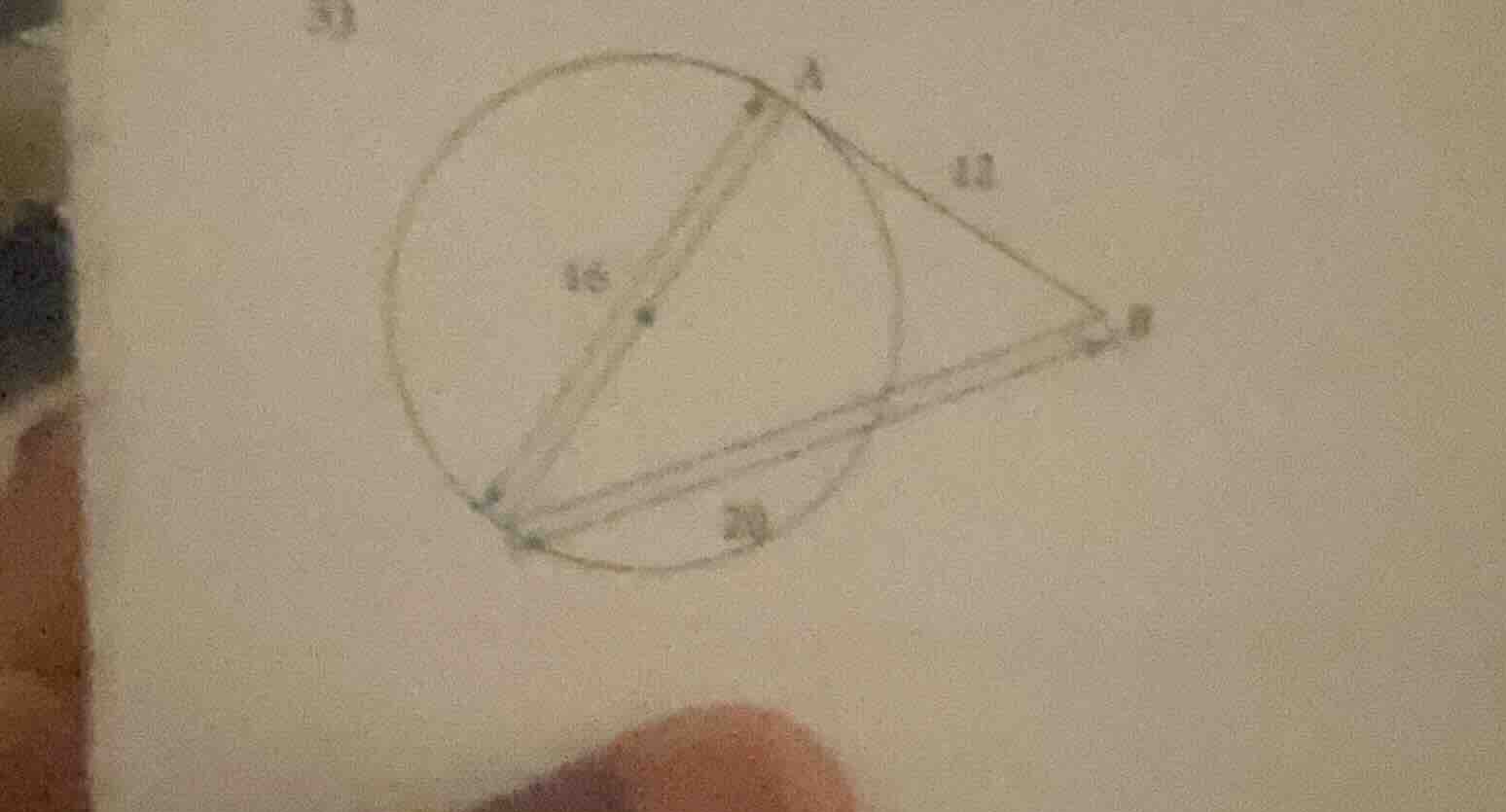
- there is a circle with a diameter of 16, a tangent segment of length 11 from an external point b to the circle, and a secant segment from b passing through the circle with the external part and the whole secant length related (the arc or chord length is 20, etc.).
Step1: Recall the tangent - secant rule
The tangent - secant rule states that if a tangent segment \(PB\) and a secant segment \(PAB\) (where \(PA\) is the external part and \(AB\) is the internal part of the secant) are drawn from an external point \(P\) to a circle, then \(PB^{2}=PA\times(PA + AB)\). Wait, actually, the correct formula is: If a tangent from point \(P\) touches the circle at \(A\) and a secant from \(P\) passes through the circle, intersecting it at \(C\) and \(D\) (with \(PC\) being the external segment and \(PD\) being the entire secant segment), then \(PA^{2}=PC\times PD\).
Looking at the diagram, let's assume: Let the tangent length be \(11\) (from \(P\) to \(A\)), the diameter of the circle is \(16\), so the radius is \(8\), and the length of the secant from \(P\) to the far side of the circle is \(x\), and the external part of the secant is \(y\), and the internal part is \(16\)? Wait, maybe I misread. Wait, the diagram has a tangent of length \(11\), a secant that goes through the circle, with the part inside the circle being \(16\) (maybe the diameter) and the external part? Wait, no, let's re - examine.
Wait, the correct formula for tangent and secant: Let \(PT\) be the tangent (length \(t\)) and \(PAB\) be the secant, where \(PA\) is the external segment (length \(e\)) and \(AB\) is the internal segment (length \(i\)), then \(t^{2}=e\times(e + i)\).
In the diagram, let's suppose the tangent is \(11\), the secant has an external part \(x\) and the internal part is \(16\) (maybe the diameter, so the length of the secant from the external point to the first intersection is \(x\), and from the first intersection to the second is \(16\)). Wait, no, maybe the secant length from the external point \(P\) to the circle is composed of two parts: the external segment \(PA\) and the internal segment \(AB = 16\), and the tangent \(PB=11\)? Wait, no, the labels: the tangent is \(11\), the secant has a part of \(16\) (maybe the chord length) and another part. Wait, maybe the diameter is \(16\), so the radius is \(8\), and the secant from \(P\) to the circle: let the distance from \(P\) to the center be \(d\), the tangent length \(l = 11\), the radius \(r = 8\), then by the Pythagorean theorem, \(d^{2}=l^{2}+r^{2}=11^{2}+8^{2}=121 + 64=185\). Then, for the secant, if the secant passes through the center, the length of the secant from \(P\) to the far side of the circle is \(d + r\) and from \(P\) to the near side is \(d - r\). Wait, no, the secant length from \(P\) to the far side is \(d + r\) and to the near side is \(d - r\), so the product of the external segment (\(d - r\)) and the entire secant segment (\(d + r\)) is \((d - r)(d + r)=d^{2}-r^{2}=l^{2}\) (by Pythagoras, since \(l^{2}=d^{2}-r^{2}\)). Wait, that's the tangent - secant theorem: \(l^{2}=(d - r)(d + r)\), where \((d - r)\) is the external part of the secant and \((d + r)\) is the entire secant.
Wait, maybe the secant has an external part \(x\) and the internal part \(16\) (the diameter). So the secant length is \(x + 16\), and the external part is \(x\). Then by the tangent - secant theorem: \(11^{2}=x(x + 16)\). Wait, but that would be a quadratic equation. But maybe the secant is passing through the center, so the length of the secant from \(P\) to the circle is \(x\) (external) and the diameter is \(16\), so the total secant length is \(x+16\). But maybe I made a mistake. Wait, the other length is \(20\)? Wait, the diagram has a \(20\) as well. Oh! Maybe the secant is composed of two parts: the external part is \(y\) and the internal part is \(16…

Snap & solve any problem in the app
Get step-by-step solutions on Sovi AI
Photo-based solutions with guided steps
Explore more problems and detailed explanations
Step1: Recall the tangent - secant rule
The tangent - secant rule states that if a tangent segment \(PB\) and a secant segment \(PAB\) (where \(PA\) is the external part and \(AB\) is the internal part of the secant) are drawn from an external point \(P\) to a circle, then \(PB^{2}=PA\times(PA + AB)\). Wait, actually, the correct formula is: If a tangent from point \(P\) touches the circle at \(A\) and a secant from \(P\) passes through the circle, intersecting it at \(C\) and \(D\) (with \(PC\) being the external segment and \(PD\) being the entire secant segment), then \(PA^{2}=PC\times PD\).
Looking at the diagram, let's assume: Let the tangent length be \(11\) (from \(P\) to \(A\)), the diameter of the circle is \(16\), so the radius is \(8\), and the length of the secant from \(P\) to the far side of the circle is \(x\), and the external part of the secant is \(y\), and the internal part is \(16\)? Wait, maybe I misread. Wait, the diagram has a tangent of length \(11\), a secant that goes through the circle, with the part inside the circle being \(16\) (maybe the diameter) and the external part? Wait, no, let's re - examine.
Wait, the correct formula for tangent and secant: Let \(PT\) be the tangent (length \(t\)) and \(PAB\) be the secant, where \(PA\) is the external segment (length \(e\)) and \(AB\) is the internal segment (length \(i\)), then \(t^{2}=e\times(e + i)\).
In the diagram, let's suppose the tangent is \(11\), the secant has an external part \(x\) and the internal part is \(16\) (maybe the diameter, so the length of the secant from the external point to the first intersection is \(x\), and from the first intersection to the second is \(16\)). Wait, no, maybe the secant length from the external point \(P\) to the circle is composed of two parts: the external segment \(PA\) and the internal segment \(AB = 16\), and the tangent \(PB=11\)? Wait, no, the labels: the tangent is \(11\), the secant has a part of \(16\) (maybe the chord length) and another part. Wait, maybe the diameter is \(16\), so the radius is \(8\), and the secant from \(P\) to the circle: let the distance from \(P\) to the center be \(d\), the tangent length \(l = 11\), the radius \(r = 8\), then by the Pythagorean theorem, \(d^{2}=l^{2}+r^{2}=11^{2}+8^{2}=121 + 64=185\). Then, for the secant, if the secant passes through the center, the length of the secant from \(P\) to the far side of the circle is \(d + r\) and from \(P\) to the near side is \(d - r\). Wait, no, the secant length from \(P\) to the far side is \(d + r\) and to the near side is \(d - r\), so the product of the external segment (\(d - r\)) and the entire secant segment (\(d + r\)) is \((d - r)(d + r)=d^{2}-r^{2}=l^{2}\) (by Pythagoras, since \(l^{2}=d^{2}-r^{2}\)). Wait, that's the tangent - secant theorem: \(l^{2}=(d - r)(d + r)\), where \((d - r)\) is the external part of the secant and \((d + r)\) is the entire secant.
Wait, maybe the secant has an external part \(x\) and the internal part \(16\) (the diameter). So the secant length is \(x + 16\), and the external part is \(x\). Then by the tangent - secant theorem: \(11^{2}=x(x + 16)\). Wait, but that would be a quadratic equation. But maybe the secant is passing through the center, so the length of the secant from \(P\) to the circle is \(x\) (external) and the diameter is \(16\), so the total secant length is \(x+16\). But maybe I made a mistake. Wait, the other length is \(20\)? Wait, the diagram has a \(20\) as well. Oh! Maybe the secant is composed of two parts: the external part is \(y\) and the internal part is \(16\), but there is another segment of \(20\). Wait, no, let's look again.
Wait, maybe the tangent is \(11\), the secant has an external segment of length \(x\) and the entire secant (from \(P\) to the second intersection) is \(x + 16\), but there is a segment of \(20\). Wait, perhaps the secant is \(x\) (external) and the chord is \(16\), and the other segment is \(20\). Wait, I think I misread the diagram. Let's assume: Let the tangent be \(11\), the secant from \(P\) to the circle: the external part is \(x\), and the part inside the circle is \(16\), and there is a segment of \(20\) which is the length from \(P\) to the center? No, that doesn't make sense.
Wait, maybe the correct approach: Let's denote the tangent as \(t = 11\), the secant has an external segment \(a\) and the internal segment \(b = 16\), and the length of the secant from \(P\) to the first intersection is \(a\), and from the first to the second is \(b = 16\). Then by the tangent - secant formula: \(t^{2}=a(a + b)\). But we also see a length of \(20\). Wait, maybe the secant is \(a + 16\), and \(a+16 = 20\)? No, \(20-16 = 4\), then \(11^{2}=4\times20\)? \(121 = 80\), no. Wait, maybe the diameter is \(16\), so the radius is \(8\), and the distance from \(P\) to the center is \(d\), then \(d^{2}=11^{2}+8^{2}=121 + 64 = 185\). Then the length of the secant from \(P\) to the circle: the secant length \(L\) can be found by \(L = 2\sqrt{d^{2}-r^{2}}\)? No, that's for a chord through the center. Wait, no, the secant from \(P\) to the circle: if the secant passes through the center, then the length of the secant is \(d - r\) (external) and \(d + r\) (total). So \(d - r=\sqrt{d^{2}-r^{2}}=\sqrt{185 - 64}=\sqrt{121}=11\)? No, that's the tangent. Wait, I'm confused.
Wait, maybe the diagram has a tangent of length \(11\), a secant that has an external part of length \(x\) and the internal part is \(16\), and the length of the secant from \(P\) to the second intersection is \(x + 16\), and there is a segment of \(20\) which is \(x + 16\). So \(x+16 = 20\), then \(x = 4\). Then check the tangent - secant formula: \(11^{2}=4\times20\)? \(121
eq80\). That's not correct.
Wait, maybe the formula is different. Wait, the correct tangent - secant theorem is: If a tangent from \(P\) touches the circle at \(T\) and a secant from \(P\) intersects the circle at \(A\) and \(B\) (with \(PA\) being the external segment and \(PB\) being the entire secant segment, so \(PB=PA + AB\)), then \(PT^{2}=PA\times PB\).
Looking at the diagram, let's assume that the tangent length is \(11\), the secant has \(PA=x\) (external) and \(AB = 16\) (internal), and \(PB=x + 16\), and there is a length of \(20\) which is \(PB\). So \(PB = 20\), then \(PA=20 - 16=4\). Then check \(11^{2}=4\times20\)? \(121 = 80\), no. That's wrong.
Wait, maybe the diameter is \(16\), so the radius is \(8\), and the distance from \(P\) to the center is \(d\). The tangent length \(l = 11\), so \(d^{2}=l^{2}+r^{2}=121 + 64 = 185\). The length of the secant from \(P\) to the circle: if the secant passes through the center, then the length of the secant is \(d - r\) (external) and \(d + r\) (total). So \(d - r=\sqrt{d^{2}-r^{2}}=\sqrt{185 - 64}=\sqrt{121}=11\) (which is the tangent), and \(d + r=\sqrt{185}+8\approx13.6 + 8 = 21.6\), which is not \(20\).
Wait, maybe the diagram has a tangent of length \(11\), a secant with external part \(x\) and internal part \(16\), and the length of the secant is \(x + 16\), and we need to find \(x\) such that \(11^{2}=x(x + 16)\). Solving \(x^{2}+16x - 121 = 0\). Using the quadratic formula \(x=\frac{-16\pm\sqrt{256 + 484}}{2}=\frac{-16\pm\sqrt{740}}{2}=\frac{-16\pm2\sqrt{185}}{2}=-8\pm\sqrt{185}\). Since length can't be negative, \(x=-8+\sqrt{185}\approx - 8 + 13.6=5.6\). But there is a \(20\) in the diagram. Maybe the \(20\) is the length of the secant. So if the secant length is \(20\), and the internal part is \(16\), then the external part is \(20 - 16 = 4\). Then \(11^{2}=4\times20\)? No.
Wait, maybe I mixed up the tangent and secant. Wait, maybe the \(11\) is the secant and the \(20\) is the tangent? No, the tangent is a single - point contact.
Wait, another approach: Let's assume that the circle has a diameter of \(16\), so radius \(r = 8\). Let the distance from the external point \(P\) to the center of the circle be \(d\). The length of the tangent from \(P\) to the circle is \(l = 11\), so by the Pythagorean theorem, \(d^{2}=l^{2}+r^{2}=11^{2}+8^{2}=121 + 64 = 185\). Now, the length of the secant from \(P\) to the circle: if the secant passes through the center, then the length of the secant is \(d + r\) (from \(P\) to the far side) and \(d - r\) (from \(P\) to the near side). So the length of the secant from \(P\) to the far side is \(d + r=\sqrt{185}+8\approx13.6+8 = 21.6\), and to the near side is \(d - r=\sqrt{185}-8\approx13.6 - 8 = 5.6\). But the diagram has a \(20\), which is close to \(21.6\), maybe a rounding error. And the \(16\) is the diameter (\(2r = 16\), so \(r = 8\)), which matches.
But the question is probably to find the length of the tangent or the secant. Wait, maybe the problem is to find the length of the tangent or the secant, but the user hasn't specified. Wait, maybe the original problem is to find the length of the tangent or the secant, and we have to use the tangent - secant theorem.
Wait, let's start over. Let's denote:
Let \(PT\) be the tangent (length \(t\)), \(PAB\) be the secant, where \(PA\) is the external segment (length \(e\)) and \(AB\) is the internal segment (length \(i\)). Then \(t^{2}=e(e + i)\).
From the diagram, let's assume:
- The internal segment \(i = 16\) (the diameter, so the chord length is \(16\))
- The entire secant segment \(PB=e + i=20\) (so \(e=20 - 16 = 4\))
- The tangent length \(t = 11\)
Wait, but \(11^{2}=121\) and \(4\times20 = 80\), which are not equal. So there must be a mistake in my assumption.
Wait, maybe the internal segment is not \(16\) but the length of the secant from \(A\) to \(B\) is \(16\), and the external segment \(PA=x\), and the tangent \(PT = 11\), and the length \(PB=x + 16\), and there is a \(20\) which is \(x\). So \(x = 20\), then \(t^{2}=20\times(20 + 16)=20\times36 = 720\), then \(t=\sqrt{720}\approx26.83\), which is not \(11\).
Wait, I think I misread the diagram. Maybe the \(16\) is the length of the external segment, and the internal segment is \(20\), and the tangent is \(11\). Then \(t^{2}=16\times(16 + 20)=16\times36 = 576\), \(t = 24\), not \(11\).
Wait, maybe the diagram has a tangent of length \(11\), a secant with external part \(x\) and the secant length (from \(P\) to the second intersection) is \(x + 16\), and we need to find \(x\) such that \(11^{2}=x(x + 16)\).
Solving \(x^{2}+16x-121 = 0\)
Using the quadratic formula \(x=\frac{-16\pm\sqrt{16^{2}+4\times121}}{2}=\frac{-16\pm\sqrt{256 + 484}}{2}=\frac{-16\pm\sqrt{740}}{2}=\frac{-16\pm2\sqrt{185}}{2}=-8\pm\sqrt{185}\)
Since \(x>0\), \(x=-8+\sqrt{185}\approx - 8 + 13.601=5.601\)
But the diagram has a \(20\), maybe the \(20\) is \(x + 16\), so \(x + 16=20\), \(x = 4\), but that doesn't satisfy the tangent - secant formula.
Wait, maybe the formula is for two secants: If two secants are drawn from \(P\), one intersecting the circle at \(A\) and \(B\), and the other at \(C\) and \(D\), then \(PA\times PB=PC\times PD\). But there is a tangent, so it's the tangent - secant case.
Alternatively, maybe the diagram is a right triangle with the tangent, the radius, and the line from \(P\) to the center. The radius is \(8\) (since diameter is \(16\)), the tangent is \(11\), so the distance from \(P\) to the center is \(\sqrt{11^{2}+8^{2}}=\sqrt{121 + 64}=\sqrt{185}\approx13.6\). Then the length of the secant from \(P\) to the circle: if the secant passes through the center, the length from \(P\) to the far side is \(\sqrt{185}+8\approx21.6\), and to the near side is \(\sqrt{185}-8\approx5.6\). The \(20\) in the diagram is close to \(21.6\), maybe a measurement error, and the \(16\) is the diameter.
But since the user hasn't specified the question, maybe the original question is to find the length of the tangent or the secant, and we have to use the tangent - secant theorem. Assuming the question is to find the length of the tangent or the sec