QUESTION IMAGE
Question
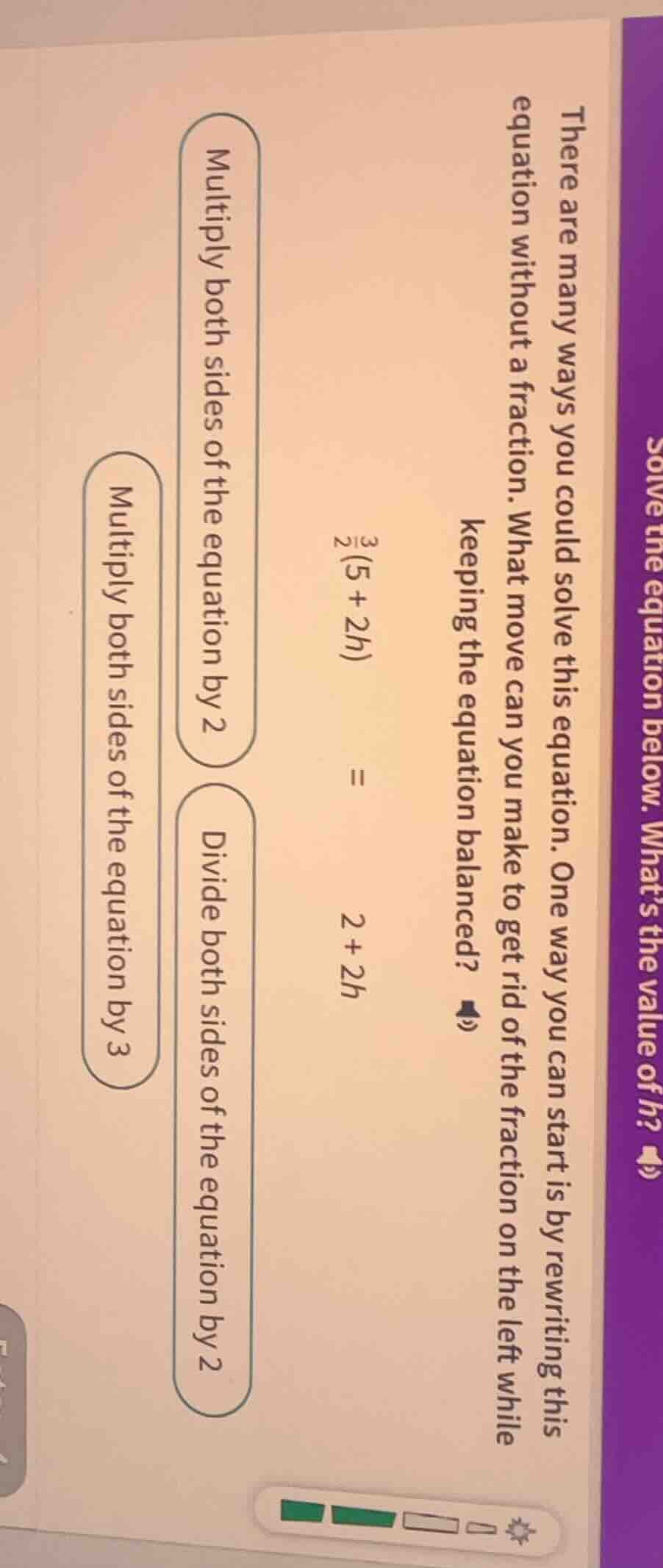
there are many ways you could solve this equation. one way you can start is by rewriting this equation without a fraction. what move can you make to get rid of the fraction on the left while keeping the equation balanced?\\
\\(\frac{3}{2}(5 + 2h)\\) = \\(2 + 2h\\)\\
options: multiply both sides of the equation by 2; divide both sides of the equation by 2; multiply both sides of the equation by 3
Step1: Eliminate fraction, multiply by 2
Multiply both sides by 2 to cancel the denominator:
$$2 \times \frac{3}{2}(5 + 2h) = 2 \times (2 + 2h)$$
Simplify to get:
$$3(5 + 2h) = 4 + 4h$$
Step2: Expand left-hand side
Distribute the 3 across the parentheses:
$$15 + 6h = 4 + 4h$$
Step3: Isolate h terms, subtract 4h
Subtract $4h$ from both sides:
$$15 + 6h - 4h = 4 + 4h - 4h$$
Simplify to get:
$$15 + 2h = 4$$
Step4: Isolate constant terms, subtract 15
Subtract 15 from both sides:
$$15 + 2h - 15 = 4 - 15$$
Simplify to get:
$$2h = -11$$
Step5: Solve for h, divide by 2
Divide both sides by 2:
$$h = \frac{-11}{2}$$

Snap & solve any problem in the app
Get step-by-step solutions on Sovi AI
Photo-based solutions with guided steps
Explore more problems and detailed explanations
$h = -\frac{11}{2}$ (or $h = -5.5$)
Additionally, the valid first step to eliminate the fraction is: Multiply both sides of the equation by 2