QUESTION IMAGE
Question
m∠x =
m∠y =
m∠z =
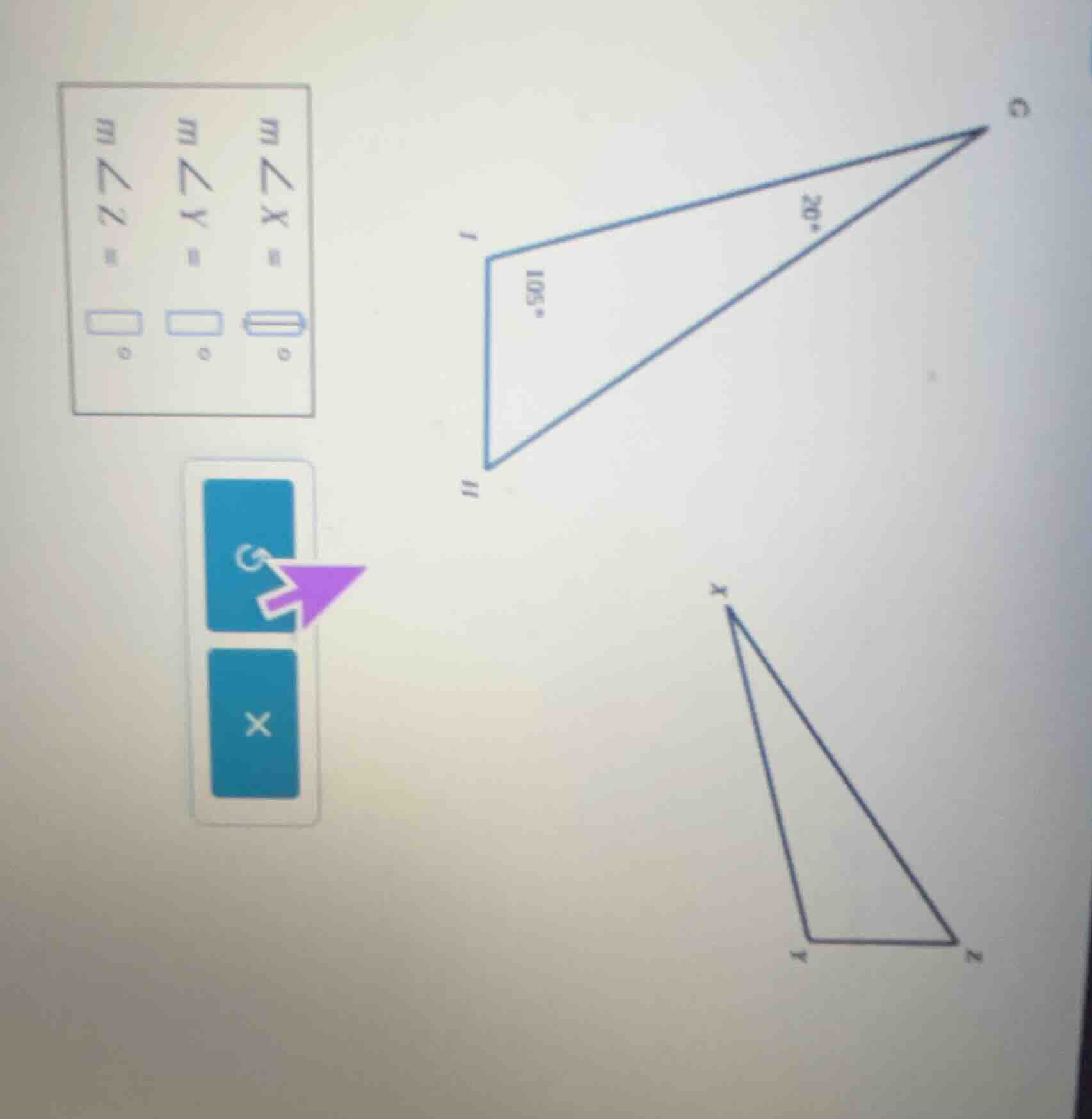
(there are two triangles in the image, one with angles 105° and 20°, and another triangle labeled x, y, z. also, there are two blue buttons with a refresh icon and an x icon.)
Step1: Recall triangle angle sum
The sum of angles in a triangle is \(180^\circ\). Also, since \(IJ\parallel YZ\) (implied by the congruent triangle setup), corresponding angles or properties of isosceles/ congruent triangles apply. First, find the third angle in the top triangle.
In the top triangle, angles are \(105^\circ\), \(20^\circ\), and the third angle (let's say at \(I\) or corresponding) – wait, actually, the two triangles are congruent? Wait, the bottom triangle has \(Y\), \(Z\), \(X\), and the top has \(I\), \(J\), \(G\) with \(IJ\parallel YZ\) (since \(IJ\) and \(YZ\) are marked as parallel? Wait, the diagram shows \(IJ\) and \(YZ\) as the bases, maybe the triangles are congruent. Wait, first, calculate the missing angle in the top triangle.
Sum of angles in a triangle: \(m\angle I + m\angle J + m\angle G = 180^\circ\). Wait, no, the top triangle has angles: one is \(105^\circ\) (at \(I\)), one is \(20^\circ\) (at \(G\)), so the third angle at \(J\) is \(180 - 105 - 20 = 55^\circ\)? Wait, no, maybe the bottom triangle's angles correspond. Wait, the bottom triangle: \(m\angle Y\) – if \(IJ\parallel YZ\), then \(m\angle Y = 105^\circ\) (corresponding angles), \(m\angle Z\) – let's see, in the top triangle, the angle at \(J\) is \(180 - 105 - 20 = 55^\circ\)? Wait, maybe the two triangles are congruent, so \(m\angle X = 20^\circ\) (corresponding to \(m\angle G\)), \(m\angle Y = 105^\circ\) (corresponding to \(m\angle I\)), and \(m\angle Z = 55^\circ\) (since \(180 - 105 - 20 = 55\)).
Wait, let's re-express:
For the top triangle (with vertices \(I\), \(J\), \(G\)):
\(m\angle I = 105^\circ\), \(m\angle G = 20^\circ\), so \(m\angle J = 180 - 105 - 20 = 55^\circ\).
Now, the bottom triangle (with vertices \(Y\), \(Z\), \(X\)) is congruent to the top triangle (since \(IJ\parallel YZ\) and sides are equal, maybe), so:
\(m\angle X = m\angle G = 20^\circ\) (corresponding angle),
\(m\angle Y = m\angle I = 105^\circ\) (corresponding angle),
\(m\angle Z = m\angle J = 55^\circ\) (corresponding angle).
Wait, that makes sense. So:
\(m\angle X = 20^\circ\),
\(m\angle Y = 105^\circ\),
\(m\angle Z = 55^\circ\).
Step1: Calculate \(m\angle X\)
Since the triangles are congruent (or corresponding angles due to parallel lines), \(m\angle X\) corresponds to \(m\angle G = 20^\circ\). So \(m\angle X = 20^\circ\).
Step2: Calculate \(m\angle Y\)
\(m\angle Y\) corresponds to \(m\angle I = 105^\circ\), so \(m\angle Y = 105^\circ\).
Step3: Calculate \(m\angle Z\)
Sum of angles in a triangle: \(m\angle X + m\angle Y + m\angle Z = 180^\circ\).
So \(20 + 105 + m\angle Z = 180\)
\(125 + m\angle Z = 180\)
\(m\angle Z = 180 - 125 = 55^\circ\).

Snap & solve any problem in the app
Get step-by-step solutions on Sovi AI
Photo-based solutions with guided steps
Explore more problems and detailed explanations
\(m\angle X = 20^\circ\), \(m\angle Y = 105^\circ\), \(m\angle Z = 55^\circ\)