QUESTION IMAGE
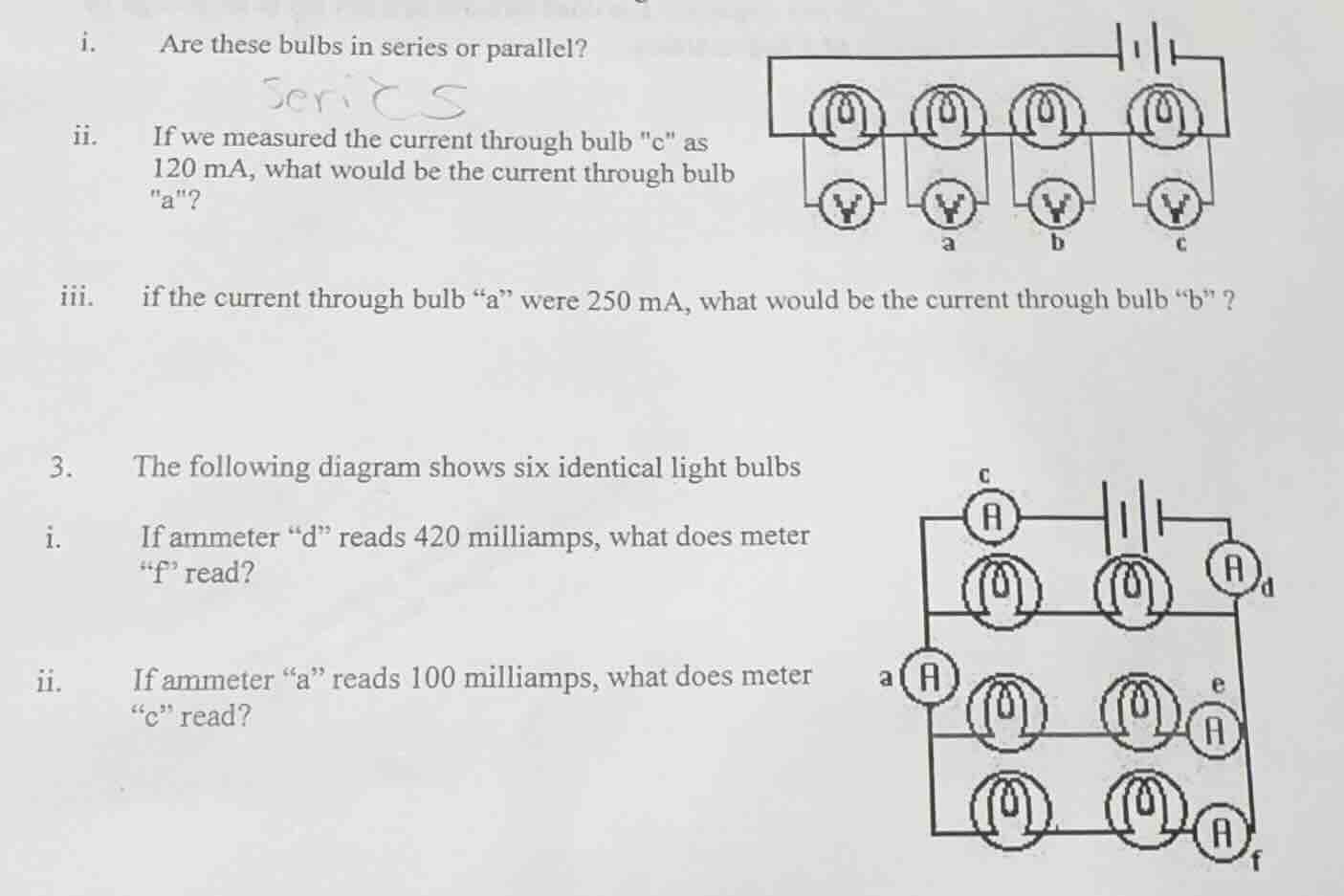
Question
i. are these bulbs in series or parallel?
ii. if we measured the current through bulb \c\ as 120 ma, what would be the current through bulb \a\?
iii. if the current through bulb \a\ were 250 ma, what would be the current through bulb \b\?
- the following diagram shows six identical light bulbs
i. if ammeter \d\ reads 420 milliamps, what does meter \f\ read?
ii. if ammeter \a\ reads 100 milliamps, what does meter \c\ read?
---
First Circuit Questions (Top Diagram)
Step1: Identify circuit type
Observe wiring: bulbs share 2 common nodes → parallel.
Step2: Parallel current rule
In parallel, branch currents equal (identical bulbs).
For ii: $I_a = I_c = 120\ \text{mA}$
For iii: $I_b = I_a = 250\ \text{mA}$
---
Second Circuit Questions (Bottom Diagram)
Step1: Analyze circuit structure
3 parallel branches, each with 2 series identical bulbs.
Step2: Solve i: Find $I_f$
Total current $I_d = 420\ \text{mA}$. Divide equally across 3 branches:
$I_f = \frac{I_d}{3} = \frac{420}{3} = 140\ \text{mA}$
Step3: Solve ii: Find $I_c$
Branch current $I_a = 100\ \text{mA}$. 3 identical branches, so total current:
$I_c = 3 \times I_a = 3 \times 100 = 300\ \text{mA}$
---

Snap & solve any problem in the app
Get step-by-step solutions on Sovi AI
Photo-based solutions with guided steps
Explore more problems and detailed explanations
- i. Parallel
ii. $120\ \text{mA}$
iii. $250\ \text{mA}$
- i. $140\ \text{mA}$
ii. $300\ \text{mA}$